Searching for a hubspot alternative that doesn't require five different add-ons to get the same functionality? ConvergeHub brings sales, marketing, customer service, billing, and every team onto one platform - no surprise costs. For businesses working through a ConvergeHub vs HubSpot decision, this is the starting point: one login, one subscription, everything included.
No credit card required
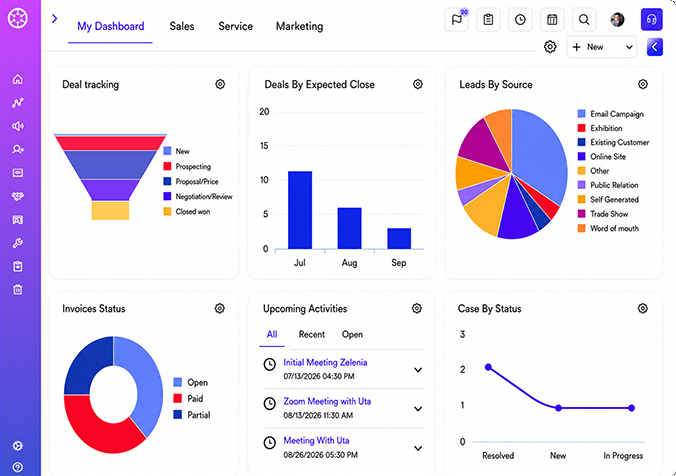
Trusted by companies & business worldwide





ConvergeHub is built as an alternative CRM to HubSpot for teams that want sales, marketing, service, and billing running on one login and one bill.

HubSpot remains the right pick for businesses with the in-house team to run several connected Hubs and build out complex, custom workflows.
Every row below breaks down where ConvergeHub and HubSpot actually differ. Click into any capability for the full comparison - this is the detail most "hubspot alternative" roundups skip, and it's exactly what a ConvergeHub vs HubSpot decision usually comes down to.
| Capabilities | ConvergeHub | HubSpot |
|---|---|---|
CRM & Pipeline Management |  Built-in workflow |  Needs extra setup |
| ConvergeHub keeps pipeline visibility, task management, and revenue forecasting built into the same core workflow from day one, which is part of why it's positioned as a best alternative to HubSpot for teams that want the CRM basics working out of the box rather than assembled piece by piece. | For teams comparing ConvergeHub vs HubSpot on pipeline management alone, the fundamentals look similar on paper - deal stages, contact records, and forecasting exist in both. The difference shows up in setup. HubSpot's pipeline tools work well, but the full workflow (task assignments, revenue forecasting, and won/lost reporting) often needs a paid Sales Hub tier or apps layered on top. | |
Marketing Automation | Native marketing | Separate license needed |
| ConvergeHub includes email marketing, lead scoring, and automated workflows in the same platform sales teams already use, so a lead's marketing history and sales history live on the same record without an integration project. | HubSpot keeps marketing automation gated behind Marketing Hub - running email campaigns, lead scoring, or nurture sequences typically means licensing a separate Hub with its own seat cost and its own marketing-contact tiers on top. This is one of the most common reasons SMBs start looking at hubspot crm alternatives in the first place: paying for and managing a second Hub just to run campaigns. | |
Customer Service | Unified support | Separate Service Cloud |
| ConvergeHub's customer service tools are unified with sales and marketing from the start, so a support ticket shows up on the same customer timeline as a deal or a campaign touch, with no export or sync step required. | Support and ticketing in HubSpot lives under Service Hub, a separate product with its own license. For businesses evaluating a hubspot alternative specifically to cut down on the number of connected tools, this is usually where the case gets made. | |
Quotes & Invoicing | Built-in invoicing | Add-on CPQ needed |
| ConvergeHub builds quotes and invoicing directly into the base platform, so the step from a closed deal to an invoice doesn't require leaving the CRM at all. | Quotes and invoicing aren't part of HubSpot's core Sales Hub license - most teams add Commerce Hub or a third-party billing tool to cover this, which means another Hub, another login, and another monthly cost. | |
Help Desk Automation | Unified automation | Separate license needed |
| ConvergeHub's help desk automation runs on the same rules engine used for sales and marketing workflows, so a support process - auto-assigning tickets, escalation rules, follow-up reminders - is built using the same tools a sales manager would use to automate lead follow-up, with no separate admin skill set required. | Help desk automation in HubSpot typically means configuring Service Hub's automation rules on top of an already separate license. | |
Integrations & Stack | 200+ built-in | Extensive but complex |
| For a small or mid-sized business looking for an alternative CRM to HubSpot that doesn't require a part-time admin just to manage connections, ConvergeHub ships with 200+ built-in integrations (POS systems, M2M platforms, Twilio, and others) aimed squarely at the tools SMBs already use day to day. | HubSpot's integration ecosystem is one of the largest in the CRM market, which is a genuine advantage for businesses already running a large, specialized tool stack - but that scale comes with real setup and maintenance overhead, and many integrations need dedicated technical support to configure and keep running. | |
AI Features | Included predictive AI | Separate Einstein license |
| ConvergeHub includes predictive lead scoring and workflow AI as part of the base platform, so smaller teams get automation without a second AI subscription stacked on their CRM bill. | HubSpot's AI capabilities live under Breeze, priced on a usage-based credit system separate from base Hub pricing - another line item on top of the base CRM cost. | |
Overall Cost | One bundled subscription | Several stacked licenses |
| That stacking is exactly why ConvergeHub is often searched for as the best hubspot alternatives pick or one of the more practical hubspot alternatives for small business: one subscription covers what would otherwise be four or five separate ones. | Add up HubSpot's Sales Hub plus the licenses most businesses end up needing to match ConvergeHub's included feature set - Marketing Hub, Service Hub, Commerce Hub, Breeze credits - and the real cost is usually several Hubs deep, not one. |

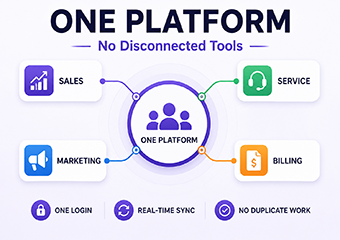
Sales, marketing, service, and billing run on one login instead of five disconnected tools. Data syncs in real time across every team, so nobody's re-entering the same customer information twice or waiting on an integration to catch up.

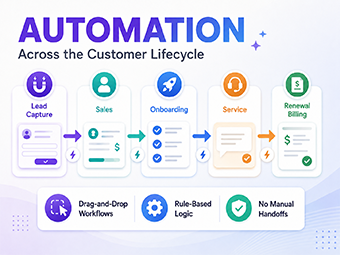
Drag-and-drop workflows and rule-based automation cover everything from lead capture to renewal billing. Once a workflow is built, it runs the same way for every customer moving through the pipeline - no manual handoffs between systems.

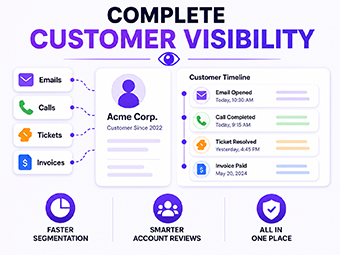
Every interaction - emails, calls, tickets, invoices - lives on one customer timeline. That makes segmentation and account reviews faster, because the full history is already in one place instead of scattered across separate tools.

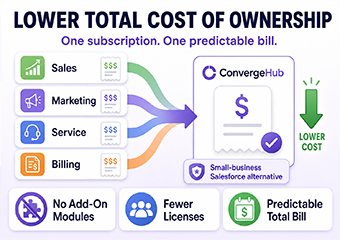
One subscription covers sales, marketing, service, and billing, with no add-on modules to negotiate separately. It's a big part of why ConvergeHub keeps coming up in searches for hubspot alternatives for small business - fewer licenses generally means a lower, more predictable total bill.

ConvergeHub is better suited for small to mid-sized businesses and fast-growing startups - teams looking for the best alternative to HubSpot without the escalating per-Hub price tag or the multi-month implementation timeline.

HubSpot may be the better fit for larger businesses with complex, multi-department needs, dedicated in-house resources, and the appetite for long-term customization.
What I like most about ConvergeHub is getting the best value for my money; Especially as compared to other offerings such as Salesforce or HubSpot. You just can't beat the value proposition ConvergeHub offers.

Thinking Capital
Convergehub has all functions for CRM that sales CRM should have. Zapier integration allows to connect it with anything. I like also in this crm: Sales pipeline, Great dashboards, Automations, Twilio integration

Softenq LLC
Straight forward. It's ux isn't fancy or that modern but it is very clear where things are and what they do. I use two other CRM's and this one is easily the most straightforward.

SE Ranking - Marketing and Advertising



Yes. ConvergeHub brings CRM, marketing automation, customer service, and billing together in one platform, covering what HubSpot typically requires several separately licensed Hubs to do. There's no added complexity or extra cost layered on top to match that functionality.
ConvergeHub is generally the better fit for small and mid-sized businesses, since it's priced and built as a single platform rather than a core CRM plus paid add-on Hubs. HubSpot tends to suit larger organizations with dedicated in-house resources and more complex, multi-department requirements.
For small and mid-sized businesses, ConvergeHub is generally considered one of the best hubspot alternatives because it bundles CRM, marketing automation, customer service, and billing into a single subscription. Businesses researching hubspot alternatives for small business are usually trying to solve the same problem: reducing the number of separate Hubs and licenses needed to run sales, marketing, and support together.
ConvergeHub is built primarily for small to mid-sized businesses and fast-growing startups. Larger businesses with complex, multi-department requirements and dedicated in-house resources may still be better served by HubSpot's deeper customization options.

Try the CRM built as a true alternative to HubSpot - free for 14 days, no credit card required.

