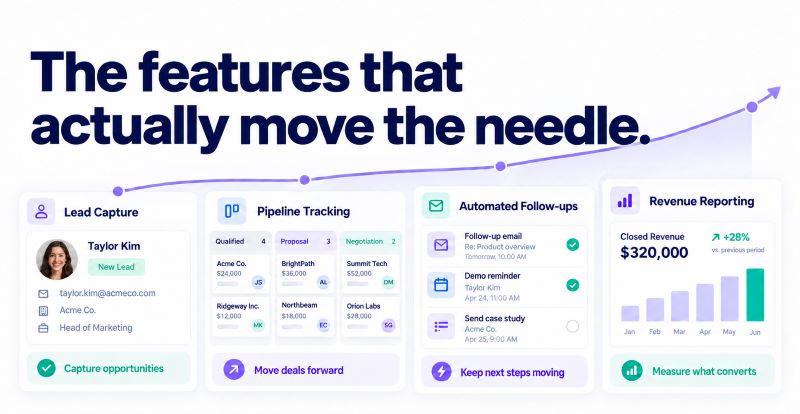
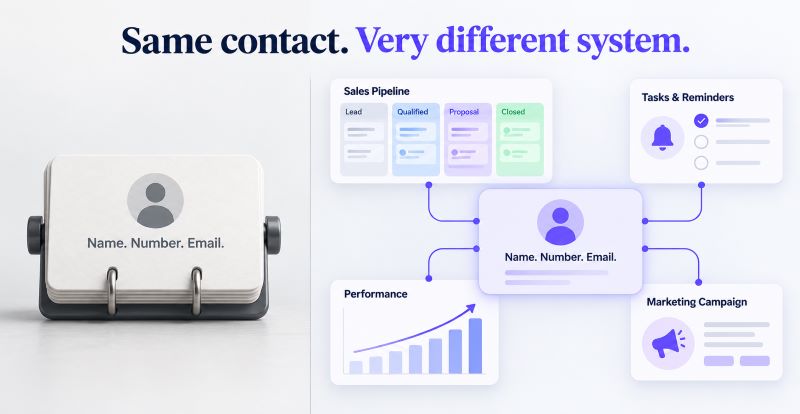
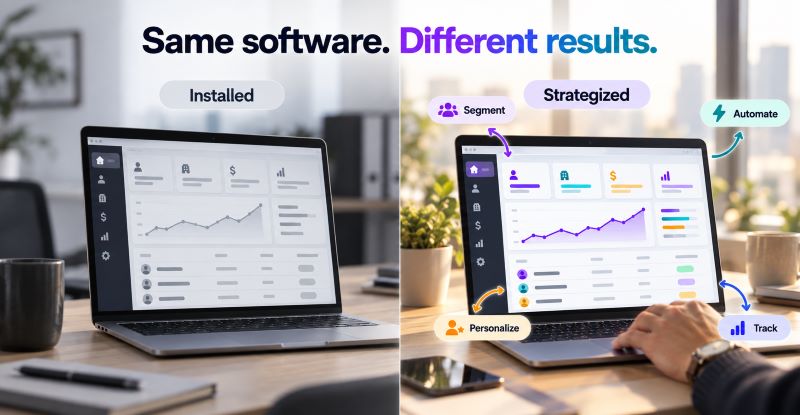
An AI CRM is a customer relationship management platform that uses artificial intelligence to score leads, automate follow-up, and recommend next steps instead of just storing contact records. For a small business, that difference matters more than it sounds: it closes the gap between a five-person team and a competitor with a dedicated sales operations department. ConvergeHub’s AI CRM was built for exactly that gap, turning a static database of names into a system that actively drives engagement, retention, and revenue. Here’s what’s changed, what the data shows, and how to choose the right platform.
A traditional CRM records what happened. An AI CRM decides what should happen next — scoring a lead, drafting a follow-up, or flagging a customer who’s gone quiet — without a rep having to dig through the database first.
The practical differences show up in daily use:
See how ConvergeHub’s AI CRM automates this from the first lead touch — the platform is built around this exact shift from passive record-keeping to active engagement.
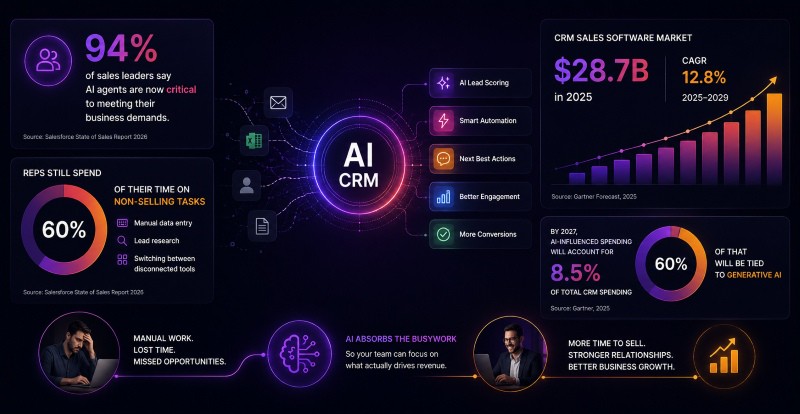
The push toward AI CRM isn’t a marketing trend — it shows up directly in how sales and service teams now operate. 94% of sales leaders say AI agents are now critical to meeting their business demands, a sharp jump from a few years ago when AI in CRM was still considered experimental.
Part of the reason is where reps’ time actually goes. Sales reps still spend 60% of their time on non-selling tasks — manual data entry, lead research, and switching between disconnected tools — which is precisely the work an AI CRM is built to absorb.
The spending data backs this up at the market level. Gartner forecasts the CRM sales software market growing from $28.7 billion in 2025 at a 12.8% compound annual growth rate through 2029, driven largely by generative AI and AI sales agents expanding what CRM platforms do. Separately, Gartner projects that by 2027, AI-influenced spending will account for 8.5% of total CRM spending, with 60% of that tied to generative AI specifically. Small businesses adopting AI CRM now are moving with the market, not ahead of it.
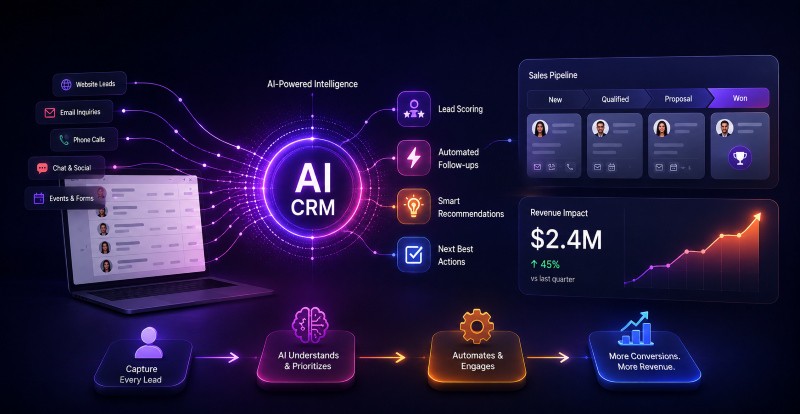
The clearest advantage of an AI CRM isn’t a feature list — it’s speed and consistency, applied to every single lead and customer rather than just the ones a rep has time for.
Response time has one of the largest measurable effects on whether a lead ever becomes a customer. Research published in Harvard Business Review found that firms contacting a new lead within an hour were nearly seven times more likely to qualify it than firms that waited even one hour longer — and more than 60 times more likely than firms that waited 24 hours or more. An AI CRM removes the human bottleneck here entirely: it can acknowledge and begin qualifying a lead the moment it arrives, at any hour, without waiting on a rep’s schedule.
Small teams can’t hand-personalize every outreach message, but customers now expect it anyway. 73% of B2B buyers actively avoid vendors who send irrelevant outreach, which means generic, one-size-fits-all follow-up is actively costing deals, not just underperforming. An AI CRM pulls from a contact’s actual history to personalize outreach automatically, at a volume no individual rep could sustain manually.
A missed evening inquiry or weekend lead doesn’t have to sit untouched until Monday. AI CRM automation handles the first response and nurture sequence continuously, so engagement doesn’t depend on business hours.
Instead of a rep noticing a customer has gone quiet after the fact, an AI CRM flags declining engagement early enough to act on it — a renewal conversation, a check-in call, or a targeted offer before the account is actually at risk.
Talk to ConvergeHub about setting this up for your pipeline — most of this runs automatically once lead scoring and follow-up sequences are configured.
Each of these benefits maps to a specific part of the platform, not a generic “AI” label bolted onto old CRM software:
Explore ConvergeHub’s full AI CRM feature set to see which of these would save the most time for your team first.
Not every “AI-powered” CRM applies automation the same way. For a small business specifically, a few things matter more than a long feature list:
The data is consistent across sources: AI CRM adoption is accelerating, response speed and personalization are now baseline customer expectations rather than differentiators, and the businesses capturing the strongest ROI are the ones actually using the automation built into their platform. For a small business competing against larger teams, an AI CRM is what makes fast, personalized, always-on engagement possible without adding headcount. Book a ConvergeHub demo to see how much of this can run on autopilot for your business.
An AI CRM is a customer relationship management platform that uses artificial intelligence and automation to score leads, personalize outreach, predict customer behavior, and recommend next actions — going beyond the contact-storage function of a traditional CRM.
A traditional CRM is a system of record: it stores contacts, notes, and deal stages for a rep to review manually. An AI CRM is a system of action: it actively scores, prioritizes, drafts, and automates the next step based on that same data.
Yes. Most AI CRM platforms built for SMBs price per seat with AI features included rather than sold as expensive add-ons, and the automation itself reduces the need to hire additional sales or support staff to keep up with lead volume.
No. An AI CRM removes repetitive, time-consuming tasks — data entry, initial lead response, follow-up drafting — so reps spend more time on conversations that need a human, like negotiation and relationship-building.
An AI CRM can acknowledge and begin qualifying a new lead within seconds of it arriving, any time of day, rather than waiting for a rep to see it during business hours.
It needs clean, centralized contact and interaction history — emails, calls, website activity, and past deals. The more complete that record is, the more accurate its lead scoring and follow-up recommendations become.
Reputable AI CRM platforms apply the same security and compliance standards as traditional CRM software, including encryption and access controls, while using that data internally to power automation rather than sharing it externally.
Most small businesses see measurable time savings within the first month, since automation immediately reduces manual lead entry and follow-up work. Revenue impact typically becomes visible over the following one to two sales cycles.
Automatic lead scoring and routing, AI-drafted follow-up, and no-code setup matter most early on — these deliver the fastest time savings without requiring a dedicated CRM administrator.
No. The same automation applies to customer support (faster case routing and response drafting) and marketing (personalized, behavior-triggered campaigns), making it useful across a small business, not just the sales pipeline.