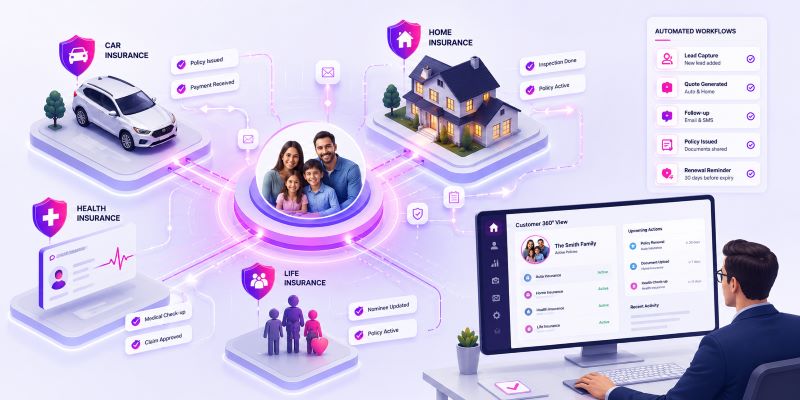
Running an insurance agency means juggling leads, quotes, active policies, renewal deadlines, and client service — all at once. Most small agencies try to manage this across spreadsheets, email inboxes, and sticky notes. That’s where things fall apart. The right CRM for small businesses in the insurance space doesn’t just organize contacts — it automates the entire client journey from first inquiry to renewal. This blog breaks down exactly how that works and why it matters.
Insurance is a relationship business. But relationships are hard to maintain when your team is buried in manual follow-ups, chasing renewal dates, and toggling between disconnected tools.
The numbers reflect this: according to Salesforce’s State of Sales report, sales reps spend only 28% of their week actually selling. The rest goes to administrative tasks — exactly the kind of work a well-configured insurance CRM software can handle automatically.
For small agencies, this isn’t just an efficiency problem. Missed renewals, slow lead response, and inconsistent follow-ups directly cost revenue. A client who doesn’t hear from you 60 days before renewal will find someone who does reach out.
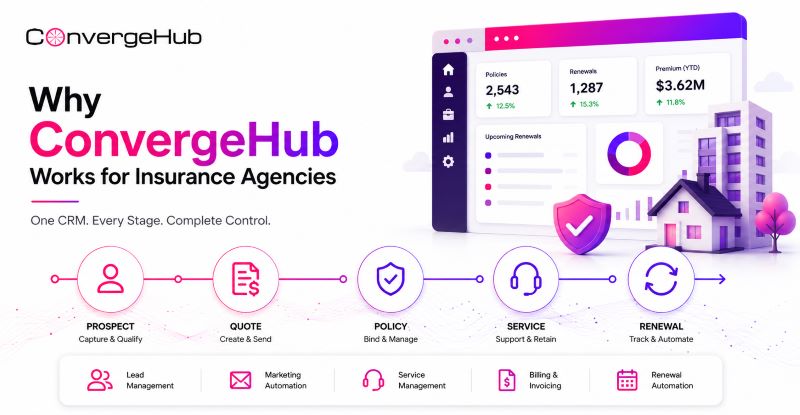
Before you can automate anything, you need to understand what you’re automating. A typical insurance client journey covers:
Each of these stages has tasks, deadlines, and communication touchpoints. Without a structured system, things slip. With the right insurance CRM systems, the entire sequence runs on automation.
Here is a practical roadmap of how ConvergeHub deals with each stage of client dealing and handling
When a new inquiry comes in, your CRM for insurance agents should automatically assign it to the right agent, trigger a response email, and create a follow-up task — all without anyone manually touching it. Leads are scored, prioritized, and moved through a structured pipeline so nothing gets buried.
According to InsureTech Connect research, agencies that respond to leads within the first five minutes are 9x more likely to convert them. Automation makes that response time consistent — not dependent on who’s in the office.
This is where most agencies bleed revenue without realizing it. A lapsed policy is a lost client — and often a lost referral source too.
A proper insurance CRM software tracks every active policy, flags upcoming renewal dates, and triggers a structured outreach sequence automatically:
ConvergeHub’s insurance CRM does exactly this — automating renewal reminders and outreach sequences so agents focus on conversations, not calendar management.
Clients don’t just interact with their agent at renewal. They need certificates of insurance, policy endorsements, coverage changes, and claims assistance throughout the year.
Without a case management system, these requests get lost in email threads. With insurance CRM systems, every service request is logged, assigned, prioritized, and tracked to resolution — with full client history visible to whoever picks it up.
The most overlooked revenue source in insurance is right inside your existing book of business. A client with auto coverage is a candidate for home. A business owner with general liability needs workers’ comp. A family with life insurance needs an annual review.
A CRM for insurance agents surfaces these opportunities by tracking client profiles, policy history, and engagement signals. Automated triggers can prompt agents to reach out at the right time — not just when renewal season arrives.
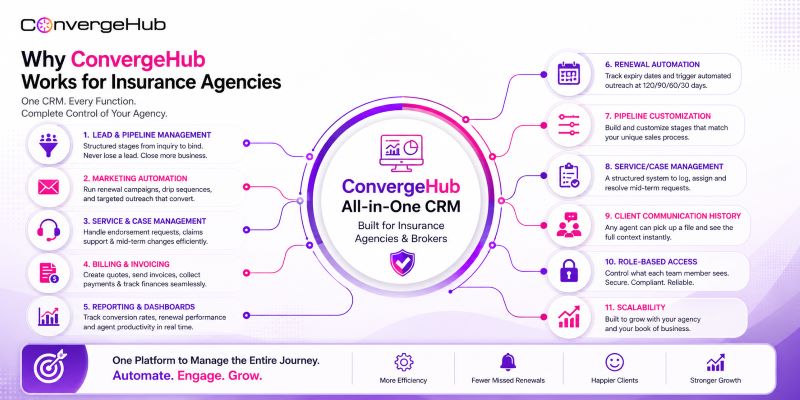
ConvergeHub is built as a CRM for small businesses that handles the full operational picture — not just contact storage. For insurance agencies and brokers specifically, it brings together:
ConvergeHub checks every one of these boxes — and it’s designed to be operational from day one, not after months of setup. It’s purpose-built for agencies that need clarity across the entire client lifecycle — without paying enterprise-level prices or managing five separate tools.
Insurance agencies don’t lose clients because they don’t care — they lose them because follow-up falls through the cracks. The right CRM for small businesses fixes that by automating every stage of the journey: lead capture, quoting, policy management, renewals, and cross-sell. ConvergeHub gives insurance agencies and brokers one platform to run it all — without complexity, without high costs, and without missed opportunities. Start your free trial today and see the difference a structured system makes.
Q: What is insurance CRM software?
Insurance CRM software is a platform built to help agencies and brokers manage leads, policies, renewals, and client communication from one place. It replaces spreadsheets and disconnected tools with automation, structured pipelines, and a complete view of every client relationship.
Q: How does a CRM help with policy renewals?
It tracks every policy expiry date and automatically triggers a renewal outreach sequence — emails, tasks, and reminders — at 120, 90, 60, and 30 days before the policy lapses. This keeps agents proactive instead of reactive.
Q: Can small insurance agencies afford a CRM?
Yes. Platforms like ConvergeHub are specifically built as a CRM for small businesses — enterprise-grade functionality without enterprise pricing. ConvergeHub offers a free 14-day trial with no credit card required.
Q: Is ConvergeHub suitable for both agents and brokers?
Yes. Whether you’re a solo agent or managing a multi-carrier brokerage, insurance CRM systems like ConvergeHub scale with your book of business and team size.
Q: What’s the difference between a generic CRM and an insurance-specific one?
A generic CRM stores contacts. An insurance CRM software tracks policies, automates renewal sequences, manages service requests, and gives you visibility into your entire book of business — structured around how insurance actually works.