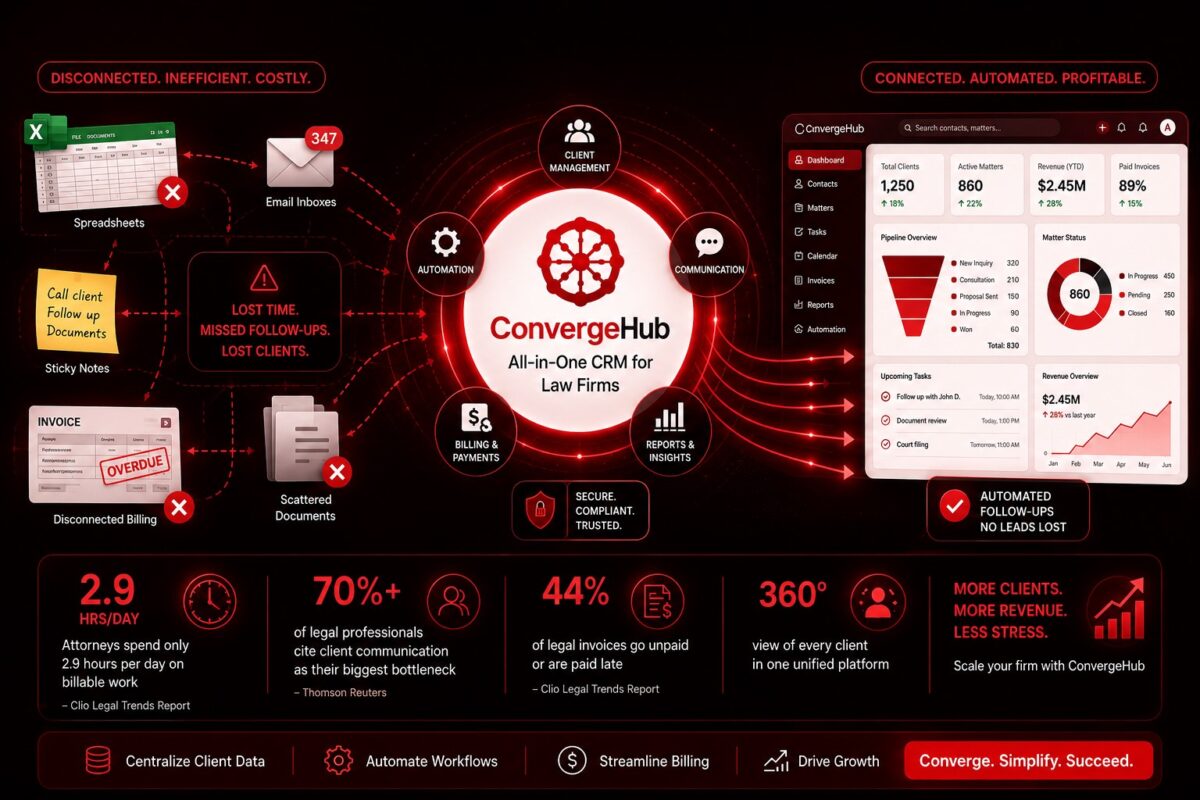
Law firms today face a unique operational challenge: clients demand timely, personalized attention, yet most small practices operate with lean teams and limited budgets. Choosing the right CRM for a small business is no longer optional — it is the backbone that separates firms that scale from those that stagnate. According to Thomson Reuters, over 70% of legal professionals cite client communication as their biggest bottleneck. Platforms like ConvergeHub — a purpose-built CRM help legal firms centralize client data, automate follow-ups, and grow without expanding payroll. Let’s find out more about it in the following article.
Before understanding how CRM for law firms can transform a practice, it helps to appreciate what poor client management actually costs. Many small legal firms still rely on
This fragmentation creates costly inefficiencies that compound over time.
Consider this: research from the Legal Trends Report (Clio) reveals that attorneys spend only 2.9 hours per day on billable work, with the rest spent on administrative tasks, follow-up emails, and non-billable coordination, for a small firm that represents thousands of dollars in lost revenue every month.
Beyond the financial impact, there is the client experience to consider.
When a client feels neglected, the consequences are swift: negative reviews, referral loss, and attrition. For a small practice, losing even two or three key clients per year can materially impact annual revenue. The underlying problem is not a staffing shortage but a systems shortage. The right legal CRM software addresses this head-on by automating the repetitive, administrative work that currently consumes attorney bandwidth.
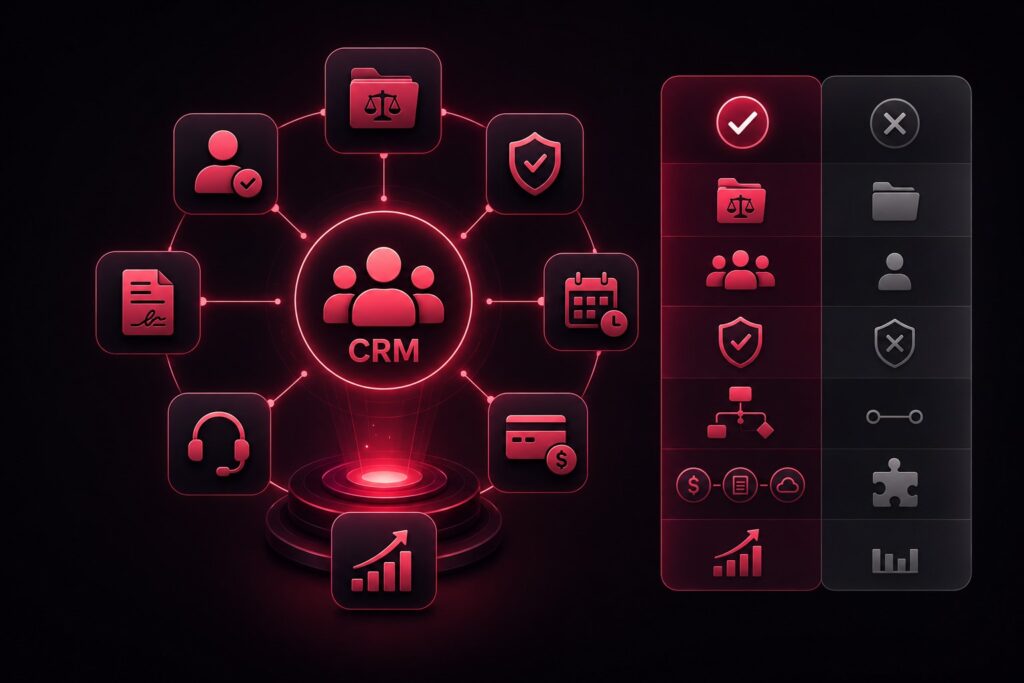
A law firm CRM software is a customer relationship management platform tailored to the specific workflows, compliance requirements, and communication patterns of legal practices. While a generic CRM might help a retail business manage leads, it often lacks the nuanced features that attorneys need — conflict-of-interest checks, matter-based contact segmentation, intake workflow automation, and integration with billing and document management systems.
Key capabilities that define effective CRM for legal firms include:
| Capability | What It Does for Your Firm |
| Centralized Contact & Matter Management | Keeps all client records, case notes, and communications in one place for instant access |
| Automated Intake & Follow-Up Workflows | Triggers onboarding sequences automatically so no new client inquiry goes unanswered |
| Integrated Invoicing & Payment Tracking | Links billing directly to the client record, reducing missed payments and invoice delays |
| Team Collaboration Tools | Allows attorneys and support staff to share updates and tasks without switching platforms |
| Real-Time Pipeline & Activity Reporting | Delivers instant visibility into lead status, case progress, and team performance. |
ConvergeHub, as an all-in-one platform designed for small businesses, brings a particularly compelling value proposition to legal practices. Rather than stitching together multiple tools — a separate CRM, a billing system, an email marketing platform — ConvergeHub unifies sales, marketing, service, and billing under one roof. For a small legal firm, this consolidation eliminates the data silos that cause delays and errors.
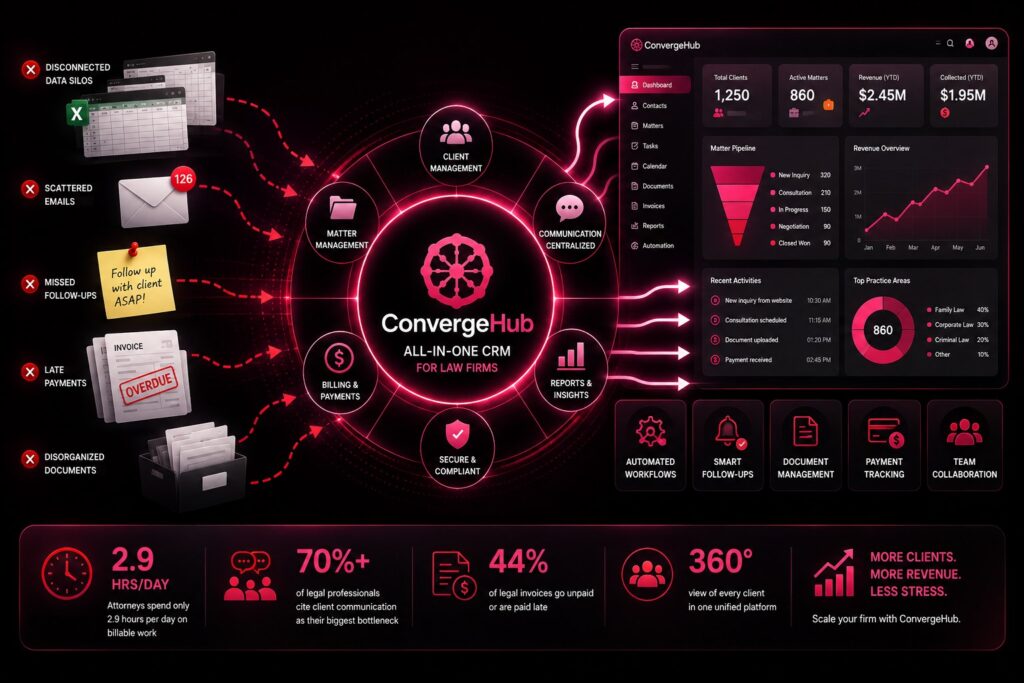
The intake process is one of the most time-consuming steps in client onboarding. Without automation,
With CRM for lawyers like ConvergeHub, these steps can be automated via
One of the most common pain points in small legal practices is:
When a client calls for an update, the attorney scrambles to piece together a coherent history.
ConvergeHub addresses this by providing a
Billing is a critical function that many small firms manage through disconnected tools, leading to invoice delays, missed payments, and cash flow gaps.
According to the Clio Legal Trends Report, 44% of legal invoices go unpaid or are paid late — a number that can be significantly reduced with integrated billing automation.
ConvergeHub, A legal Crm for small businesses, integrates
Decision-making in a small firm often happens on instinct rather than data. An attorney may know anecdotally which practice area drives the most revenue, but rarely has the time to verify it with actual numbers.
This guesswork can lead to misallocated marketing spend and missed growth opportunities.
ConvergeHub’s built-in reporting and dashboards provide i
No analyst is required. Attorneys and firm administrators can make informed, strategic decisions with real-time data at their fingertips.

ConvergeHub is positioned as the all-in-one CRM for small businesses that eliminates the need for scattered tools. Here is what you can expect:
The evidence is clear: small legal practices that invest in the right CRM for small businesses dramatically outperform those relying on manual processes. The best CRM removes friction, automates the mundane, and centralizes what matters most — without adding headcount. ConvergeHub delivers exactly that: one platform, every client touchpoint, zero guesswork.
Ready to transform how your law firm manages clients?
Explore ConvergeHub — the all-in-one CRM built for small businesses like yours.
Visit www.convergehub.com to start your free trial today.
1. What is a CRM for small businesses, and do law firms really need one?
A CRM for small businesses is a platform that centralizes client data, automates follow-ups, and streamlines operations. For law firms, it replaces scattered spreadsheets and disconnected tools — making it essential, not optional.
2. How is legal CRM software different from a generic CRM?
Legal CRM software is built around law firm workflows — intake automation, matter-based contact management, and billing integration — features a generic CRM simply does not offer out of the box.
3. Can a small law firm afford CRM software?
Yes. Platforms like ConvergeHub are priced specifically for small businesses, and the return — through time saved, leads converted, and invoices collected — far outweighs the monthly cost.
4. How quickly can a law firm get started with ConvergeHub?
ConvergeHub is designed for non-technical users with guided onboarding and video tutorials, meaning most small firms are operational within days, not weeks.
5. Will a CRM for small businesses replace the need for support staff?
Not entirely — but it significantly reduces the administrative load on existing staff, allowing a lean team to manage a substantially larger client base without compromising service quality.