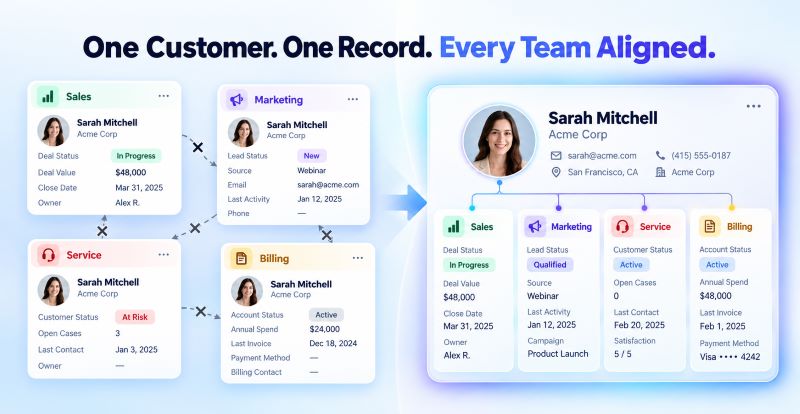
Sales sees the deal. Marketing sees the campaign. Service sees the case. Billing sees the invoice. The customer experiences all four as one relationship. When those teams work from different systems, context gets lost and the customer feels it.
A true CRM customer 360 solves this by giving every team one shared customer record. ConvergeHub was built for exactly this purpose: one unified view that keeps sales, marketing, service, and billing aligned around the same customer lifecycle.
This is not a nice-to-have feature. It is the foundation of consistent customer experience and efficient operations.
Data silos are expensive. Research shows they can cost organizations 20–30% in operational efficiency each year. Poor data quality driven by silos costs companies an average of $12.9 million annually according to Gartner.
Customers notice the gaps. 80% of customers say the experience a company provides is as important as its products or services. When a support agent does not know what sales promised, or marketing messages a customer who just opened a case, trust erodes.
The typical symptoms are familiar:
A CRM customer 360 eliminates these gaps by making one record the single source of truth.
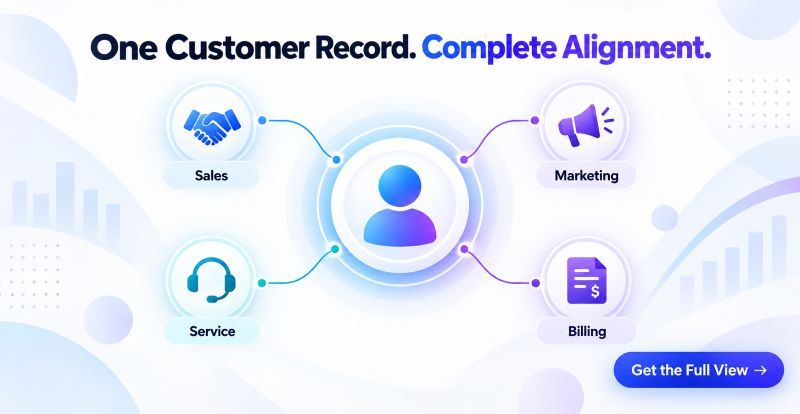
A CRM customer 360 (also called a single customer view or unified customer record) brings every interaction into one place. In ConvergeHub this includes:
When sales, marketing, service, and billing all work from this shared record, context travels with the customer instead of getting stuck in departmental tools.
Sales sees the full relationship before they pick up the phone. Open cases, recent invoices, and past campaign responses are visible alongside the deal. Conversations become more relevant and less repetitive.
Marketing can segment and message with real context. Instead of blasting everyone, they can avoid customers with open issues or target those who recently expanded. Personalization improves because the data is complete.
Service resolves issues faster. Agents see the full history — what was sold, what was promised, and what has been billed — without switching systems or asking the customer to repeat themselves.
Billing stays connected to the relationship. Payment status and invoice history live on the same record, so account managers and service teams can see outstanding balances in real time.
This is the practical power of a CRM customer 360. ConvergeHub makes it operational by keeping all four functions inside one platform.
Many tools claim a 360-degree view but still leave critical pieces outside the core record. Quotes and invoices often live in accounting software. Support history sits in a separate help desk. Marketing engagement data stays in an email platform.
The result is a partial view. Teams still switch tools and still lose context. ConvergeHub was designed as an all-in-one system so the customer record is genuinely complete — sales, marketing, service, and billing together.
Teams using ConvergeHub’s unified customer record typically experience:
When every team trusts the same record, coordination improves without extra meetings or status updates. These are not abstract concepts. They show up as shorter response times, fewer escalations, and higher customer confidence.
ConvergeHub keeps the entire customer lifecycle on one record:
Sales, marketing, service, and billing all work from this shared foundation. No tool switching. No missed context.
You do not need a multi-year data project. Most teams begin seeing benefits by:
Once the core record is trusted, automation and reporting become far more powerful because they draw from complete data.

Disconnected systems create more than an IT problem. They create a customer experience problem. When each team works from a different version of the customer, promises get lost, issues get repeated, and opportunities get missed.
A true CRM customer 360 keeps sales, marketing, service, and billing aligned around one shared customer record. This is how ConvergeHub is built. Every interaction — deals, campaigns, cases, invoices, and conversations — lives in one place so every team can act with full context.
If your teams still switch systems to understand a single customer, the experience is more fragmented than it needs to be. Start your free 14-day trial of ConvergeHub — no credit card required — and give every team the same complete customer view.
A CRM customer 360 is a single, complete customer record that combines sales, marketing, service, and billing data so every team works from the same up-to-date view.
It prevents lost context between teams. Sales, service, and billing all see the same history, which leads to faster responses, fewer repeated questions, and a more consistent customer experience.
ConvergeHub keeps leads, deals, campaigns, cases, quotes, invoices, and activity history on one shared customer record so sales, marketing, service, and billing stay aligned.
A basic contact record often holds only sales or contact data. A true single customer view (or CRM customer 360) also includes service history, marketing engagement, and billing information.
Yes. In ConvergeHub, marketing engagement and campaign responses appear on the same customer profile that sales and service use, enabling more relevant messaging.
Yes. When quotes, invoices, and payment status live on the same record, account managers and service teams can see outstanding balances in real time without switching tools.
Agents see the full relationship — what was sold, what was promised, and recent interactions — so they can resolve issues faster and avoid asking customers to repeat information.
No. Growing small and mid-sized businesses benefit strongly because they often feel the pain of disconnected tools first. ConvergeHub is built specifically for these teams.
Teams gain a single source of truth, a unified customer record, real-time visibility across roles, and the ability to run the full customer lifecycle without constant tool switching.
Start a free 14-day trial of ConvergeHub with no credit card required. You can bring sales, service, marketing, and billing activity onto shared customer records and experience the difference immediately.