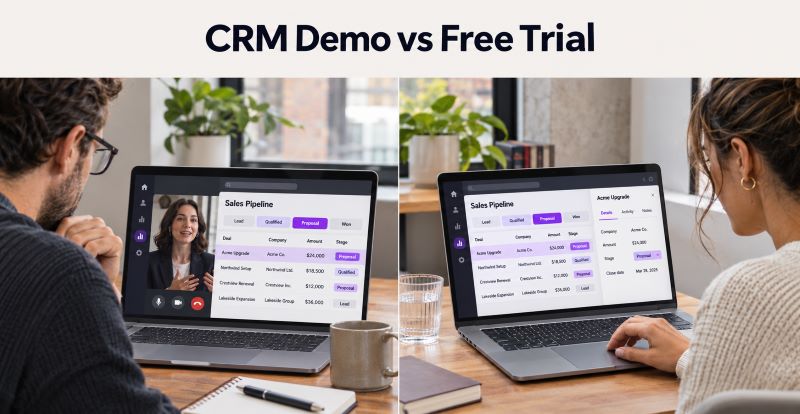
Choosing a CRM is one of the most critical decisions a business can take Now, most CRM providers offer two ways to evaluate their software: a CRM software free demo or a free CRM trial.
Although both options help you understand a CRM platform, they serve different purposes. A demo gives you a guided overview while a free trial lets you explore the platform through hands-on experience.
So, which one should you choose? Let’s explore the differences and how to decide which option makes sense for your business.

A CRM software free demo is a guided presentation of a CRM platform, usually conducted by a product specialist or sales representative.
During the demo, you get an overview of the software, its key features, and how it can support your business processes. You can ask questions, discuss your requirements, and understand whether the platform aligns with your team’s needs.
A CRM demo is particularly useful when you are evaluating multiple platforms and want to understand their capabilities before investing time in a trial.
A well-structured CRM demo should help you understand:
A demo should not simply be a tour of buttons and dashboards. It should demonstrate how the CRM can support your actual business processes.
A free CRM trial gives you temporary access to a CRM platform so you can explore its features and functionality yourself.
Unlike a guided demo, a trial allows you to interact with the software, navigate its interface, test available capabilities, and understand how it fits into your daily operations.
A CRM free trial is particularly useful when you want to evaluate usability and determine whether your team can comfortably work with the platform.
Use your trial period to explore the capabilities that matter most to your business.
1. Lead and contact management
Check how easily you can capture, organize, update, and manage customer information. Understand whether your team can access the information it needs without switching between multiple tools.
2. Sales pipeline management
Explore how the CRM organizes opportunities, tracks deal progress, and gives your sales team visibility into its pipeline.
3. Workflow automation
Test whether you can create workflows that reduce repetitive work, trigger relevant actions, and support timely follow-ups.
4. Communication management
Understand how emails, phone calls, SMS, and other interactions are connected to customer records. A unified communication history can help teams maintain context throughout the customer journey.
5. AI-powered capabilities
Do not evaluate a modern CRM only on its traditional features. Explore how its AI capabilities support your team’s decisions and customer interactions.
For example, ConvergeHub uses AI to:
6. Reporting and visibility
Understand whether the platform provides the information your team needs to monitor activities, opportunities, and customer relationships.
The goal of a trial is not to test every feature randomly. It is to determine whether the CRM can support the way your business actually works.
Although both options help businesses evaluate CRM software, the experience and purpose are different.
| Evaluation factor | CRM software free demo | CRM free trial |
| Experience | Guided walkthrough | Hands-on access |
| Learning approach | Product specialist explains the platform | You explore the platform yourself |
| Time required | Usually shorter | Requires time over the trial period |
| Feature discovery | Highlights relevant capabilities | Allows you to test available features |
| Business requirements | Discuss requirements with a specialist | Evaluate features against your workflows |
| AI capabilities | Understand how AI features work | Explore available AI capabilities yourself |
| Usability testing | Limited direct interaction | More practical experience |
| Best suited for | Initial evaluation and product understanding | Practical testing and team evaluation |
The key difference: A demo helps you understand what a CRM can do, while a trial helps you evaluate how well you can use it.
Not Sure Whether to Choose a CRM Demo or Free Trial?
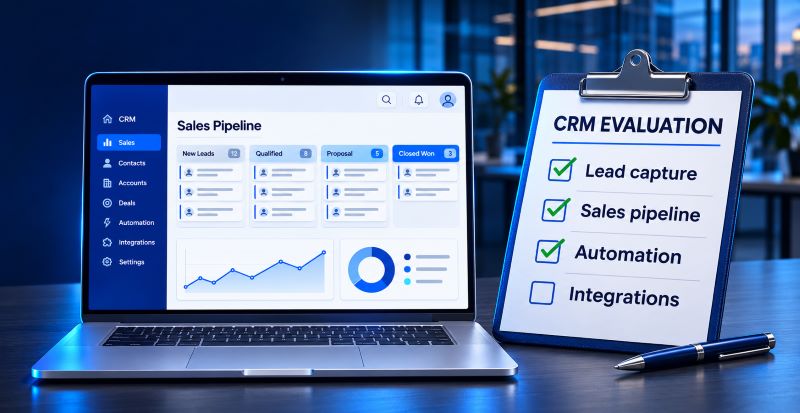
Download our free CRM Evaluation Checklist to compare your options, ask the right questions, and choose the best way to evaluate CRM software.
The right option depends on where you are in your CRM buying journey.
You are evaluating multiple CRM platforms.
A demo helps you understand what each platform offers without spending time setting up multiple trial accounts.
You have specific business requirements.
If your business needs particular workflows, integrations, communication capabilities, or AI features, a product specialist can help explain how the platform addresses those requirements.
You want to understand the AI capabilities.
AI features can be difficult to evaluate based on feature descriptions alone. During a demo, ask how AI lead readiness scoring, intent understanding, and relationship insights work in real business scenarios.
You want to involve decision-makers.
A guided demo can help business owners, sales managers, marketing leaders, and other stakeholders understand the platform together.
You want to test the actual user experience.
A trial helps you understand the interface, navigation, and day-to-day usability.
You want to evaluate your workflows.
Explore whether the CRM supports your lead management, sales processes, communication, and customer management requirements.
You want your team to test the platform.
Give relevant team members an opportunity to explore the software and share feedback.
You want to validate features before purchasing.
A trial allows you to assess whether the available capabilities match your expectations and requirements.
CRM evaluation has changed. Businesses are no longer looking only for software that stores customer details and tracks sales activities.
They also want systems that help teams understand customer behaviour, prioritize opportunities, and manage relationships more intelligently.
This is where AI-powered CRM capabilities become important.
When comparing a CRM demo with a free trial, make sure you understand how the platform uses AI throughout the customer journey.
Not every lead is equally ready to engage with your sales team.
AI-powered lead readiness scoring helps teams understand which prospects may be more prepared for the next stage of the sales process. This can help sales representatives prioritize their attention instead of treating every lead in the same way.
What to ask during a demo: How does the CRM assess lead readiness, and how can the sales team use that information?
Customer intent can be reflected through interactions and engagement over time.
ConvergeHub’s AI capabilities help read intent across interactions, giving teams additional context about prospect interest and the conversations that may need attention.
What to ask during a demo: How does the CRM help teams understand intent across customer interactions?
Winning a customer is only one part of revenue growth. Businesses also need to maintain relationships after the deal is closed.
ConvergeHub helps surface relationships that may be cooling, supporting timely and relevant outreach before important customer relationships weaken.
What to ask during a demo: How can the CRM help identify relationships that may need attention?
Existing customers can represent opportunities for additional business.
ConvergeHub supports teams in tracking relationship health and identifying potential expansion opportunities, helping businesses take a more intentional approach to customer growth.
What to ask during a demo: How can the platform help us identify opportunities to strengthen and expand existing customer relationships?
The takeaway: Don’t just ask whether a CRM has AI. Understand how its AI capabilities support lead prioritization, customer engagement, retention, and revenue growth.
Traditional CRM evaluation often focuses on contact management and sales pipeline visibility. However, businesses need to consider the complete customer journey, from the first interaction to long-term customer relationships.
ConvergeHub positions itself as an AI-powered Revenue CRM designed to manage this broader lifecycle.
Its approach brings together five important stages:
ConvergeHub also brings together capabilities such as unified email, phone and SMS communication, workflow automation, built-in forms, integrations, and industry-tailored flexibility.
This is particularly relevant for small and mid-sized businesses that want to manage more of their revenue lifecycle without adding unnecessary tools and disconnected systems.
Rather than evaluating ConvergeHub only as a sales CRM, businesses can explore how its AI-powered capabilities support the journey from first contact to lasting customer relationships.
Want to understand how this works for your business? Request a personalized ConvergeHub demo.
A CRM demo and a free trial are not competing options. They serve different purposes and can complement each other.
A demo helps you understand the platform, ask questions, and evaluate whether it matches your business requirements. A free trial gives you the opportunity to test the software and assess its practical value.
If you are still exploring CRM platforms, start with a demo. If you already have a shortlist and want to validate usability, start a trial. If you want to make a more informed decision, use both.
And when comparing modern CRM platforms, remember to evaluate their AI capabilities alongside traditional features. Look at how AI supports lead readiness scoring, intent understanding, customer retention, and expansion opportunities.
Ready to explore a CRM that manages more than just sales deals?
Discover how ConvergeHub brings the revenue lifecycle together in one AI-powered platform.
[Request a Demo]
See how ConvergeHub’s AI-powered Revenue CRM can support your business requirements.
[Start Free for 14 Days]
Explore ConvergeHub and evaluate its capabilities for your business.
A CRM demo is a guided presentation of the software, usually conducted by a product specialist. A free trial provides temporary access to the CRM so you can explore and test its features yourself. A demo helps you understand the platform, while a trial helps you evaluate its practical usability.
Many CRM providers offer free product demonstrations to help prospective customers understand their software before purchasing. However, the format and availability can vary by provider. Check the provider’s website for its demo terms.
Neither is universally better. A free trial is more useful when you want hands-on experience, while a demo is useful when you need a guided explanation of the platform. Using both can help you make a more informed decision.
Ask about lead management, sales pipeline visibility, workflow automation, communication management, integrations, reporting, pricing, and support. If the platform offers AI capabilities, ask how it supports lead readiness scoring, intent understanding, customer retention, and expansion opportunities.
The availability of AI capabilities during a free trial depends on the CRM provider and its trial plan. Before starting, ask which AI features are accessible and whether you can evaluate them during the trial period.
Look for AI capabilities that support practical business outcomes, such as lead readiness scoring, understanding intent across interactions, identifying cooling customer relationships, and spotting potential expansion opportunities. Evaluate how these capabilities fit into your team’s existing processes.
The time required depends on your business requirements, the complexity of your workflows, and the number of people involved in the decision. Use a demo to understand the platform and the available trial period to test the most important features.
Yes. A relevant CRM demo can help you understand the platform’s capabilities, discuss your requirements, and identify whether the software is worth evaluating further through a trial.
An AI-powered Revenue CRM helps businesses manage more than customer contacts and sales opportunities. It supports the broader revenue lifecycle, including attracting prospects, converting leads, managing billing, strengthening customer relationships, and identifying expansion opportunities. AI capabilities can add intelligence to activities such as lead readiness scoring, intent understanding, and relationship monitoring.
If you want to understand how ConvergeHub’s AI-powered Revenue CRM fits your business, request a demo to explore its capabilities and discuss your requirements. If you prefer hands-on evaluation, you can start the 14-day free trial. You can also use both approaches to make a more informed decision.