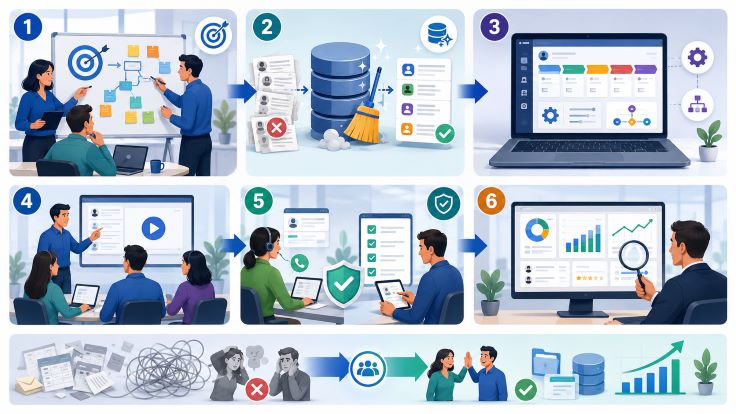
Offer letter tracking logs each stage—generation, delivery, e-signature, and countersignature—within the deal pipeline, updating funding records in real time so brokers and funders see status instantly. ConvergeHub centralizes this alongside document requests and commission tracking in one connected system.
Offer letter tracking in ConvergeHub’s Merchant Cash Advance CRM logs each stage of the funding package once documents move to multiple lenders with one click. Sales and ops managers view real-time status on pipeline dashboards, see which lender responded, and track commission assignments tied to each offer, eliminating manual follow-up before deals reach funding.
Why Do Offer Letters Get Lost in the Shuffle?
Weak underwriting rarely kills a funded deal. Process gaps do. Offer letters stall in inboxes, get buried under other tasks, or wait on someone to notice they never went out. That gap between “approved” and “delivered” is where revenue quietly disappears.
Timing makes the problem worse. Without a system flagging delays, an offer letter can go out three days late. Long enough for a merchant to take a competing offer. Brokers rarely find out until the deal is already gone.
What Causes Offer Letters to Stall Internally?
Scattered spreadsheets, shared inboxes, and separate document tools each hold a piece of the deal, but none of them show the whole picture. A broker checks one system, a funder checks another, and neither sees where the offer letter actually sits. An MCA CRM replaces that patchwork with a single connected record for the entire deal.
That consolidation solves more than storage. A structured offer approval workflow inside a connected CRM gives brokers and funders constant visibility into:
What’s pending approval right now
Who owns the next action
Which deals are at risk of slipping past the merchant’s decision window
No one has to chase colleagues for status updates or manage reminder sequences by hand. Every stalled offer becomes visible before it becomes a lost deal.
How Does an Offer Approval Workflow Move Deals Forward?
An offer approval workflow moves deals forward by structuring every stage of the offer process into visible, trackable steps. No stalled offer letter goes unnoticed when pipeline stages are permission-controlled and visible to the right team members. A well-built MCA CRM manages multiple pipelines at once, with custom list building and permission-based views that keep every stage accounted for. Brokers, funders, and ISO teams see exactly where an offer sits, and who owns the next action.
Speed matters just as much as visibility. Merchant documents and underwriting data get packaged together. Submitted to multiple lenders in one action, cutting the lag between underwriting and a signed offer.
What Happens After an Offer Gets Approved?
Approval triggers the next phase of the workflow without ending it. Sales, service, and billing teams stay aligned around one shared customer record as the deal advances, so nobody re-keys merchant data or loses context mid-funding.
From there, the same platform handles what comes next:
Generate quotes tied to the approved offer terms
Send invoices without switching to separate billing software
Track payments against the original deal record
That continuity keeps funding operations moving without handoff delays or data gaps between departments.
What Role Does an E-Signature Audit Trail Play?
An e-signature audit trail records exactly when a merchant opened, reviewed, and signed an offer letter. Sending offer documents directly from a MCA CRM gives brokers. Funders that visibility without chasing status updates by phone or email. Every open, every delay, every signature gets logged in one place. That timestamp record becomes the backbone of an offer approval workflow, showing precisely where a deal sits before funding release.
Merchant-facing logins strengthen the record further. When merchants get their own portal to view messages, upload documents, check tasks, and read notes, both sides build a shared, timestamped history of the entire offer process. Nothing lives only in someone’s inbox.
Why does documentation matter for MCA deals specifically?
Funders and ISOs face constant scrutiny over how offers were presented and accepted. A clear, traceable log protects against disputes over terms, timing, or consent. Thousands of businesses rely on ConvergeHub precisely because documented, traceable customer interactions reduce that exposure.
Does this connect to compliance needs?
Yes. ConvergeHub’s approach to financial services CRM applies the same connected record-keeping funders and brokers need for audit readiness. Offer letters, signatures, and merchant communication stay linked to one deal record — not scattered across separate tools or inboxes.
Effective offer letter tracking in merchant cash advance operations requires seamless coordination across sales, documentation, and client management. ConvergeHub’s integrated platform consolidates these critical functions into one connected system, eliminating the inefficiencies of scattered tools. By centralizing offer letter workflows alongside your broader customer lifecycle management, you establish transparency, accelerate decision cycles, and build the operational foundation necessary for sustainable growth in the competitive MCA landscape.
Frequently Asked Questions
Why do offer letters get lost in the shuffle?
Weak underwriting rarely kills a funded deal—process gaps do. Offer letters stall in inboxes or wait unnoticed. Without a system flagging delays, merchants take competing offers before brokers even realize the deal slipped.
What causes offer letters to stall internally?
Scattered spreadsheets, shared inboxes, and separate document tools each hold a piece of the deal without showing the whole picture. An MCA CRM replaces that patchwork with one connected record showing what’s pending and who owns the next action.
What happens after an offer gets approved?
Approval triggers the next phase of the workflow rather than ending it. Sales, service, and billing teams stay aligned around one shared customer record as the deal advances toward funding.
Conclusion
Offer letter tracking in ConvergeHub’s Merchant Cash Advance CRM answers the core question of how a funded deal moves from approval to signature without stalling in an inbox or spreadsheet. The system pairs real-time pipeline visibility with an e-signature audit trail, permission-based multi-pipeline management, and commission tracking, so brokers, funders, and ISOs always know an offer’s status and who owns the next action. By consolidating offer generation, delivery, signature, and countersignature into one connected record, ConvergeHub’s MCA CRM turns funding operations from a manual chase into a documented, trackable workflow. See how a connected merchant cash advance CRM can keep your deals moving toward funding.
Merchant cash advance CRM platforms track deal milestones through custom pipeline stages, document request status, and funding records updated in real time. ConvergeHub’s Pipeline Management lets MCA brokers and funders build custom lists, package merchant documents, submit files to multiple lenders with one click, and monitor commission assignments at every stage of the deal.
Key Takeaways
Merchant cash advance CRM software tracks active deals, documents, and funding records in real-time visibility for teams.
Pipeline management features enable custom list building and advanced views across multiple MCA deal pipelines simultaneously.
ConvergeHub’s all-in-one system replaces scattered tools, consolidating sales, marketing, service, billing, and automation into one platform.
MCA software selection influences the scalability of funding operations, impacting servicing and compliance.
Why Do MCA Deals Stall Mid-Pipeline?
Deals stall when brokers and funders lose sight of where a merchant sits in the process. Weak underwriting is often a contributing factor, but process gaps are the primary cause. Opportunities slip through the cracks before they ever convert into funded deals. By the time someone notices, the merchant has already gone to a competitor.
A dedicated MCA CRM exists to close that gap. It keeps every merchant relationship, active deal, document request, and funding record visible and actionable in real time, so nothing sits idle waiting for someone to remember it. Merchant Cash Advance
What actually causes deals to go cold?
Fragmented systems are the usual culprit. When sales, underwriting, and servicing teams work from separate spreadsheets or disconnected tools, no one owns the full picture. ConvergeHub solves this by aligning sales, marketing, service, and billing teams around one shared customer record, giving every stakeholder. From ISO partner to funder — the same view of a merchant’s deal status.
How does better visibility prevent stalls?
Pipeline IQ tracks pipeline progress, team productivity, and customer activity in real time. That level of deal stage visibility means a broker can spot a stalled application before the merchant walks away, turning reactive firefighting into proactive deal management.
How Are Deal Milestones Recorded And Reported?
Funding milestones get logged directly inside the deal record, from application intake through disbursement. An MCA CRM built for merchant cash advance workflows lets brokers and funders create quotes, send invoices, and track payments within the same record used to manage the deal from start to funding. No switching between spreadsheets or separate billing tools.
Every stage change generates a timestamped entry, giving underwriters and ISOs a running log of who touched a file and when. Tagging behaviors and tracking engagement metrics inside the CRM helps teams spot pain points. Opportunities before they stall a deal, turning deal stage visibility into an operational habit rather than a weekly guessing game. cite-2
What Happens When A Merchant Reports An Issue Mid-Deal?
Centralized cases with complete customer history let brokers resolve merchant issues on the spot instead of digging through email threads or shared drives. Convergehub.Com This structure supports milestone-based case tracking. A document request, a stipulation, or a payment dispute stays attached to the exact stage where it occurred.
Can Funders See Profitability At Each Stage?
Dedicated deal-tracking tools give funders visibility into:
Investment exposure at each milestone
Risk exposure across the portfolio
Cash position in real time
Overall deal profitability as terms change
That level of reporting keeps funding decisions grounded in current numbers, not last week’s snapshot.
What Should You Look For In An MCA CRM?
Strong MCA CRM software consolidates deal tracking, document collection, and funder communication into a single system. Scattered spreadsheets and disconnected email threads cause funded deals to slip through the cracks. Brokers and funders lose commission and merchant trust when no one owns the follow-up.
An effective platform delivers deal stage visibility. Every team member sees exactly where each submission sits in underwriting, offer, or funding. This transparency matters most for ISOs juggling relationships with multiple funders at once. ConvergeHub is built as an all-in-one CRM software solution for small businesses, cutting the need for separate tools at each stage of the deal lifecycle. Sales, marketing, service, billing, and automation run through one connected system rather than five disconnected apps.
What features matter most for MCA deal flow?
Look for pipeline flexibility and access controls. Key capabilities include:
Multiple pipeline management with custom list building and advanced filtering views
Permission-based security for sensitive merchant and funder data
Milestone-based case tracking to flag stalled documents or approvals
CRM software tailored for financial services, covering regulated deal handling
Does industry-specific CRM software matter for MCA funders?
Yes. Generic contact managers rarely handle syndication splits or compliance-driven recordkeeping. Financial-services-focused CRM platforms address these operational demands directly.
Tracking deal milestones in merchant cash advance operations demands a unified system that consolidates sales progress, customer interactions, and financial workflows. ConvergeHub delivers this integration through its all-in-one platform, eliminating the inefficiency of scattered tools and enabling teams to monitor advancement from initial contact through funding completion. By centralizing milestone tracking within a single connected system, businesses gain visibility into pipeline velocity, reduce administrative overhead, and accelerate deal closure—ultimately driving sustainable growth and operational excellence.
FAQ
Why do MCA deals stall mid-pipeline?
Fragmented systems create process gaps, and opportunities slip through the cracks before merchants convert into funded deals.
How does an MCA CRM record deal milestones?
What happens when a merchant reports an issue mid-deal?
Centralized cases with complete customer history let brokers resolve merchant issues on the spot instead of digging through email threads. This structure attaches document requests, stipulations, or payment disputes to the exact stage where they occurred.
Conclusion
Deal milestones in merchant cash advance work only stay visible when the systems tracking them are built for the job. As this article has shown, stalled deals almost always trace back to fragmented tools — separate spreadsheets, disconnected email threads, and no single owner of the merchant relationship. A dedicated MCA CRM closes that gap by logging every stage change, document request, and funding update inside one connected record, giving brokers, ISOs, and funders the same real-time view of where a deal stands.
ConvergeHub brings that visibility together in a single platform: custom pipeline management, milestone-based case tracking, quoting and invoicing, and permission-based data controls, all replacing the scattered tools that let deals go cold. For MCA brokers and funders, that means fewer opportunities slipping through the cracks and a clearer path from initial contact to funding completion.
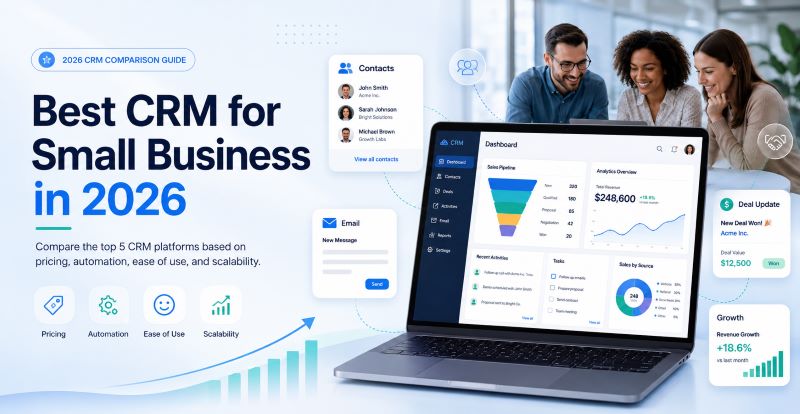
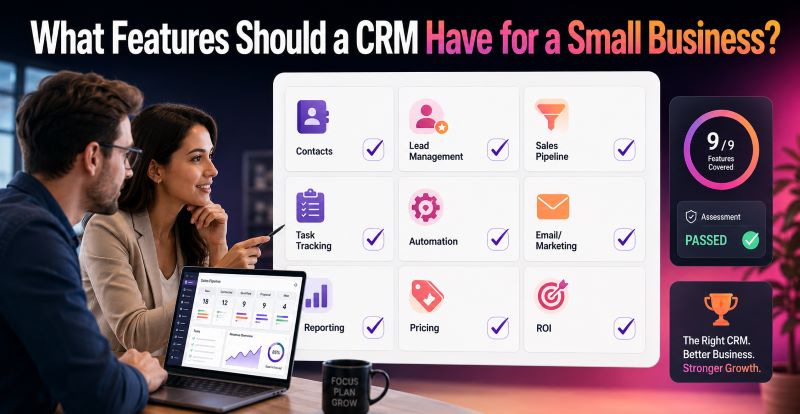
If you run a small business, you already know the feeling: customer details scattered across spreadsheets, sticky notes, email threads, and a dozen half-used apps. Someone forgets to follow up with a hot lead. A support ticket falls through the cracks. Your sales team has no idea what marketing already told a prospect. It’s not that your team isn’t working hard — it’s that you don’t have one system tying it all together.
That’s exactly the problem a CRM (Customer Relationship Management platform) is built to solve. But here’s the catch: there are dozens of CRMs on the market, and most comparison articles either read like a wall of jargon or, worse, are thinly disguised sales pitches for one product dressed up as objective research.
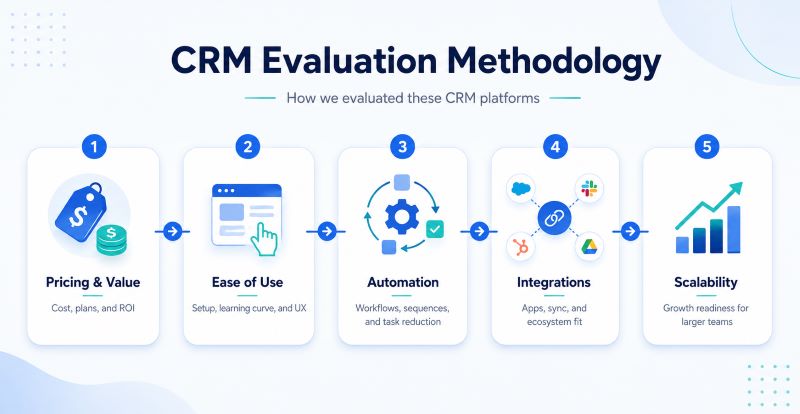
We wanted to do this differently. We tested and researched the best CRM for small business owners across five criteria that actually matter day-to-day: ease of use, automation depth, scalability, customer support quality, and how well each platform handles the full customer lifecycle — not just the initial sale.
How We Evaluated These CRM Platforms
To make this comparison as practical as possible, we evaluated each CRM based on the tasks that matter most to small business teams—not just feature lists or marketing claims.
For every platform, we looked at:
Ease of setup: How quickly a new user can get started and configure the CRM.
Contact import: Importing hundreds of contacts and organizing customer data.
Pipeline management: Creating and managing sales pipelines and assigning leads.
Workflow automation: Setting up email automation, follow-up reminders, and task workflows.
Customer support: Availability, responsiveness, and quality of support resources.
Scalability: How well the CRM adapts as your business grows and your processes become more complex.
Overall value: Features included at each pricing tier and whether additional tools are required for marketing, support, or billing.
Rather than focusing on the longest feature list, we evaluated each CRM based on how effectively it helps small businesses manage customer relationships, streamline operations, and support long-term growth.
Who this guide is for?
This comparison is designed for:
Small businesses with 2–200 employees
Companies managing sales through spreadsheets or disconnected tools
Businesses looking to improve lead management and customer relationships
Teams comparing CRM software before making a purchase
Growing companies that need sales, marketing, and customer support to work together
If you’re looking for enterprise-grade CRM software for thousands of users or a simple digital contact book for personal use, this guide may not be the best fit.
CRM
Best For
Starting Price
Free Plan
Marketing Automation
Customer Support
Billing
Overall Rating
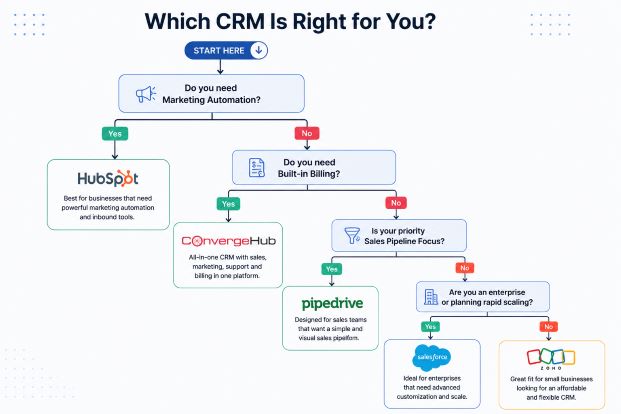
HubSpot
Marketing Teams
From $…
Yes
⭐⭐⭐⭐⭐
⭐⭐⭐⭐
No
4.7/5
Zoho
Budget Teams
From $…
Limited
⭐⭐⭐⭐
⭐⭐⭐
No
4.4/5
ConvergeHub
All-in-One
From $…
Trial
⭐⭐⭐⭐⭐
⭐⭐⭐⭐⭐
Yes
4.8/5
Pipedrive
Sales Teams
From $…
Trial
⭐⭐⭐
⭐⭐⭐
No
4.6/5
Salesforce
Scaling Businesses
From $…
Trial
⭐⭐⭐⭐⭐
⭐⭐⭐⭐
Limited
4.5/5
A comparative and tabular representation of all CRM’s for small businesses
Now let’s break each one down in detail.
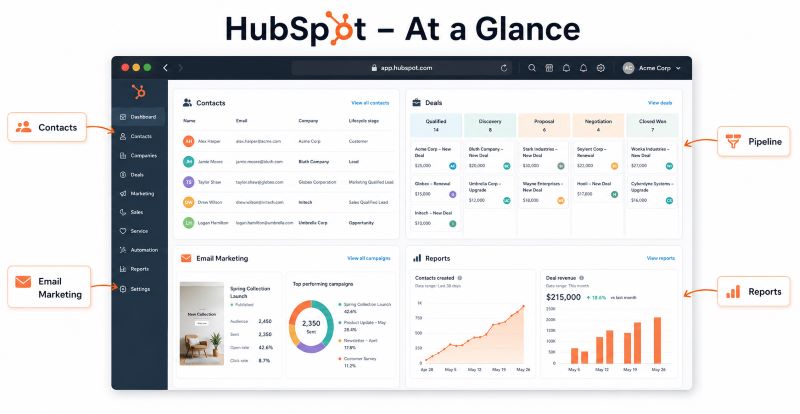
1. HubSpot CRM — Best for Marketing-Led Sales Teams
At a Glance
Best For: Marketing-led businesses
Starting Price: $XX/user/month
Free Plan: Yes
Free Trial: Yes
Ease of Use: ★★★★
Overall Rating: ★★★★ 4/5
HubSpot is one of the most recognized names in the CRM space, and for good reason. Its free tier is genuinely usable, and the platform has done more than almost any competitor to popularize inbound marketing as a strategy for small businesses. If your business runs on content marketing, email nurture sequences, and lead scoring tied tightly to your website, HubSpot’s ecosystem is built for exactly that workflow.
Pros:
Clean, intuitive interface that new hires can pick up in a day
Strong free-forever plan that covers basic contact management and pipeline tracking
Deep marketing automation integration, especially for content-driven lead generation
Excellent educational resources and certification courses for teams new to CRM concepts
Cons:
Costs escalate fast once you need advanced automation, custom reporting, or multiple pipelines
Many powerful features are locked behind higher-priced tiers, which can feel like a bait-and-switch as you grow
Can feel like marketing software with a CRM bolted on, rather than a true sales-and-support-first system
Reporting customization is more limited than dedicated sales platforms once you scale past a few users
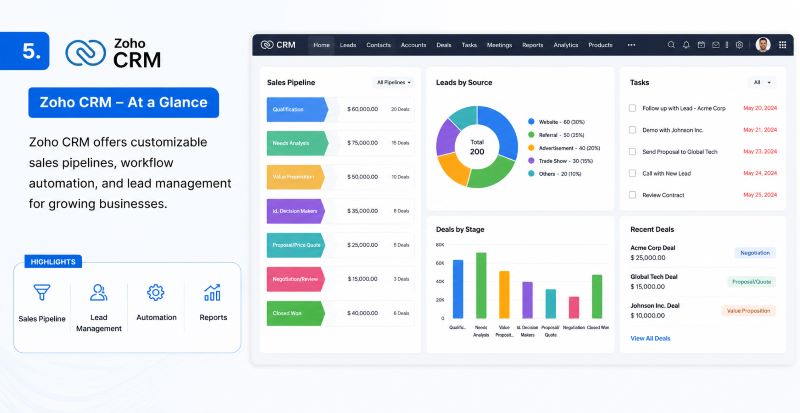
2. Zoho CRM — Best for Budget-Conscious Teams
Zoho CRM — At a Glance
Best For: Budget-conscious small businesses
Starting Price: From $14/user/month (Standard)
Free Plan: Yes (limited features)
Free Trial: Yes
Ease of Use: ★★★★☆
Overall Rating: ★★★★☆ (4.5/5)
Zoho CRM has been a small business staple for over a decade, largely because it sits inside a much larger Zoho ecosystem of business apps. If you’re already using other Zoho products for invoicing, HR, or email, the CRM slots in naturally.
Pros:
Large ecosystem of Zoho apps that integrate well together out of the box
Reasonable entry point for teams that need core CRM functionality without extras
Decent customization options for fields, layouts, and basic workflow automation
Multi-channel communication tools built in, including social and live chat
Cons:
Interface feels dated compared to newer platforms, which can slow down adoption
Steeper setup time to get automations and workflows actually working as intended
Customer support response times can be slow during peak periods, according to many small business users
Advanced features often require add-on modules, which fragments the experience
3. ConvergeHub — Best All-in-One CRM for Small Businesses That Want to Consolidate Tools
ConvergeHub — At a Glance
Best For: Small and mid-sized businesses looking for an all-in-one CRM
Starting Price: Custom pricing
Free Plan: No
Free Trial: Yes
Ease of Use: ★★★★★
Overall Rating: ★★★★★ (4.8/5)
This is where we come in. ConvergeHub was built specifically because small businesses kept telling us the same thing, over and over: they were juggling separate tools for sales, marketing, customer support, and billing, and none of those tools talked to each other. Data lived in silos. Reporting required exporting from four different dashboards. And every new hire had to be trained on multiple systems just to do their job.
ConvergeHub combines sales pipeline management, marketing automation, customer support ticketing, and billing in a single platform. That means a lead’s entire journey — from first website visit, to sales conversation, to signed deal, to ongoing support ticket — lives in one place, visible to everyone on your team who needs it.
Pros:
One unified platform for sales, marketing, support, and billing, removing the need to stitch together four or five separate tools
Built-in marketing automation, including email sequences, lead scoring, and workflow triggers, without needing a separate marketing suite
Strong customization for industry-specific workflows, including professional services, healthcare, financial services, and IT companies
Responsive, small-business-focused customer support that understands the context of growing teams
CRM free trial available with a fast setup process and no lengthy onboarding wait
Built-in billing functionality, reducing the need for a separate invoicing tool
Cons:
Steeper learning curve for solo entrepreneurs who only want a basic digital contact list — if all you need is a simple rolodex, ConvergeHub’s depth may feel like more platform than necessary
Not designed for enterprise companies with 500+ employees who need deep custom-code extensibility and dedicated enterprise architecture teams
Because it’s all-in-one, teams that have already heavily invested in separate best-in-class marketing or support tools may find some feature overlap
The breadth of features means new users benefit from spending time in onboarding resources rather than diving in cold
Who ConvergeHub is actually built for: small and mid-sized businesses, roughly 5–200 employees, who are tired of managing multiple disconnected platforms and want sales, marketing, and support unified under one roof. If that’s not your situation, one of the other four CRMs on this list may genuinely serve you better — and we’d rather tell you that upfront than waste your trial period.
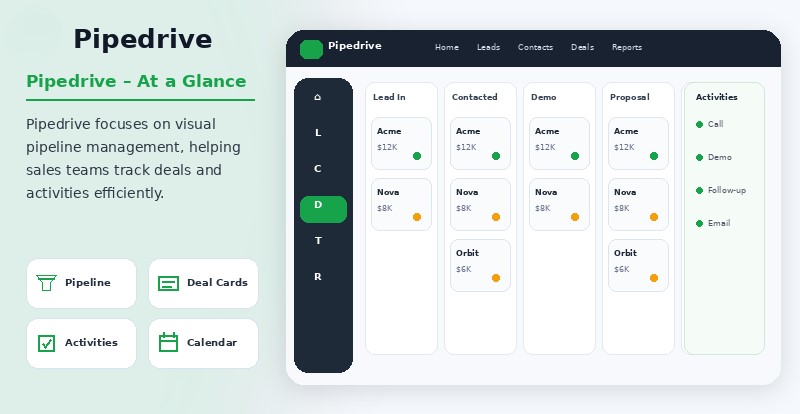
4. Pipedrive — Best for Visual Pipeline Management
l Pipedrive — At a Glance
Best For: Sales-focused teams that need simple pipeline management
Starting Price: From $14/user/month (Essential)
Free Plan: No
Free Trial: Yes
Ease of Use: ★★★★★
Overall Rating: ★★★★☆ (4.6/5)
Pipedrive built its entire reputation on one thing: making the sales pipeline dead simple to visualize. For sales teams who think in terms of deal stages and want a clean, drag-and-drop Kanban-style view, it’s hard to beat.
Pros:
Extremely intuitive drag-and-drop pipeline view that requires almost no training
Fast to set up, often usable within the first hour
Great for sales-only teams without complex marketing or support needs
Mobile app is well-regarded for reps who spend most of their day out of the office
Cons:
Marketing and customer support features are limited or require third-party add-ons
Reporting can feel shallow for teams that want deeper, cross-departmental analytics
Less suited for businesses that need a unified system covering more than just sales tracking
Integrations, while plentiful, often require middleware tools like Zapier to fully connect systems
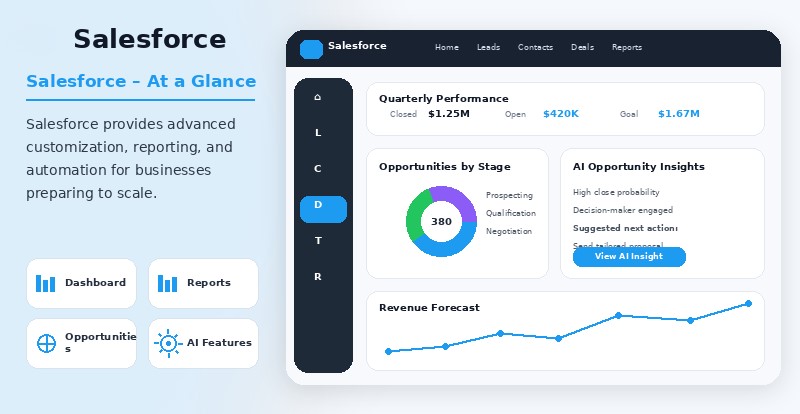
5. Salesforce Essentials — Best for Teams Planning to Scale Fast
l Salesforce Essentials — At a Glance
Best For: Businesses planning to scale rapidly
Starting Price: From $25/user/month (Starter Suite)
Free Plan: No
Free Trial: Yes
Ease of Use: ★★★☆☆
Overall Rating: ★★★★☆ (4.5/5)
Salesforce is the industry giant, and its Essentials tier tries to bring some of that enterprise-grade power down to small business budgets. If you know your company is going to grow rapidly and want a platform that can scale with you for years, it’s worth considering early.
Pros:
Massive ecosystem of integrations, add-ons, and third-party consultants
Scales extremely well as your company grows from a handful of employees to hundreds
Trusted, established platform with a huge user community and extensive documentation
Highly customizable data structure for businesses with complex sales processes
Cons:
Steep learning curve, even in the simplified small business tier
Can feel over-engineered for teams that just need core contact and deal management
Often requires a consultant or dedicated admin to configure and maintain properly
Customization power comes at the cost of a longer implementation timeline
Why We Built ConvergeHub?
We didn’t build ConvergeHub to be just another logo in a crowded CRM market. We built it because small business owners kept telling us they were exhausted from paying for and learning five different tools that barely talked to each other — a CRM here, an email marketing tool there, a separate support ticketing system, and a billing app bolted on top of it all.
Every new tool meant another login, another monthly cost, another dashboard your team had to check, and another place data could get lost in translation between systems. We watched small businesses lose deals not because their product wasn’t good, but because a lead fell through the cracks between their marketing tool and their sales spreadsheet.
ConvergeHub exists to solve that specific problem: give small businesses one platform that handles the full customer relationship, from first contact to closed deal to ongoing support, without needing an IT team to duct-tape it all together.
That said, we know ConvergeHub isn’t the right fit for everyone, and we’d rather say so directly than have you find out after a frustrating trial. If you’re a solo founder who just needs a simple contact list, a tool like Pipedrive may serve you better with less complexity. If you’re a 1,000-person company needing deep custom development and a dedicated Salesforce architecture team, Salesforce Essentials is likely a better long-term fit. Our goal with this article isn’t to convince you we’re the right choice for everyone — it’s to help you find the CRM that actually matches your business, even if that means recommending someone else.
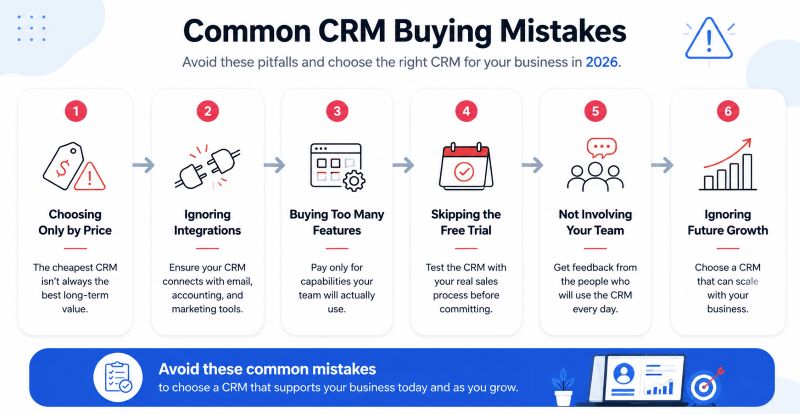
Common Mistakes Small Businesses Make When Choosing a CRM
Before you make a decision, it’s worth knowing where most small businesses go wrong during the CRM selection process:
Choosing based on brand recognition alone. The most well-known CRM isn’t automatically the best fit for your team size or workflow.
Ignoring the total tool stack. A CRM that looks affordable on its own can end up costing more once you add the marketing, support, and billing tools it doesn’t include natively.
Skipping the free trial. Every CRM on this list offers a free trial, and skipping that step is the single most common reason small businesses end up switching platforms within the first year.
Underestimating onboarding time. Even the easiest CRM requires some setup, data migration, and team training. Budget time for this rather than expecting instant productivity.
Not mapping the actual sales and support process first. The best CRM is the one that matches how your team already works, not the one with the longest feature list.
How to Choose the Right CRM for Your Small Business
When comparing CRM tools for small business, ask yourself these questions before signing up for anything:
How many tools am I already using? If you’re juggling separate sales, marketing, and support platforms, an all-in-one system like ConvergeHub can meaningfully reduce complexity and total cost of ownership.
How technical is my team? Simpler tools like Pipedrive get you moving faster if you don’t need deep customization or multi-department automation.
Am I planning to scale significantly in the next 2–3 years? If yes, look closely at platforms built for scale, like Salesforce, or an all-in-one system that grows with added modules rather than added tools.
Do I need marketing automation built in, or just contact management? This single question will heavily influence which tool makes sense for your team.
Does my business need billing and invoicing connected to customer records? If so, a platform with native billing, like ConvergeHub, can eliminate an entire separate software subscription.
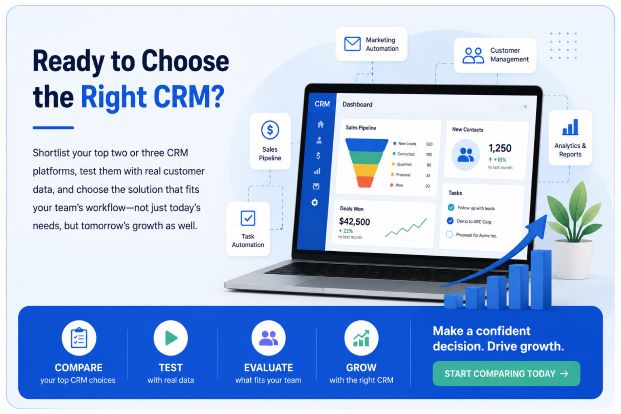
Is a free trial available? Always test-drive a CRM software for Small Business with your actual sales process, real contacts, and your actual team before committing — every CRM on this list, including ConvergeHub, offers a free trial specifically so you can do this.
Final Thoughts
Before choosing any CRM, take advantage of the free trial. Import your real contacts, recreate your actual sales pipeline, and involve the people who will use it every day. The right CRM should simplify your workflow—not add another layer of complexity. If you’re looking for one platform that combines sales, marketing, customer support, and billing, ConvergeHub is worth evaluating alongside the other options in this guide.
Frequently Asked Questions
What is the best CRM for small business owners just starting out? It depends on your priorities. If you want a simple visual pipeline and nothing more, Pipedrive is a strong starting point. If you want sales, marketing, and support unified in one system from day one so you’re not adding tools later, ConvergeHub is built for that.
Which CRM is easiest to learn? Pipedrive and HubSpot’s free tier are generally the fastest to pick up for a brand-new user. ConvergeHub has a slightly steeper learning curve upfront because it offers more built-in functionality across sales, marketing, and support, though most teams are fully comfortable within the first couple of weeks.
Can I use a CRM for invoicing and billing? Some CRMs require third-party billing add-ons, which adds cost and another system to manage. ConvergeHub includes billing functionality natively, which can reduce the number of separate tools your team needs to maintain.
Do these CRMs offer a free trial? Yes — HubSpot, Zoho, ConvergeHub, Pipedrive, and Salesforce Essentials all offer some form of free trial so you can test the platform with your own data before committing.
Is ConvergeHub good for enterprise companies? Not really, and we’re upfront about that. ConvergeHub is purpose-built for small to mid-sized businesses. Enterprise companies with 500+ employees and complex custom-development needs are usually better served by platforms like Salesforce.
How long does it take to set up a CRM? This varies by platform and how much existing data you’re migrating. Simpler tools like Pipedrive can be set up in under an hour for basic use. All-in-one platforms like ConvergeHub typically take a few days to a couple of weeks for full setup across sales, marketing, and support, though basic contact and pipeline management can be live on day one.
What’s the difference between a CRM and an email marketing tool? A CRM manages the full customer relationship, including sales pipeline stages, support history, and billing in some cases. An email marketing tool typically only manages campaigns and contact lists. Platforms like ConvergeHub and HubSpot blend both functions, while dedicated email tools require a separate CRM to track the broader relationship.
Most insurance agencies aren’t losing business to competitors quoting lower premiums. They’re losing it to slow follow-up, missed renewal windows, and policyholders who quietly drift away because nobody reached out first. That’s the real argument for insurance CRM software — it isn’t another admin tool bolted onto the sales process. It’s the system that decides whether a lead becomes a bound policy, and whether a client renews or shops elsewhere without ever telling you. Let’s delve more in the following post.
The cost of slow response and passive renewals
Insurance runs on speed and consistency, and the numbers make the stakes hard to ignore:
Agencies typically lose 16–17% of their book every year, making retention one of the industry’s biggest structural challenges rather than an occasional problem.
Contacting a new lead within five minutes, instead of waiting even half an hour, can increase contact rates by as much as 500% — yet many agencies still respond hours or days later.
Some industry data puts the average insurance lead response time at roughly 47 hours, and shows that responding within five minutes rather than thirty can multiply eventual conversion more than 20-fold.
Roughly 15–20% of renewable policies are lost to passive lapse each year — policyholders who simply weren’t contacted before their renewal date and drifted to another carrier or agent.
None of this is a talent problem. It’s a systems problem — the same gap that shows up when a renewal falls through because no one flagged it 60 days out, or a hot lead cools off because a follow-up sat in an inbox overnight.
What changes when a CRM is built for insurance, not adapted to it
A generic contact manager tracks names and deals. A CRM for insurance agents needs to track more specific details: policy types, renewal dates, household relationships, and where each opportunity sits in a pipeline that handles new business, renewals, cross-sells, and referrals all at once. That distinction is what separates a CRM a team tolerates from one it actually runs the agency on.
In practice, that looks like:
Automatic lead routing to the right agent based on policy type or region, with a real-time alert the moment a prospect requests a quote
Renewal reminders that trigger 60–90 days out, not the week a policy is about to lapse
A single client record tying together every call, email, and policy touchpoint — useful for retention conversations, and for proving compliance if a regulator ever asks for an activity history
Cross-sell prompts that surface automatically when a household’s coverage has an obvious gap, instead of relying on an agent to notice it during a service call
Here is what unfolds further.
1. Multi-line households change the retention math
Presenting multiple lines to a household during the sales conversation increases close rates by roughly 34%, and the retention effect compounds from there — policyholders carrying three or more lines are considerably less likely to shop around at renewal.
Most agencies still treat cross-selling as opportunistic — something that occurs if a policyholder calls in for service. A CRM that surfaces coverage gaps automatically, tied to real policy data instead of an agent’s memory, turns that into a systematic part of every renewal and service touchpoint rather than a lucky break.
2. Brokers need a slightly different lens
A crm for insurance brokers has to handle all of the above across multiple carriers and multiple relationships per household, which makes pipeline visibility even more critical. A broker juggling five markets for one commercial account can’t afford a renewal or a lead to fall through the cracks simply because it was living in three different inboxes instead of one shared record.
3. What agencies actually see after switching
The returns tend to land in a fairly consistent range across agencies that make the shift to a purpose-built system:
Retention improvements of roughly 5–15%, with some agencies reporting gains at the 5–8% range within the first six months.
Lead conversion boosts of 15–30% once follow-up is automated instead of manual.
Somewhere between 7 and 15 hours of admin time saved per team member, per week, depending on how much of the renewal and follow-up workflow gets automated.
For a mid-sized book of business, even the conservative end of those numbers adds up fast. A 10% retention lift on a $2M premium book alone can outweigh the cost of the software many times over in the first year, before cross-sell or time savings are even factored in.
3. Getting the rollout right
None of these gains happens automatically the day a new system goes live. The agencies that see the strongest results tend to get three things right early:
Clean Data Migration: They migrate existing policy and household data cleanly instead of starting from a blank slate.
Seamless Integration: They connect the CRM to the email and calendar tools agents already use so logging happens automatically rather than as an extra step.
Date-Driven Workflows: They build renewal and follow-up workflows around actual policy dates rather than generic reminders.
Skipping any of these tends to produce a system that looks powerful in a demo but quietly gets ignored once the busy season hits.
Where the industry is heading next
The shift toward CRM-driven retention isn’t a passing trend. A large majority of insurance companies, roughly 82%, now consider AI adoption critical to future competitiveness — largely because faster, better-targeted client communication has become table stakes rather than a differentiator. Agencies that treat their CRM as the operational backbone of lead response and renewal outreach are the ones best positioned to keep pace as that expectation becomes standard across the industry.
The bottom line
Insurance agencies don’t usually lose business because clients stop needing coverage. They lose it because nobody followed up fast enough, or because a renewal date passed quietly without a conversation. The right insurance CRM software closes both gaps. This is exactly where ConvergeHub steps in to close both gaps. By unifying sales, marketing, and customer service into one powerful platform, ConvergeHub turns lead response and renewal outreach from manual tasks an agent has to remember into automated workflows the system executes flawlessly, every single time. Stop losing clients to passive lapses and slow follow-ups—let ConvergeHub transform your agency from reactive to a retention-first powerhouse.
Frequently Asked Questions
How fast should an insurance agency respond to a new lead?
Within five minutes if possible. Response speed is one of the strongest predictors of whether a lead converts, and most agencies lose ground simply because follow-up happens hours or days later than it should.
What makes insurance CRM software different from a general CRM?
It’s built around policy types, renewal timelines, and household relationships instead of just contacts and deals, so it can flag a renewal 60–90 days out or route a lead to the right agent by product line automatically.
Can a CRM actually improve client retention, not just lead tracking?
Yes. Automated renewal reminders and proactive outreach before a policy lapses are consistently linked to measurable retention gains, since most policyholders leave because they weren’t contacted first, not because they were unhappy.
Is a CRM for insurance brokers different from one built for agents?
The core workflow is similar, but brokers typically need stronger multi-carrier and multi-relationship visibility, since one client account can span several markets and policies that all need independent tracking.
Does adopting a CRM help with compliance, not just sales?
Yes. A centralized record of every call, email, and renewal notice creates an automatic activity trail, which matters if an agency ever needs to demonstrate it followed proper client communication and renewal procedures.
Selecting the right Customer Relationship Management (CRM) for funders and Independent Sales Organizations (ISOs) in the merchant cash advance (MCA) sector improves efficiency, client engagement, and funding workflows. This buyer’s guide shows how to evaluate Merchant Cash Advance CRM options, focusing on selection criteria, core features, and implementation practices to maximize your investment.
Assess technology integration, compliance needs, and MCA-specific features—such as workflow automation, lead management, and compliance tracking—when choosing a solution that supports your funding operations.
Buyer’s Guide for Choosing a Merchant Cash Advance CRM
Successful selection requires aligning the software’s capabilities with your organization’s objectives and processes.
Selection Criteria:
Compare solutions against a small set of high-impact criteria:
360-Degree Customer View: A unified customer profile that captures interactions and history.
Integration Capabilities: Reliable connectors to financial systems, payment processors, and communication tools.
Cost-Effectiveness and Scalability: A pricing model that fits your budget and scales as your business grows.
Prioritizing these factors helps you identify the most suitable Merchant Cash Advance CRM.
Essential Features:
Core features to support MCA operations include:
Lead and Client Management: Track prospects, applications, and client histories in one place.
Automated Alerts and Reminders: Timely follow-ups and notifications to maintain momentum.
Sales Force Automation: Automate routine sales tasks and approval workflows.
These features turn a CRM into an operational platform that increases efficiency and satisfaction.
Best Practices for Implementation:
Adopt disciplined implementation steps to ensure adoption and measurable results:
Build a Project Sponsor Team: Include stakeholders who will champion the rollout.
Conduct Regular Audits: Monitor usage and adjust workflows periodically.
Train Your Team: Provide role-based training and reference materials.
Clear governance and ongoing training help realize the CRM’s benefits.
What Are the Essential Features of Merchant Cash Advance CRM Solutions?
Funders and ISOs need features that support funding decisions and operations.
Key features include:
Automated Reporting: Pipeline and performance reports for data-driven decisions.
Real-Time Analytics: Operational and client insights to inform actions.
Compliance Support: Tools to capture required records and assist reporting.
These capabilities elevate a CRM from a contact list to a performance tool.
How Does Workflow Automation Enhance MCA Funding Efficiency?
Automation reduces manual work, enforces consistent processes, and frees staff to focus on higher-value tasks.
Key benefits of workflow automation include:
Increased Efficiency: Less manual processing and faster throughput.
Improved Communication: Automated handoffs and notifications keep teams aligned.
Data Management: Consistent capture and reporting reduce errors.
Implement workflows that mirror your approval and funding processes to maximize gains.
Why Is Compliance Tracking Critical in Alternative Lending CRMs?
Compliance tracking documents adherence to regulations and protects organizational credibility.
The importance of compliance tracking includes:
Regulatory Adherence: Maintain records that demonstrate compliance.
Risk Management: Detect and address compliance gaps early.
Data Integrity: Automated checks improve reporting accuracy.
Built-in compliance features reduce risk and support long-term performance.
Which Factors Should Funders and ISOs Consider When Evaluating MCA CRM Options?
Focus on elements that determine operational fit and long-term value:
Pricing Structures: Understand subscription, licensing, and add-on costs.
Integration Capabilities: Verify connectors for your core systems.
User Experience: Choose intuitive interfaces to speed adoption.
Confirm these factors align with your objectives before committing.
How Does Lead and Client Management Impact Funding Pipeline Success?
Structured lead and client management guides prospects through the funding lifecycle and improves conversion.
The impact of effective management includes:
Lead Scoring: Prioritize high-probability opportunities.
Data Management: Maintain clean records for underwriting and renewals.
Automated Communication: Nurture leads with timely messages.
Strong management capabilities help increase conversion and pipeline predictability.
What Integration Capabilities Improve CRM Value for Alternative Lending?
Integrations keep data consistent and extend CRM functionality across your stack.
Some integration benefits include:
Seamless Data Flow: Synchronized customer records across systems.
Enhanced Customer Experience: Personalized interactions from unified data.
Comprehensive Analytics: Deeper reporting by combining CRM and analytics tools.
Prioritize integrations that support your payment, underwriting, and reporting needs.
How Do Pricing Models and Total Cost of Ownership Compare Across MCA CRM Platforms?
Evaluate pricing models and TCO to understand the long-term financial impact.
Common pricing models include:
Subscription-Based: Ongoing fees per user or module.
One-Time Purchase: Upfront license with optional maintenance fees.
Tiered Pricing: Feature or user-based tiers.
Compare models against expected growth and support costs to estimate TCO.
How Can Funders Maximize ROI When Selecting Alternative Lending CRM Software?
Use deliberate selection and deployment tactics to ensure measurable value:
Test with a Small-Scale Model: Pilot the CRM to validate fit and gather feedback.
Focus on Integration: Reduce disruption by connecting key systems before rollout.
Evaluate Specific Metrics: Track lead conversion, time-to-fund, and satisfaction to gauge impact.
A staged rollout and clear metrics help secure a positive ROI.
Where Can Funders Learn from Real-World Success Stories Using Merchant Cash Advance CRMs?
Case studies and practitioner stories provide practical lessons for selection and deployment.
Potential sources for success stories include:
Publications on Success Stories: Industry reports and trade journals with implementation examples.
Industry Reports: Aggregated performance trends and benchmarks.
Webinars and Workshops: Firsthand accounts and practical demonstrations.
Use these resources to validate vendor claims and gather implementation tips.
What Metrics Demonstrate Efficiency Gains and Compliance Improvements?
Track a focused set of metrics to demonstrate CRM impact:
Customer Retention Rates: Repeat business as a proxy for satisfaction.
Sales Quotas: Team performance against targets.
Lead Conversion Rates: Percentage of leads becoming funded clients.
Regular monitoring of these KPIs confirms the CRM’s operational and compliance benefits.
How Have ISOs Benefited from Centralized Client Data and Automation?
Centralised client data and automation give ISOs clearer visibility and consistent processes.
Some of the key benefits include:
Improved Data Tracking: Easier access to client histories and interactions.
Enhanced Collaboration: Standardized processes that aid cross-team work.
Streamlined Operations: Fewer manual tasks and smoother workflows.
These improvements support stronger relationships and scalable operations.
Request a Demo
Request a demo to evaluate the platform’s capabilities and how it maps to your workflows.
Review features and configuration options to confirm suitability for your business needs, and contact the vendor for any specific requirements.
Frequently Asked Questions
1. What is the importance of data security in Merchant Cash Advance CRMs?
Data security protects sensitive financial and customer records; choose CRMs with encryption, role-based access, and regular security reviews.
2. How can a CRM help in lead generation for MCA businesses?
A Merchant Cash Advance CRM centralizes prospect data, automates targeted outreach, and helps prioritize leads so sales teams focus on high-potential opportunities.
3. What role does user training play in CRM implementation success?
Training drives adoption and reduces errors—provide role-based learning and ongoing support to ensure effective use.
4. How can CRM analytics drive business decisions in alternative lending?
Analytics surface trends in customer behavior and funding performance, enabling data-driven product, pricing, and operational decisions.
5. What are the potential challenges in adopting a Merchant Cash Advance CRM?
Common issues are change resistance, data migration, integration complexity, and costs; mitigate these with stakeholder engagement, phased rollout, and thorough testing.
6. How does compliance tracking differ in different CRM systems?
Some platforms offer built-in compliance modules; others rely on external tools—verify a CRM’s compliance capabilities against your reporting requirements.
7. How can centralized client data benefit ISOs in the long term?
A single source of truth improves accuracy, personalization, and collaboration, enabling ISOs to scale processes and deepen client relationships.
Conclusion
Choosing the right Merchant Cash Advance CRM simplifies operations, strengthens client engagement, and supports compliance. Use the selection criteria, core features, and implementation practices in this guide to evaluate vendors and maximize your CRM investment.
Small business owners juggle dozens of leads, follow-ups, and customer conversations every week, and deals quietly slip through the cracks when that information lives in scattered spreadsheets and inboxes. A sales CRM for small business solves this problem by centralizing every contact, conversation, and deal stage in one place, so nothing gets forgotten. Instead of guessing which prospects are ready to buy, sales teams get a clear, real-time view of the pipeline. The result isn’t just better organization — it’s more closed deals, shorter sales cycles, and a sales process that actually scales as the business grows.
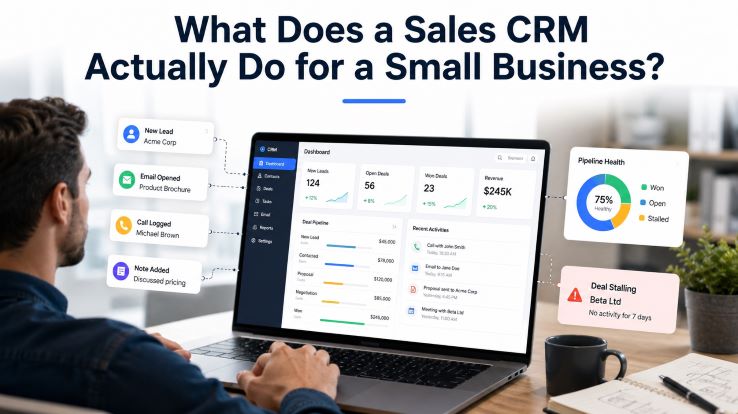
What Does a Sales CRM Actually Do for a Small Business?
At its core, CRM software for small business replaces the guesswork of manual tracking with a single source of truth for every customer relationship. Every call, email, quote, and meeting gets logged automatically, so sales reps spend less time on data entry and more time actually selling.
For a small team, this shift matters more than it might for a large enterprise. There’s no dedicated sales operations department to chase down missing notes or clean up a messy spreadsheet, so the CRM effectively becomes that support system, quietly keeping records accurate in the background.
This matters most in the moments that decide whether a deal closes or dies. A rep with instant access to a prospect’s full history — every objection raised, every promise made — walks into a conversation prepared instead of scrambling to remember where things left off. That preparation compounds across dozens of deals a month, which is exactly why CRM adoption tracks so closely with sales performance.
Centralizes contact records, emails, calls, and notes in one dashboard
Automates repetitive admin tasks like data entry and follow-up scheduling
Flags deals that are stalling before they go cold
Gives managers visibility into rep activity and overall pipeline health
How Does Lead Management CRM Help You Close More Deals?
Not every lead deserves the same amount of attention, and that’s where lead management CRM tools change the math. Instead of treating every inquiry the same way, the system scores and routes leads based on how likely they are to buy, so reps spend their limited time where it actually counts.
Automatically scores leads based on engagement, source, and buying signals
Routes high-intent leads to the right rep within minutes, not days
Sends automated reminders so a follow-up is never missed
Tracks every touchpoint across email, phone, and web forms in one timeline
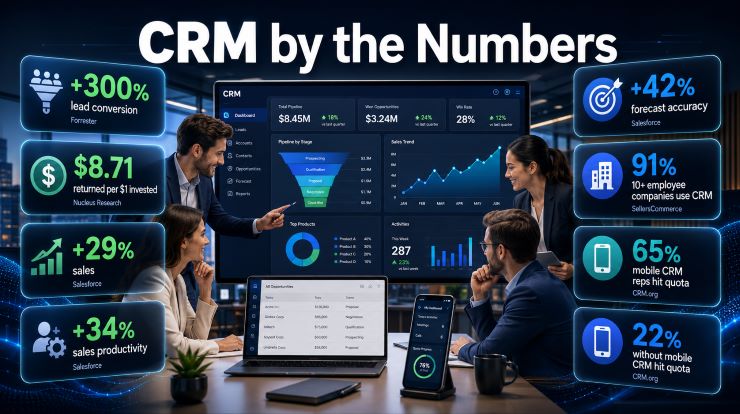
The impact shows up directly in the numbers. Research cited by Forrester found that businesses using CRM-driven lead management can see conversion rates climb by as much as 300%, largely because reps stop losing warm leads to slow or inconsistent follow-up.
Why Do Small Businesses Need an All-in-One CRM for Sales?
Running sales, marketing, and customer service through separate tools creates blind spots — and blind spots cost deals. An all-in-one CRM for small business pulls everything into a single platform, so a lead generated by a marketing campaign lands directly in a rep’s pipeline instead of getting lost in a handoff.
This consolidation also protects institutional knowledge. When a rep is out sick or leaves the company, the next person can pick up every open deal without starting from scratch, because the entire conversation history already lives inside the CRM rather than in someone’s personal inbox.
Connects marketing campaigns directly to sales follow-up, closing the loop on lead source
Gives every team member the same up-to-date customer record
Reduces the number of logins, spreadsheets, and tools reps have to juggle
Cuts the administrative overhead of maintaining separate systems
The return on that consolidation is measurable. Nucleus Research found that companies earn an average of $8.71 back for every dollar invested in CRM software, while Salesforce reports that CRM adoption can lift sales by 29%, sales productivity by 34%, and forecast accuracy by 42%.
That’s a big reason CRM has become close to standard practice for growing companies. SellersCommerce reports that 91% of companies with 10 or more employees now run their sales process on a CRM system.
How Does Customer Lifecycle Management CRM Turn Leads Into Repeat Customers?
Closing the first deal is only half the job — the real revenue often comes from what happens after. Customer lifecycle management CRM tools track a customer from first contact through onboarding, renewal, and upsell, so no relationship goes quiet once the contract is signed.
For small businesses, repeat revenue is often cheaper to win than a brand-new deal, since the trust and account history already exist. A CRM that keeps the entire lifecycle visible makes it far easier to spot the right moment for a renewal conversation or an upsell, instead of relying on a rep to remember.
Automates onboarding sequences so new customers get a consistent experience
Flags renewal dates and upsell opportunities before they’re missed
Surfaces at-risk accounts based on declining engagement or support activity
Keeps a full history of the relationship, so any team member can pick up the conversation
Mobile access matters here too. CRM.org reports that 65% of sales reps with mobile CRM access hit their annual sales quota, compared with only 22% of reps who don’t have mobile access to their CRM.
What Should You Look for in CRM Software for Small Business?
Not every platform is built with small teams in mind. The right CRM software for small business should feel lightweight enough to adopt quickly, without sacrificing the automation that actually moves deals forward.
Simple setup that doesn’t require a dedicated IT resource
Built-in lead scoring and pipeline automation
Mobile access for reps working outside the office
Reporting that shows pipeline health at a glance, not buried in spreadsheets
Transparent pricing that scales with the size of the team
The key takeaway
Closing more deals rarely comes down to working harder — it comes down to working with better information. A sales CRM for small business gives every rep a clear view of the pipeline, automates the follow-ups that used to fall through the cracks, and keeps customer relationships alive well past the first sale. Whether it’s lead scoring, mobile access, or lifecycle tracking, the right CRM turns scattered sales activity into a repeatable process. For small businesses ready to stop losing deals to disorganization, the investment consistently pays for itself.
Frequently Asked Questions
What is a sales CRM for small business?
A sales CRM for small business is software that centralizes contacts, deals, and communication history in one platform. It replaces spreadsheets and scattered notes with automated tracking, so reps always know a lead’s status and can follow up at the right moment, which shortens sales cycles and helps close more deals.
How does lead management CRM improve conversion rates?
Lead management CRM scores incoming leads based on engagement and buying signals, then routes the strongest ones to reps automatically. This prevents warm leads from going cold while sitting in a shared inbox, which is a major reason CRM-driven lead management is linked to significantly higher conversion rates.
Is an all-in-one CRM worth it for a small team?
Yes — an all-in-one CRM for small business connects marketing, sales, and service data that would otherwise live in separate tools. That means fewer handoffs, fewer duplicate records, and a clearer view of every customer, which typically pays for itself through faster deal cycles and stronger retention.
What’s the difference between lead management and customer lifecycle management?
Lead management focuses on converting prospects into paying customers, while customer lifecycle management CRM continues tracking the relationship after the sale, through onboarding, renewals, and upsells. Together, they cover the full journey from first contact to long-term, repeat revenue.
A merchant communication timeline in an MCA CRM is a chronological record showing every touchpoint—calls, emails, texts, document requests—tied to a specific merchant account. ConvergeHub’s Merchant Cash Advance CRM logs these interactions in real time, giving brokers, ISOs, and funders full visibility into deal progress, funding status, and follow-up history without switching platforms.
Why Track Every Merchant Interaction Over Time?
Deals fall apart between first contact and funding, not because underwriters miss red flags but because process gaps swallow opportunities before they close. A missed callback on Friday afternoon becomes a lost merchant by Monday. An offer letter that goes out three days late loses the merchant to a faster competitor. Weekend inquiries pile up unanswered while nobody owns the follow-up.
An MCA CRM solves this by replacing scattered spreadsheets and disconnected tools with one connected system spanning sales, marketing, service, billing, and automation. Every call, document request, and offer stage lives in a single place instead of six different inboxes.
What should a merchant timeline actually include?
A complete timeline maps every touchpoint from the first inquiry through funding and renewal. That means logging inquiry date, document requests, offer terms, funding date, and renewal conversations in one continuous record.
Why does a visible history matter for renewals?
Renewal timing depends on knowing exactly where a merchant stands in the repayment cycle. Brokers and back-office staff working from a unified interaction log see every prior conversation without hunting through email threads.
Consider what gets tracked in a solid merchant record history:
Inquiry source and initial contact date
Document requests and submission status
Offer terms sent and merchant response
Funding date and repayment schedule
Renewal eligibility and follow-up notes
Without this visibility, funded merchants quietly become missed renewals.
What Should a Unified Interaction Log Capture?
A complete unified interaction log captures every call, email, offer, and payment tied to a merchant, not just a running note field. An MCA CRM built for brokers and funders aligns sales, marketing, service, and billing teams around one shared customer record, so no department works from outdated information.
Coverage should extend past conversations. The same log that stores calls and emails should also connect to quotes, invoices, and payment tracking for each merchant file, giving back-office teams a single source for financial status alongside communication history.
What details belong in a merchant’s communication timeline?
A strong timeline includes deal-stage markers such as Submitted. Has Offer, giving brokers and funders a shared reference point without checking a separate pipeline tool. Tagging behaviors and tracking engagement metrics inside the same record helps ops managers spot pain points before they turn into lost deals. cite-1
Does the log help with more than record-keeping?
Yes. A well-structured merchant record history turns raw activity into a diagnostic tool. Recommended fields include:
Call and email timestamps with outcome notes
Offer and submission status by funder
Invoice, payment, and balance updates
Engagement tags flagging stalled or at-risk deals
This structure keeps every team working from identical data, reducing duplicate outreach and missed follow-up.
How Does Merchant Record History Stop Deals From Slipping?
Scattered notes and forgotten follow-ups sink funded deals long before underwriting ever comes into play. A centralized merchant record history closes that gap by keeping every balance, payment, renewal, and exception visible in one place. One-third of small and medium businesses never measure retention or churn at all, which means a broker or funder without organized records is often flying blind on which merchants are actually at risk of default or attrition.
An MCA CRM built for post-funding servicing tracks balances automatically, manages renewal timing, and maintains reporting across the entire portfolio without manual reconciliation. That level of visibility turns reactive firefighting into proactive account management.
What should merchant record history actually include?
Complete history goes beyond a payment ledger. Effective platforms combine:
Funding terms and factor rate details
ACH or card remittance history
Renewal eligibility and timing
Case notes tied to a unified interaction log
Why does centralized history reduce lost deals?
Centralized cases paired with full customer history let staff resolve merchant issues instantly instead of digging through disconnected spreadsheets. Convergehub, trusted by thousands of businesses, gives teams that single source of truth. Faster resolution keeps merchants engaged and reduces the silent churn that unmeasured portfolios miss entirely.
Frequently Asked Questions
What is a merchant communication timeline in an MCA CRM?
It is a chronological record of every touchpoint—calls, emails, texts, document requests—tied to a specific merchant account, logged in real time for full visibility into deal progress and funding status.
What information belongs in a merchant’s communication timeline?
The timeline maps inquiry source, document requests, offer terms, funding date, repayment schedule, and renewal notes, giving brokers and funders one continuous record from first contact through renewal.
Why does a unified interaction log matter for MCA deal management?
It aligns sales, marketing, service, and billing teams around one shared merchant record, connecting calls and emails with quotes, invoices, and payment tracking so no department works from outdated information.
Conclusion
A merchant communication timeline in an MCA CRM is the chronological record that ties every call, email, text, and document request to a specific merchant account, giving brokers, ISOs, and funders one shared view of deal progress and funding status. Its value comes from three connected attributes: a unified interaction log that aligns sales, marketing, service, and billing around the same record; a merchant record history that extends visibility into funding terms, balances, and renewal timing; and deal-stage tracking that keeps every team working from identical data. Together, these attributes close the process gaps—missed callbacks, late offer letters, unmeasured churn—that quietly turn funded merchants into lost renewals. Brokers and funders looking to replace scattered spreadsheets with this kind of connected visibility can see how ConvergeHub’s Merchant Cash Advance CRM brings the timeline, interaction log, and record history together in one platform.
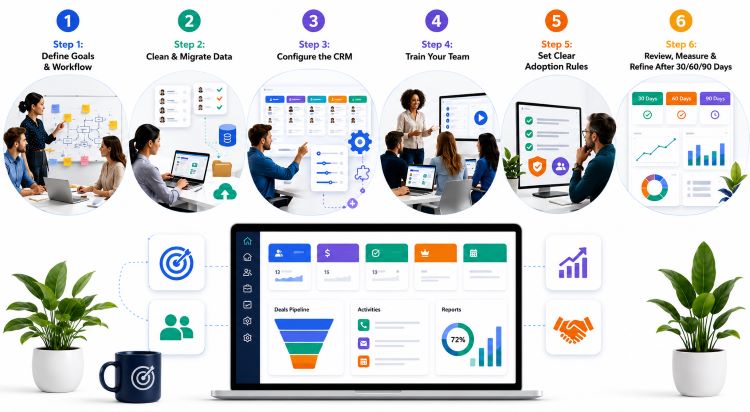
Buying a CRM is the easy part. Knowing how to implement CRM software correctly is what determines whether it becomes the backbone of your sales process or an expensive tool your team quietly stops opening after week two. A poorly planned rollout wastes budget and frustrates staff; a well-planned one pays for itself within months through faster follow-ups and cleaner data. This guide walks through the exact steps of a successful CRM implementation, the mistakes that sink most rollouts, and how to set your team up to use the system daily.
What Does CRM Implementation Actually Involve?
CRM implementation is the full process of getting a CRM system live and adopted inside a business — not just installing software. It includes defining goals, mapping your existing workflow, migrating and cleaning customer data, configuring the platform, training your team, and monitoring adoption after launch. It’s tempting to treat implementation as a technical task handed off to whoever’s “good with software.” In practice, the businesses that get this right treat it as a change management project first and a software configuration task second. The platform matters far less than how deliberately the rollout is planned.
Step 1: Define Your Goals and Workflow Before You Configure Anything
Before opening any settings menu, map your current sales and customer service process on paper. Where do leads actually come from? Where do they stall? Which handoffs between sales and support currently rely on someone remembering to send an email?
Get specific about what “success” looks like — faster follow-ups, fewer dropped leads, a single source of truth for customer history. These goals should drive every configuration decision that follows, rather than configuring the CRM around its default settings and hoping your process bends to fit.
Standardize formats (phone numbers, company names, deal stages)
Archive or delete outdated, inactive records
Migrate in small batches so errors are easy to catch and fix
Most small business CRMs support CSV imports, which makes this step manageable without technical help — but only if the source data is clean first.
Step 3: Configure the CRM Around Your Workflow
With goals set and data cleaned, configure the CRM to mirror the process you mapped in Step 1 — not the other way around. Set up pipeline stages that match your actual sales process, not a generic template. Build automations around real bottlenecks, like sending a follow-up reminder when a lead goes quiet for three days.
Resist the urge to turn on every available feature immediately. Start with the core workflow — contact records, pipeline stages, and basic automation — and layer in advanced features once the team is comfortable with the fundamentals. Trying to launch reporting dashboards, AI scoring, and multi-channel automation all in week one usually means none of it gets used properly; a phased rollout, adding one new capability once the last one has stuck, tends to produce far stronger long-term adoption than a single “big bang” launch.
Step 4: Train Your Team (The Step Most Rollouts Skip)
Role-specific. A sales rep needs to know how to log calls and move deals; a support rep needs to know how to track tickets. Don’t run one generic session for everyone.
Short and repeated. A single two-hour walkthrough is forgotten by week two. Short, focused sessions tied to real tasks stick better.
Tied to daily habits, not features. Teach the two or three things people need to do every day before introducing anything advanced.
Step 5: Set Clear Adoption Rules
A CRM only works if everyone actually uses it consistently. Set explicit rules from day one: every call gets logged, every deal stage gets updated before end of day, no side spreadsheets. Ambiguity here is where old habits creep back in.
Naming a “champion” on each team — someone who’s genuinely comfortable in the system and can answer quick questions — helps enforce this without turning every hiccup into an IT ticket.
Step 6: Review, Measure, and Refine After 30/60/90 Days
Implementation doesn’t end at launch. Set checkpoints at 30, 60, and 90 days to review data completeness, how consistently the team is logging activity, and whether pipeline visibility has actually improved. The first 30–90 days typically show initial adoption, but sustainable, embedded use tends to take a few months to fully take hold — which is exactly why early check-ins matter, before old habits have a chance to resurface. Use these checkpoints to ask direct questions: Is the team logging activity without being reminded? Are deal stages accurate enough that a manager could forecast from them? If the answer is no at 60 days, that’s a signal to revisit training or simplify the workflow — not to add more features.
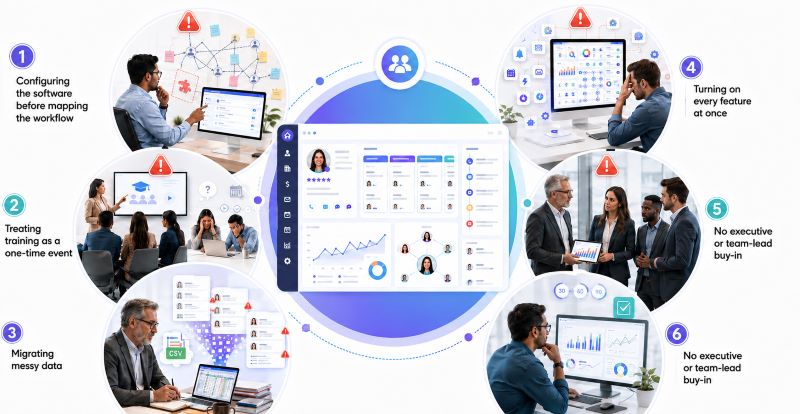
Common CRM Implementation Mistakes to Avoid
Configuring the software before mapping the workflow. This forces your process to bend around default settings instead of the other way around.
Treating training as a one-time event. Adoption fades without reinforcement in the weeks after launch.
Migrating messy data. Duplicate and inconsistent records undermine trust in the system immediately.
Turning on every feature at once. Overwhelm is a fast track to abandonment.
No executive or team-lead buy-in. When leadership doesn’t visibly use the system, teams deprioritize it too. Adoption tends to follow whoever’s watching — if managers pull reports from the CRM and reference it in team meetings, reps follow suit; if leadership quietly keeps working from spreadsheets, so does everyone else.
How ConvergeHub Makes Implementation Easier
ConvergeHub is built to shorten every step above rather than add complexity to it. Guided setup walks new accounts through pipeline configuration without needing a developer, CSV import tools make data migration straightforward, and because sales, marketing, and support live in one platform, teams aren’t stitching together training for three separate tools. For a small business rolling out CRM for the first time, that means a faster path from purchase to a team that’s actually using the system daily — explore it at convergehub.com.
Frequently Asked Questions
How long does CRM implementation take for a small business?
Most small businesses can implement a CRM in 2–4 weeks, covering data migration, configuration, and basic team training. Simpler platforms with guided setup can be live in days, while custom workflows or large data migrations may extend the timeline.
What is the first step in CRM implementation?
The first step is defining your sales and customer service workflow before configuring anything. Map where leads come from, how they move through your pipeline, and where handoffs happen — then set up the CRM to match that process, not the other way around.
Why do CRM implementations fail?
Most CRM implementations fail due to poor user adoption, not the software itself. Common causes include inadequate training, overly complex setup, and configuring the system around features instead of the team’s actual daily workflow.
How do you migrate data into a new CRM?
Clean your existing contact and deal data before migrating — remove duplicates, standardize formats, and archive outdated records. Most CRMs support CSV imports, and migrating in small batches makes it easier to catch errors early.
Do employees need training to use a CRM? Yes. Training is one of the biggest factors in successful CRM adoption. Short, role-specific sessions focused on daily tasks — logging calls, updating deal stages — work better than one long, generic walkthrough.
How do you measure CRM implementation success? Track adoption rate (how consistently the team logs activity), data completeness, and pipeline visibility in the first 30, 60, and 90 days. Rising follow-up consistency and shorter deal cycles are strong early signals implementation is working.
Conclusion
Getting CRM implementation right comes down to sequencing: define your workflow, clean your data, configure around your process, train deliberately, set adoption rules, and keep reviewing after launch. Skip any of these steps and even the best software risks becoming an unused line item. Businesses that follow how to implement CRM software correctly — treating it as a change management project rather than a one-time setup task — see faster adoption, cleaner data, and a system the whole team actually relies on. ConvergeHub is built to make that rollout simpler from day one; explore it at convergehub.com to see how it fits your team.
Managing submissions, tracking funders, and overseeing commission payments are core functions for merchant cash advance (MCA) brokers. ISO Broker CRM, as a leading merchant cash advance CRM, is designed to streamline these workflows, reduce manual work, and improve reporting accuracy. This article summarizes the platform’s core capabilities for tracking submissions, funders, and commissions to boost efficiency and profitability.
We also cover best practices and integrations that support reliable commission management and clearer decision‑making.
How Does ISO Broker CRM Optimize Submission Tracking for Merchant Cash Advance Brokers?
ISO Broker CRM centralises submission records and provides real‑time visibility from a single repository. Brokers can manage multiple submissions, reduce manual errors, and move deals forward faster with automated status alerts and template‑based submission tools for quicker client responses.
What Are the Best Practices for Tracking Submission Status Accurately?
Enhance submission tracking accuracy by adopting clear process stages, keeping records current, and using automation to maintain consistent status updates.
Define Clear Stages: Establish distinct phases to keep everyone aligned.
Regularly Update Information: Keep data current to avoid errors and miscommunication.
Utilize Automation: Use automated workflows to maintain consistency and accuracy.
How Does Integration with Funders Enhance Submission Monitoring?
Integrations enable seamless data exchange with funder systems, minimising manual entry and keeping information synchronized. Real‑time updates and automated workflows reduce repetitive tasks and let brokers focus on client engagement.
What Features Define Effective Funders and Relationship Management in ISO Broker CRM?
Funders management includes partner portals, commission attribution, and compliance support to strengthen relationships and simplify cooperation.
Affiliate Portals for Partner Access: Dedicated portals let funders view submissions and manage interactions.
Attribution Models for Commission Tracking: Transparent models clarify how commissions are calculated.
Compliance Tools for Managing Partners: Built‑in compliance features help ensure partnerships meet regulatory standards.
How Do CRM Tools Facilitate Funding Partner Integration?
CRM capabilities support collaboration and process control between brokers and funders.
Document Management and E-Signatures: Secure document workflows speed up deal closure.
Automated Deal Tracking: Tracks every step of a funding request for clarity and accountability.
Billing and Financial Management Tools: Provide accurate financial views for revenue and profit monitoring.
Which Metrics Help Monitor Funder Approvals and Deal Status?
Key metrics to monitor funder performance and deal progress include:
Deal Registration Counts: Measures deal activity over time.
Approval Numbers Tracking: Shows funder responsiveness and approval trends.
Close Date Estimations: Helps forecast revenue and plan next steps.
Regularly reviewing these metrics enables brokers to refine strategy and improve conversion rates.
How Can ISO Broker CRM Solutions Streamline Residual Commission Tracking and Payouts?
ISO Broker CRM simplifies residual commission management with transparent tracking, automated payout notifications, and detailed reporting to reduce reconciliation errors and support cash‑flow planning.
Tracking Commissions with Visibility: Central views of commission structures simplify reconciliations.
Automated Notifications for Payouts: Timely alerts help ensure payments are processed promptly.
Detailed Reporting for Accuracy: Reports verify distributions and identify discrepancies quickly.
What Technologies Improve Commission Calculation and Accuracy?
Integrations and automation improve calculation accuracy and timeliness.
Integration with Financial Tools: Connect CRM systems to financial calculators for accurate values.
Real-Time Data Access: Current figures support reliable financial decisions.
Automated Calculations: Remove human error and standardise payout rules.
These technologies reduce manual adjustment and increase confidence in commission figures.
Which Automated Processes Support Timely Commission Payments?
Automation ensures commissions are processed on schedule and keeps agents informed.
Automated Commission Triggers: Conditions that initiate payout workflows.
Task Management Automation: Reduces repetitive work so teams can focus on revenue-driving tasks.
Real-Time Updates for Agents: Keeps agents aware of status changes and payout timing.
Automated processes help maintain strong relationships with agents and funders while ensuring timely payments.
Why Is Deal Pipeline Management Crucial for ISO Broker CRM Success?
Deal pipeline management delivers better visibility, clearer revenue tracking, and stronger client communication—essential for prioritising opportunities and forecasting.
Better Deal Visibility: Helps brokers manage workload and priorities.
Enhanced Revenue Tracking: Improves forecasting accuracy across stages.
Improved Client Relationships: Keeps clients informed and builds trust.
Effective pipeline management equips brokers to capitalise on opportunities and manage operations efficiently.
How Does Pipeline Visualization Enhance Deal Forecasting and Decision-Making?
Visual pipeline tools clarify deal status and conversion patterns, supporting tactical adjustments and strategic decisions.
Graphical Representation of Deals: Visuals make deal dynamics easier to interpret.
Identification of Conversion Rates: Spot trends to optimise submissions and follow-ups.
Supporting Strategic Decisions: Quickly identify where to intervene to improve outcomes.
Visualization increases transparency across the organisation and aids planning.
What Are the Best Practices for Managing ISO Broker Deals in CRM Systems?
Follow practical steps to maximise CRM value: maintain visibility, prioritise quality leads, and provide coaching to users.
Visibility and Tracking: Ensure deals are visible to relevant stakeholders.
Focus on Quality Leads: Concentrate efforts on high-potential opportunities.
Coaching and Training Opportunities: Train staff to leverage CRM features effectively.
These practices improve deal outcomes and ROI.
Reviewing product demo options gives insight into specific features and workflows.
Prospective users can assess pricing structures to match feature sets with investment levels.
For direct engagement about requirements or partnerships, contact the team via the official contact channels.
More on CRM solutions for merchant cash advance is available on the industry page.
Frequently Asked Questions
What are the benefits of using ISO Broker CRM for merchant cash advance management?
ISO Broker CRM centralises submission, funder, and commission data while automating key processes to reduce errors, improve reporting, and support strategic decisions—leading to stronger client relationships and better profitability.
How does ISO Broker CRM support compliance in funder partnerships?
The CRM includes tools for managing documentation, monitoring standards, and simplifying audits, increasing transparency and helping ensure regulatory adherence.
Can ISO Broker CRM be customized to fit specific business needs?
Yes. The system is configurable for templates, commission models, and reporting metrics so firms can align the CRM with their operational processes.
What kind of training is available for new ISO Broker CRM users?
Training typically includes webinars, video tutorials, documentation, and personalised support to help teams adopt the system and apply best practices.
How does ISO Broker CRM assist in the analysis of deal performance?
The platform offers reporting and analytics to track KPIs like deal registrations, approval rates, and close‑date estimates, which reveal trends and areas for improvement.
What technology integrations does ISO Broker CRM offer?
ISO Broker CRM integrates with financial management systems, document platforms, and e‑signature services to enable seamless data exchange and reduce manual entry.
Is there customer support available for troubleshooting issues with ISO Broker CRM?
Support includes live chat, email, phone, and a knowledge base with articles and FAQs to help users resolve issues quickly and maintain productivity.
Conclusion
ISO Broker CRM centralises data and automates processes to improve submission, funder, and commission management. These capabilities support profitability and strategic decision‑making while strengthening client relationships. Evaluate available solutions to find the best fit for your brokerage’s operational goals.
Selecting the right CRM is strategic for small businesses seeking funding. This article compares Small Business Lending CRMs and Merchant Cash Advance (MCA) CRMs, their key features, benefits, and roles. Learn how each supports loan origination and fund management and how they can improve efficiency and client engagement. For practical options, review offerings such as ConvergeHub.
What Defines Small Business Lending CRM and MCA CRM?
Small Business Lending CRMs and MCA CRMs address different funding workflows for small and medium-sized enterprises. A Small Business Lending CRM manages the end-to-end loan application process, from inquiry through approval. An MCA CRM is built to administer merchant cash advances, which involve purchasing a future portion of a business’s credit card sales at a discount. Both improve client relationship management and data handling, but each targets specific operational needs and client profiles.
This comparison demonstrates how each CRM type aligns features to particular funding needs, making them essential tools for lenders and funders in their respective markets.
How Do Small Business Lending CRMs Support Loan Origination?
Small Business Lending CRMs speed loan origination with automated workflows, client tracking and centralised data. Automation cuts repetitive tasks like document collection and status updates, shortening timelines. Sales-force integration ensures consistent follow-up and better conversion, increasing capacity to serve more clients.
What Specialized Functions Does MCA CRM Offer for Merchant Cash Advances?
MCA CRMs include functions tailored to merchant cash advance workflows. They provide expedited approval processes to deliver funding in days, flexible repayment structures that follow sales patterns, and communication tools that clarify repayment terms. These capabilities support faster access to capital while helping maintain positive customer relationships. For specialised solutions, see ConvergeHub for Merchant Cash Advance.
Which Features Differentiate Business Funding Software for Lending Versus MCA?
Feature differences help organisations choose the right CRM. Both types share core client-management functions but differ in user experience and funding-specific tools. Match platform capabilities to your operational priorities and client expectations.
What Loan Management Capabilities Are Essential in Commercial Loan CRMs?
Key loan management capabilities include secure storage of client data, robust pipeline management to track application stages, and compliance reporting to meet regulatory requirements. These functions reduce operational errors and maintain transparency throughout the lending lifecycle, supporting trust with clients and regulators.
How Does MCA CRM Automate Merchant Cash Advance Processing?
Automation is central to MCA CRM design. Automated application processing accelerates funding decisions, while approval workflow rules allow concurrent handling of multiple requests. Repayment management automation adjusts collections based on sales performance, improving cash-flow alignment and reliability for both funders and merchants.
How Can CRMs Enhance Efficiency and Customer Engagement in Business Funding?
CRMs centralise client information and streamline interdepartmental access, improving operational coordination. By automating routine interactions, teams can focus on high-value engagement that strengthens client relationships. The result is improved client satisfaction, higher retention, and more consistent service delivery.
In What Ways Does Automated Workflow Improve Lending Decision Processes?
Automated workflows accelerate application processing and reduce manual data entry, lowering error rates and enhancing compliance. These efficiencies shorten decision timelines and enable institutions to maintain consistent service standards while increasing throughput.
How Do CRMs Foster Stronger Client Pipelines for Lending and MCA Providers?
CRMs strengthen pipelines by standardising follow-up and nurturing from initial contact through closing. Structured workflows ensure consistent engagement, which improves conversion rates and creates a more dependable client experience that supports long-term relationships.
What Are Best Practices for Choosing Between MCA CRM and Small Business Lending Software?
Evaluate your financial requirements and operational processes when selecting a CRM. Determine whether immediate funding needs favour an MCA-focused solution or whether a comprehensive lending platform better serves sustained client engagement and structured financing. Review pricing tiers and feature sets—such as those available on the ConvergeHub pricing page—and consider requesting a demo via ConvergeHub to validate fit.
Which Business Types Benefit Most From Each CRM Solution?
Businesses with frequent cash-flow variability, such as retailers, often benefit from MCA CRMs due to rapid access to capital and flexible repayment. Firms that require structured loan servicing and longer-term financing, such as professional services, typically align better with Small Business Lending CRMs.
Can One CRM Platform Manage Both MCA and Traditional Business Loans Effectively?
While a unified platform is possible, combining MCA and traditional loan workflows can create complexity and dilute specialised features. Organisations should assess a platform’s capabilities against their specific operational requirements before committing to a single solution.
For further inquiries or to discuss specific needs, contact ConvergeHub via ConvergeHub.
Frequently Asked Questions
What criteria should I consider when selecting a CRM for my small business?
Define your core needs—loan processing speed, customer tracking, scalability—then choose a CRM accordingly. Check usability, integrations with existing systems, vendor support, pricing models, and customer reviews to assess long-term value.
How does data security factor into selecting a CRM solution?
Data security is essential for financial services. Verify encryption for data at rest and in transit, and confirm compliance with relevant regulations such as GDPR or CCPA. Evaluate the vendor’s backup and disaster-recovery capabilities and review their security track record to ensure protection against breaches.
How can I measure the success of my CRM implementation?
Measure CRM success against defined KPIs: user adoption rates, lead conversion improvements, customer satisfaction scores, and reductions in loan processing times. Monitor these metrics regularly and adjust processes to optimise ROI and alignment with business objectives.
Are there any risks associated with using a CRM for financial services?
Risks include data breaches if security is insufficient, reduced personal interaction from excessive automation, and poor ROI if the system does not match business needs. Mitigate these risks through staff training, robust security measures, and continuous evaluation of the CRM’s relevance to operations.
What are common misconceptions about CRMs in lending and finance?
Common misconceptions are that CRMs are one-size-fits-all, too large only for enterprise use, or an immediate cure-all. In reality, CRMs vary by purpose and require ongoing training, configuration, and evaluation to deliver intended benefits across organisations of all sizes.
Can I integrate my existing tools with a new CRM?
Most modern CRMs support integrations with accounting, ERP, and marketing platforms. Confirm compatibility with your current systems to ensure seamless data flow and minimise disruption. Proper integration preserves workflows and delivers a unified client view across tools.
Conclusion
Choosing between Small Business Lending CRMs and MCA CRMs shapes workflows and client outcomes. Each fits specific funding scenarios; the right system improves processing efficiency and client engagement. Review your requirements and ConvergeHub’s options to find the best fit.
Running a small business means juggling leads, follow-ups, invoices, and customer questions — often with a small team and a full inbox. A CRM for a small business is a tool built to bring all of that under one roof. Instead of chasing scattered spreadsheets and sticky notes, a CRM organizes every contact, conversation, and deal in a single system your whole team can see. This guide breaks down what a small business CRM actually does, the signs you need one, the features that matter most, and why ConvergeHub was built specifically for businesses like yours.
What is a CRM for Small Business?
A CRM for small businesses is software designed to manage customer relationships, sales pipelines, and day-to-day communication without the complexity or cost of enterprise systems. At its core, it’s a central database that stores every customer interaction — emails, calls, quotes, support tickets — so nothing falls through the cracks.
Unlike CRM systems built for large sales organizations with dozens of departments, a small business CRM prioritizes simplicity, fast setup, and affordability. It’s meant to be used by a five-person team on day one, not configured by an IT department over several months.
How Does a CRM for Small Business Work?
A small business CRM works by pulling customer data into one place and organizing it around your sales and service process. When a lead fills out a form, calls your office, or emails a question, that interaction is logged automatically. From there, the CRM:
Tracks where each contact sits in your sales pipeline (new lead, quote sent, closed deal)
Sends reminders for follow-ups so no lead goes cold
Automates repetitive tasks like welcome emails or appointment confirmations
Gives every team member visibility into the same customer history
The result is a single source of truth. Instead of asking “who talked to this customer last?” in a Slack message, anyone on the team can open the record and see the full history in seconds.
Benefits of Using a Small Business CRM
The case for CRM adoption isn’t theoretical — it shows up directly in revenue and retention numbers. Businesses that implement CRM software have reportedclose to a 30% increase in sales following adoption, driven largely by better pipeline visibility and fewer missed follow-ups. On the retention side,organizations using CRM have seen customer retention rates climb by close to half, since reps have full context on every account instead of relying on memory or scattered notes.
These gains compound over time. A small business that closes even a few extra deals per quarter through better follow-up discipline, or retains a handful of accounts that would otherwise have churned, quickly sees a CRM pay for its own subscription cost many times over.
Beyond the numbers, small businesses gain:
Fewer missed opportunities. Every lead is tracked, so nothing slips through a full inbox.
Faster onboarding. New hires can see full customer history instead of asking around the office.
Better forecasting. A clear pipeline view makes it easier to predict next month’s revenue.
Stronger customer relationships. Reps walk into every conversation already knowing the context.
6 Signs Your Small Business Needs a CRM
Not sure if it’s time? These are the clearest signals:
You’re tracking leads in spreadsheets or your inbox. If “the system” is a shared Google Sheet, you’ve likely already outgrown it.
Leads go cold because follow-ups get missed. Without automated reminders, busy weeks mean dropped opportunities.
Your team can’t answer “what’s the status of this customer?” without digging through email threads.
You’re growing fast and losing visibility. More customers means more moving parts than any one person can track manually.
Reporting takes hours instead of minutes. If pulling a sales report means manually compiling data from three tools, that’s a CRM problem.
You’ve lost a deal because no one followed up in time. This is usually the moment businesses stop debating and start shopping for a CRM.
Features to Look for in a Small Business CRM
Not every CRM feature matters equally for a small team. Focus on:
Sales pipeline management. Visual deal stages that show exactly where every lead sits.
Marketing automation. Built-in email sequences, follow-up reminders, and lead nurturing.
Mobile access. Your team isn’t always at a desk, and the CRM shouldn’t require one.
Reporting and dashboards. Real-time visibility into pipeline health and rep performance.
Integrations. Connections to the email, calendar, and invoicing tools you already use.
Affordable, transparent pricing. Small business budgets don’t have room for hidden per-feature upcharges.
How to Choose the Best CRM for Your Small Business
Choosing the right CRM comes down to matching the tool to your actual workflow, not the flashiest feature list. Start by mapping your current sales and customer service process on paper — where do leads come from, and where do they get stuck? Then look for a CRM that supports that exact flow out of the box.
Transparent pricing. No long-term contracts or hidden per-feature upcharges.
Real customer support. Not just a help center or chatbot — access to people who can actually help.
A free trial. Test it against your actual workflow before committing.
Scalability. The CRM should grow with you — more contacts, more automation, more team members — without forcing a painful migration a year from now.
Strong onboarding support. A short demo call, self-serve setup guides, and responsive support all reduce the risk that your investment goes unused.
Why ConvergeHub CRM is the Perfect Fit for Small Businesses
ConvergeHub was built around a simple idea: small businesses need enterprise-level capability without enterprise-level complexity or cost.
It brings sales, marketing, support, and billing into one unified platform, so your team isn’t juggling five disconnected tools to manage a single customer relationship.
For a small business evaluating a CRM system for small business use, ConvergeHub offers a visual sales pipeline, built-in marketing automation, case and support ticket management, and reporting dashboards — all configurable without a developer.
Because it combines CRM, marketing, and customer service in a single subscription, teams get the functionality of several point solutions without paying for (or learning) several separate systems.
It’s designed to be live and useful within days, not months, which matters most for lean teams that can’t afford a long, disruptive rollout.
The Key takeaway
Choosing the right CRM for small business operations isn’t about picking the tool with the most features — it’s about finding a system your team will actually use every day to manage leads, automate follow-ups, and keep every customer relationship organized in one place. Whether you’re replacing spreadsheets or upgrading from an outgrown system, the right CRM pays for itself through better retention, faster follow-ups, and clearer visibility into your pipeline. ConvergeHub was purpose-built for growing small businesses that need real CRM capability without enterprise complexity — explore it atconvergehub.com to see how it fits your team.
Frequently Asked Questions
What is the best CRM for a small business?
The best CRM for a small business is one that’s easy to adopt, combines sales, marketing, and support in one platform, and scales without added complexity. ConvergeHub is built specifically for this — offering enterprise features at small business pricing with fast setup.
Is CRM worth it for small businesses?
Yes. CRM software helps small businesses organize leads, automate follow-ups, and prevent missed opportunities. Businesses that adopt CRM commonly see measurable gains in sales and customer retention, making it one of the higher-return tools a growing business can invest in.
How much does CRM software cost?
Small business CRM pricing typically ranges from free/freemium plans to $75+ per user per month for advanced tools. Many platforms, including ConvergeHub, offer affordable entry-level plans built specifically for smaller teams and budgets.
Can a small business use CRM software?
Absolutely. Modern CRMs are designed with small teams in mind — simple setup, intuitive dashboards, and pricing that scales with your team size, so you’re not paying for enterprise-level infrastructure you don’t need.
What features should a small business CRM include?
Look for pipeline management, marketing automation, mobile access, reporting, and easy integrations. Ease of use matters most — a CRM your team avoids opening delivers no return, regardless of its feature list.
Is CRM better than using spreadsheets?
Yes. Spreadsheets can’t automate follow-ups, track full customer history, or give your whole team live visibility. A CRM replaces manual tracking with automated workflows, reducing missed opportunities as your customer base grows.
Managing Merchant Cash Advance (MCA) deals involves complex workflows that benefit from an efficient, centralised system. This article explains how specialised software improves handling of MCA deals, renewals, and commissions. You will learn core CRM features tailored for MCA brokers and practical strategies to automate renewals and improve commission tracking. Common challenges—multiple systems and unreliable data—create inefficiencies; consolidating these functions into a single CRM reduces those risks. The sections below cover essential MCA software features, the value of a unified CRM, and criteria for choosing the right solution. For a comprehensive MCA-focused platform, consider ConvergeHub.
What Are the Core Features of Merchant Cash Advance Software for MCA Brokers?
Merchant Cash Advance software includes core features designed to streamline broker operations. Key capabilities include Sales Force Automation for lead and sales tracking, and Data Warehousing to centralise and retrieve critical information efficiently.
Sales Force Automation: This feature allows brokers to automate tasks, improving efficiency in client interactions and streamlining the sales process.
Data Warehousing: Centralises data from various sources so brokers have access to comprehensive information to make informed decisions.
360-Degree Customer View: Offers a complete perspective of customer interactions, allowing brokers to tailor their approach to specific client needs.
These capabilities improve productivity and accuracy when handling MCA transactions.
CRM Platforms for Sales Performance and Automation
Enterprise digital transformation has increased CRM platforms’ strategic role in optimising sales performance. Salesforce Sales Cloud is a widely adopted cloud platform offering intelligent sales automation, predictive analytics, customer engagement management, and workflow orchestration. Despite broad adoption, operational challenges—system latency, inefficient data synchronization, high API consumption, poor query optimisation, and suboptimal sales process automation—can undermine efficiency and sales productivity.Performance Optimization In Sales Force Cloud, 2025
Why Is a Unified CRM Essential for Managing MCA Deals, Renewals, and Commissions?
A unified CRM centralises deal information, reduces manual errors, and streamlines tracking through integrated reporting. This consolidated approach improves lifecycle visibility and operational control. A dedicated Merchant Cash Advance CRM can provide sector-specific tools to support these capabilities.
Tracking Capabilities: A centralised system enhances tracking, ensuring all deals are monitored throughout their lifecycle without fragmentation across platforms.
Integration with Other Systems: Unified CRMs often integrate with payment processing systems, allowing real-time updates on transactions and commission calculations.
User Experience Improvements: A single interface for managing multiple aspects of MCA deals improves usability, helping brokers navigate and manage workloads more efficiently.
Implementing a unified CRM improves commission and renewal management while increasing efficiency and transparency.
How Does Centralized Deal Lifecycle Management Reduce Manual Errors?
Centralized lifecycle management reduces manual-entry errors by automating data entry and updates for MCA deals and renewals, preserving data integrity. Consistent reporting formats also limit discrepancies in commission calculations.
What Reporting Dashboards Provide Insights into Commissions and Renewals?
CRMs provide dashboards that aggregate cross-channel data into actionable insights—trend, commission, and renewal metrics—so brokers can refine strategies and improve profitability. Review pricing options when evaluating comprehensive solutions.
How to Select the Best CRM for MCA Brokers to Maximize Deal and Commission Management?
Select a CRM by assessing required functionality, user interface, and integration capabilities. Ensure the solution supports commission management, aligns with operational needs, and evaluate scalability and customer support for long-term success.
Which Integration Capabilities with Payment Systems Are Crucial?
Payment-system integrations enable automated payment-status updates and simplify commission calculations within the CRM, improving accuracy and operational efficiency.
What Are the Pricing and Demo Options to Evaluate CRM Solutions?
Evaluate pricing models for budget fit and feature coverage. Requesting a demo provides hands-on access to test functionality before purchase and confirms the solution meets operational requirements.
Frequently Asked Questions
1. What challenges do MCA brokers face without a unified CRM system?
Without a unified CRM, brokers face data fragmentation, manual errors, and inefficient workflows. Managing multiple platforms leads to discrepancies and lost records, which hinders deal tracking, client assessment, and commission management, and reduces productivity and service quality.
2. How can automation improve the efficiency of commission tracking for MCA brokers?
Automation streamlines data entry and calculations, improving commission-tracking accuracy. Automated CRM workflows cut time spent on manual updates, enable real-time commission monitoring, and allow prompt resolution of discrepancies.
3. What features should MCA brokers look for in reporting dashboards?
Look for dashboards with customizable visualizations, trend analysis, and deal- and commission-specific metrics. Drill-down capabilities, real-time updates, and intuitive interfaces speed data interpretation and support informed decision-making.
4. What role does customer engagement play in managing MCA deals?
Customer engagement enables brokers to understand client needs. A CRM should record interactions and feedback so brokers can tailor offerings; this improves satisfaction and increases renewals and repeat business.
5. How do MCA brokers benefit from a 360-degree customer view?
A 360-degree view provides a complete client history, preferences, and interactions, supporting personalised service and stronger relationships. It helps identify cross-sell opportunities and detect issues early, improving retention and satisfaction.
6. What support should brokers expect from CRM providers?
Expect onboarding, training, and ongoing technical support. Providers should supply tutorials and FAQs to help brokers maximise platform use. Responsive customer service is essential for resolving issues quickly and minimising operational disruption.
7. How can brokers ensure successful integration of a new CRM into their existing processes?
For successful CRM integration, conduct a needs assessment to match features to processes. Engage stakeholders during implementation and assign a dedicated transition team to ensure a smooth rollout and full adoption.
Conclusion
An integrated CRM enhances operational efficiency by reducing manual errors and improving tracking. Consolidating data and automating workflows lets brokers prioritise client engagement and strategy over administrative tasks. Explore tailored CRM solutions to transform MCA management and start optimising deal processes by reviewing recommended platforms.
This site uses cookies to store information on your computer. Some are essential to make our site work; others help us improve the user experience. By using the site, you consent to the placement of these cookies.Privacy Policyx