Best CRM for Alternative Lending: A 2026 Guide for Brokers and Funders

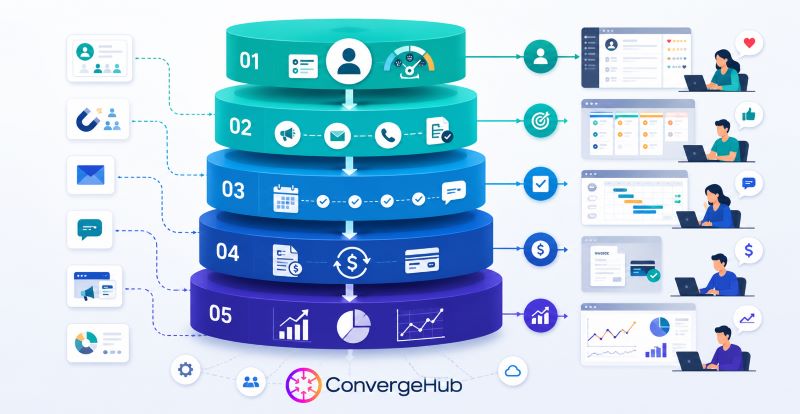
This guide evaluates the best MCA CRM options for alternative lending in 2026, focusing on brokers and funders. It summarises essential features that streamline workflows, improve client interactions, and support compliance. Sections cover functionality, client-relationship tools, loan origination integration, compliance monitoring, and industry trends.

What Are the Essential Features of Merchant Cash Advance CRM Software?

Merchant cash advance CRM software provides targeted capabilities to optimize the lending cycle for brokers and funders, consolidating client interactions and lending history to improve decisions and efficiency. The essential features include:

  • 360-Degree Customer View: An all-encompassing view of customer data, including personal details and past interactions.
  • Sales Force Automation: Automates sales tasks so brokers can focus on relationships rather than repetitive work.
  • Data Warehousing: Stores large datasets so lenders can analyse trends and derive actionable insights from their customer base.

Which Tools Support Brokers and Funders in Client Relationship Management?

Brokers and funders can deploy tools that increase productivity and centralise client communication, reducing manual work and improving response times. Notable tools include:

  • Cross-Selling Capabilities: Features that identify opportunities to sell additional services to existing clients and increase revenue.
  • Auto Alerts and Reminders: Ensure timely follow-ups and maintain client engagement to prevent leads from slipping away.
  • Integrated Communication Tools: Email, chat, and social media integration keeps all client interactions tracked and documented.

How Does Loan Origination Software Enhance Broker Efficiency in Alternative Lending?

Loan origination software automates intake, underwriting, and approval to shorten cycle times and reduce manual errors. Built-in analytics track performance so brokers can refine processes and improve conversion rates, while scalability supports client growth without sacrificing service quality.

How Does Compliance Monitoring Impact Alternative Lending Operations?

Compliance monitoring establishes structured processes that ensure regulatory adherence and mitigate operational risk. Effective systems keep traceable records and surface issues early to protect firms from penalties and reputational harm. Key aspects include:

  • Establishing Auditable Processes: A clear audit trail helps companies track and review compliance activities.
  • Real-Time Compliance Monitoring: Immediate identification and rectification of issues keeps lending operations within legal bounds and reduces penalty risk.

Why Choose ConvergeHub’s CRM as the Optimal Alternative Lending Software in 2026?

ConvergeHub delivers a CRM designed for the operational and compliance needs of alternative lenders. The platform consolidates capabilities that boost productivity, customer engagement, and financial workflows. Notable attributes of ConvergeHub’s CRM include:

  • Sales Force Automation: Automates repetitive sales tasks to increase productivity.
  • Marketing Automation: Enables targeted campaigns that are easy to track.
  • Integration with QuickBooks: Synchronises accounting and customer data for consistent financial workflows.
Feature Description Benefit
Sales Force Automation Automates the sales process Increases efficiency and reduces workload
Marketing Automation Automates marketing campaigns Enhances lead generation and conversion rates
QuickBooks Integration Synchronizes financial data Simplifies financial management

The table summarises core ConvergeHub features and their direct benefits for brokers and funders in alternative lending.

How Do Pricing Plans and Demo Options Facilitate CRM Adoption?

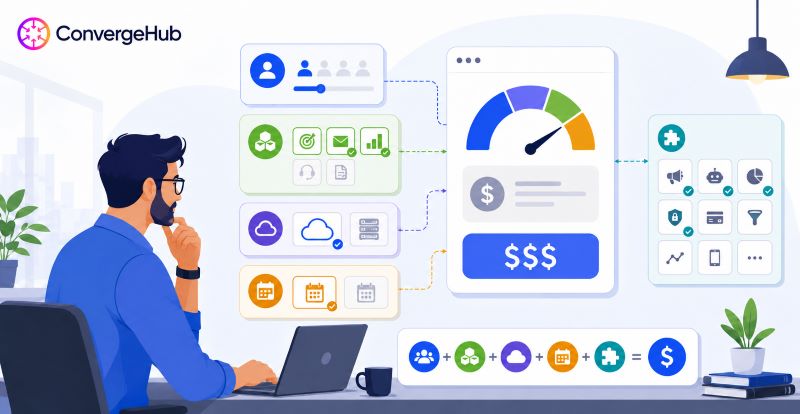
Transparent pricing and accessible demos reduce adoption friction, especially for small and mid-sized firms. Clear cost structures enable better budgeting, while live demonstrations let decision makers validate functionality before purchase. Key insights include:

  • Affordability for SMBs: Competitive pricing helps smaller operations access quality CRM solutions.
  • Availability of Demo Sessions: Live demos clarify functionality and minimise the implementation learning curve.

For those interested in exploring pricing plans, ConvergeHub provides transparent options for different business needs.

What Are the Emerging Trends and Industry Demands Driving CRM Adoption in Alternative Lending?

Alternative lending is shifting toward automation, cloud deployment, and analytics-driven decision making. Automation reduces manual workload; cloud solutions enable remote access and scalability; and data-driven insights let lenders tailor offers and measure performance. These trends shape the features required from modern CRM systems.

Why Is Real-Time Customer Data Integration Critical for Lending CRM?

Real-time data integration ensures brokers work from current information, improving decision quality and client responsiveness. Immediate access to consolidated customer records supports a unified view and accelerates issue resolution, enhancing operational efficiency and customer satisfaction. The benefits include:

  • Unified Customer View: A centralized database that compiles all customer data in one accessible location helps brokers understand clients better.
  • Operational Efficiency: Up-to-date information allows brokers to respond quickly to client inquiries, improving satisfaction.

Requesting a demo is the recommended way to evaluate these capabilities in practice. Assess loan origination integration and compliance monitoring during a demonstration to judge fit for your operations.

Frequently Asked Questions

1. What criteria should brokers consider when selecting a CRM for alternative lending?

When selecting a CRM, brokers should evaluate scalability, integration with existing tools, user interface and ease of use, and availability of customisable features. Prioritise systems that deliver real-time analytics, robust compliance monitoring, and dependable customer support. Ensure the CRM aligns with your business model and supports loan workflows.

2. How can CRM software improve customer retention in alternative lending?

CRM software improves retention by enabling personalised communication and tailored offers. Data analytics reveal client needs and preferences so brokers can address issues proactively. Automated follow-ups and scheduled check-ins maintain engagement and build loyalty.

3. How does CRM support compliance requirements in alternative lending?

CRM systems support compliance with audit trails, automated data capture, and real-time alerts that document regulatory activity. These features simplify audits and reduce non-compliance risk by ensuring lending actions are recorded accurately and can be reviewed.

4. What is the role of cloud technology in lending CRMs?

Cloud technology delivers flexibility, scalability, and remote access for lending CRMs. It enables automatic updates and backups, reduces on-premises infrastructure needs, and ensures firms receive current features and security patches without interruption.

5. Are there specific integrations that enhance CRM functionality in alternative lending?

Yes. Integrations with financial systems such as QuickBooks streamline accounting, while communication platforms centralise client interactions. Marketing automation and analytics tools boost lead generation and insight, consolidating essential functions in one platform.

6. How can brokers measure the effectiveness of their CRM system?

Measure CRM effectiveness using KPIs such as retention rates, satisfaction scores, lead conversion rates, response times, and loan processing speed. Monitor user engagement and collect staff feedback to identify gaps and drive continuous improvement.

Conclusion

Implementing a robust CRM improves operational efficiency and client engagement for brokers and funders in alternative lending. Choosing a system that combines sales automation and compliance monitoring streamlines processes, supports regulatory adherence, and raises customer satisfaction. Contact ConvergeHub to evaluate available solutions to determine which CRM aligns with your business objectives and operational requirements.
Recruitment CRM Software: How Staffing Agencies Manage Candidates & Clients Without the Chaos

If you run a staffing agency, you already know that recruitment CRM software is no longer optional — it is the operational backbone that separates agencies that scale from those that stall. The average cost per hire has climbed to $5,475 (SHRM, 2025), and every open role costs businesses $98 per day in lost productivity (eInvoice Blog, 2026). With numbers like that, your clients cannot afford slow pipelines, missed follow-ups, or candidate data scattered across spreadsheets. Neither can you.

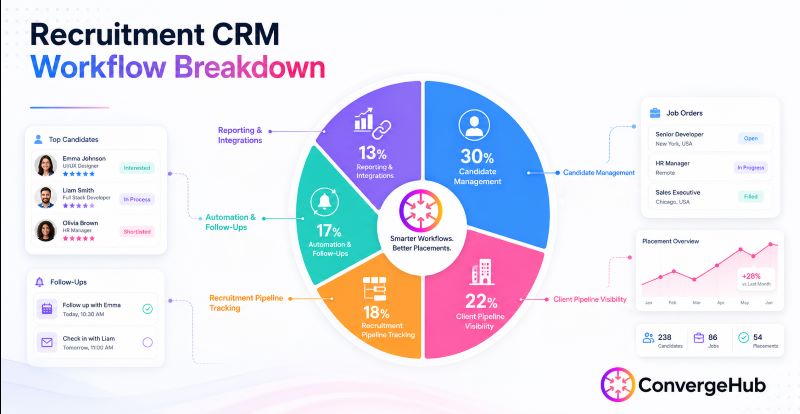
Recruitment CRM workflow breakdown infographic showing candidate management, client pipeline visibility, recruitment pipeline tracking, automation and follow-ups, and reporting integrations with percentage segments around a ConvergeHub workflow chart.

The Real Problem: Two Pipelines, Zero Visibility

Running a staffing agency means managing two completely separate relationships at the same time — candidates on one side, client companies on the other. Most agencies try to juggle both inside a combination of email threads, spreadsheets, sticky notes, and disconnected ATS tools. The result is predictable: candidates fall through the cracks, client follow-ups get missed, and your team spends more time managing information than placing people.

Here is what the data actually says about where agencies lose time and money:

  • 38% of recruiter time is spent on scheduling interviews alone — not sourcing, not placing (GoodTime, 2025)
  • More than 60% of candidates drop off if they wait over two weeks without a response (Staffing Hub, 2026)
  • Over half of staffing firms fill roles from their existing database less than 30% of the time — meaning most agencies are not even leveraging the candidates they already have (Bullhorn)
  • The U.S. staffing industry represents nearly $200 billion in annual revenue — yet many agencies still operate without a unified system to manage their most valuable assets: relationships (eInvoice Blog, 2026)

This is not a people problem. It is a systems problem. And staffing CRM solutions exist precisely to solve it.

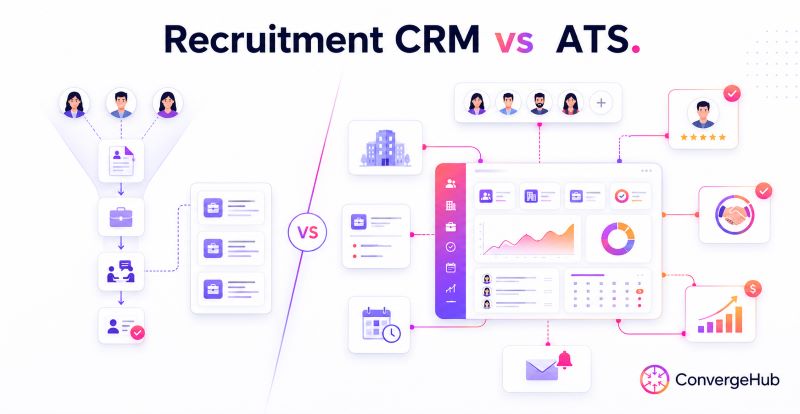
CRM vs ATS comparison infographic showing how recruitment teams use CRM to manage client relationships, follow-ups, and sales pipelines, while ATS focuses on applicant tracking, resumes, hiring stages, and candidate workflows.

What Recruitment CRM Software Actually Does for Staffing Agencies

Unlike a generic CRM built for product sales, recruitment CRM software is purpose-built to handle the dual-pipeline reality of staffing. Think of it as your agency’s central nervous system — connecting candidate management, client relationship tracking, and placement workflows in one place.

Here is what a purpose-built recruitment CRM delivers:

1. A Unified Candidate Management Platform

Every candidate your agency has ever worked with — their resume, skills, availability, interview history, and placement record — lives in one searchable database. When a new role opens, you are not posting on job boards and waiting. You are searching your own talent pool and reaching out within hours. Agencies that actively work their existing candidate database reduce time-to-fill dramatically, yet most are not doing it because the data is too fragmented to be useful. A candidate management platform fixes that.

2. Client Relationship Management — Separate from Candidate Tracking

Your client relationships require just as much nurturing as candidate relationships — maybe more. CRM gives you a dedicated pipeline for client companies: open job orders, hiring manager contacts, contract renewal dates, billing history, and communication logs. Your team always knows where each client account stands, who last spoke to them, and what is due next. No more dropped balls during handoffs.

3. Recruitment Pipeline Management

A good recruitment pipeline management system gives you a visual, stage-by-stage view of every open role — from job order received to candidate submitted, interviewed, offered, and placed. You can see at a glance where bottlenecks are forming, which roles are aging, and which recruiters need support. Pipeline visibility is what lets you manage 20 open requisitions without losing track of a single one.

4. Hiring Automation Tools

Scheduling, follow-up emails, interview reminders, status updates to candidates — these tasks eat recruiter time without adding placement value. Hiring automation tools built into your CRM handle the administrative layer automatically, so your recruiters can focus on the conversations that actually move placements forward. With AI tools now proven to reduce cost-per-hire by up to 30% and accelerate candidate screening by 75% (eInvoice Blog, 2026), automation is not a nice-to-have — it is a competitive necessity.

5. Applicant Tracking System (ATS) Integration

The best recruitment CRMs either include a built-in applicant tracking system (ATS) or integrate cleanly with one. This means candidate applications, screening notes, assessment results, and communication history are tied directly to the CRM record — not sitting in a separate tool your team has to toggle between. The goal is a single source of truth for every candidate from first contact to placement.

Talent Acquisition Software vs. Recruitment CRM: What’s the Difference?

This is a question we hear often from small staffing agencies evaluating technology for the first time. Here is the honest answer:

  • Talent acquisition software (like standalone ATS platforms) is built primarily to track applicants through a hiring funnel — it is focused on the candidate side, and it is usually designed for in-house HR teams, not agencies.
  • Recruitment CRM software is built for agencies — it manages both the candidate side AND the client side, connects them through placement workflows, and adds relationship management, business development, and revenue tracking on top.
  •  

For a staffing agency, a CRM is not a replacement for an ATS — it is the upgrade that makes your ATS actually useful. The two work together, with the CRM serving as the relationship engine that surrounds and supports the transactional tracking your ATS handles.

Signs Your Staffing Agency Has Outgrown Spreadsheets

If you are still running your agency without a dedicated recruitment CRM, you will recognize at least a few of these:

  • Recruiters are asking each other Did anyone follow up with this candidate?’ — because nobody knows
  • Client job orders are tracked in one spreadsheet, candidate pipelines in another, and nothing is connected
  • Your best candidates are being placed by competitors because your follow-up was two days too slow
  • You cannot answer basic questions like: what is our average time-to-fill this month, or which client accounts have gone cold?
  • Every time a recruiter leaves, institutional knowledge walks out the door with them

These are not signs of a bad team. They are signs of a system that has not kept up with the business. The good news: every one of these problems has a direct solution inside a well-configured recruitment CRM.

 Why Growing Staffing Agencies Choose ConvergeHub

ConvergeHub is an all-in-one CRM for small and mid-sized businesses — and it is purpose-adaptable for staffing agencies that need to manage candidates, clients, and placements without buying five separate tools.

Here is what staffing agencies get with ConvergeHub:

  • Dual-pipeline management — run your candidate pipeline and your client pipeline side by side in one platform
  • 360-degree contact records — every interaction, document, note, and communication history for candidates and clients in one view
  • Workflow automation — automate follow-ups, interview scheduling reminders, and stage-based task assignments so nothing falls through
  • Recruitment pipeline management — visual drag-and-drop pipelines for every open job order, with stage tracking and aging alerts
  • Marketing automation — stay in front of passive candidates and warm client contacts with targeted email sequences, all managed from inside the CRM
  • Reporting and analytics — real-time dashboards on time-to-fill, recruiter productivity, client account health, and revenue forecasting
  • Native integrations — connect with email, calendars, and business tools your team already uses, with no complex setup.

The key takeaway

The staffing industry placed 11 million people into jobs in 2024 (American Staffing Association). The agencies that captured the most of that opportunity were not the ones with the most recruiters — they were the ones with the best systems. Recruitment CRM software is how a small staffing agency competes at the same level as a large one: by having every candidate relationship, every client account, and every open pipeline stage organized, automated, and visible in a single platform. The chaos that comes with spreadsheets and disconnected tools is not inevitable. It is a choice — and it is one you can fix today.

Start your free 14-day trial of ConvergeHub — no credit card required.

Frequently Asked Questions

1. What is recruitment CRM software, and how is it different from a regular CRM?

Recruitment CRM software manages both sides of a staffing agency’s business — candidates and clients — in one platform. Unlike a standard CRM built for product sales, it adds a candidate pipeline, placement tracking, and applicant workflow support alongside client relationship management.

2. Can a small staffing agency afford recruitment CRM software?

Yes — and the ROI case is straightforward. With open roles costing $98 per day in lost productivity, a CRM that speeds up placements pays for itself quickly. Platforms like ConvergeHub are priced for small and mid-sized businesses, not enterprise budgets.

3. How does recruitment CRM software help with candidate management?

It centralizes your entire talent pool in one searchable database — skills, availability, placement history, and communication logs all tied to a single contact record. When a new role opens, recruiters search the existing database first rather than starting from scratch on job boards.

4. What is the difference between a recruitment CRM and an applicant tracking system (ATS)?

An ATS tracks candidates through a specific job requisition — it is transactional. A recruitment CRM manages the long-term relationship with both candidates and clients, supports business development, and gives your agency the strategic visibility an ATS alone cannot provide. The two work best together.

5. How quickly can a staffing agency get up and running with ConvergeHub?

Most small agencies are up and running within days — not months. ConvergeHub’s drag-and-drop interface requires no technical expertise, and the 14-day free trial gives your team time to test it against your actual workflow before committing. Book a free demo here to see it in action.

Merchant Cash Advance CRM Pricing: What Brokers Should Expect to Pay

Understanding the pricing landscape for Merchant Cash Advance (MCA) CRM software is essential for brokers seeking streamlined operations and stronger client engagement. Demand for MCA-focused CRM solutions is rising as alternatives to traditional lending grow. This article examines common pricing structures to help brokers estimate investment needs and align feature sets with strategic objectives. For advanced or tailored functionality, consider exploring Merchant Cash Advance CRM options.

What Are the Typical Pricing Plans for Merchant Cash Advance CRM Software?

Pricing plans typically use subscription models, one-time fees, or tiered pricing based on user counts or feature sets. Brokers should match plan structure to operational scale and financial forecasts, balancing needed functionality with budget and expected ROI.

How Do Free, Basic, and Pro Packages Compare in Features and Cost?

Free, basic, and professional packages vary in scope. Free plans suit very small or start-up brokers; basic plans add core tools like lead management and reporting; professional packages include advanced reporting, automation, and integrations that can justify higher upfront costs by optimising workflows and boosting revenue potential.

What Pricing Models Suit Small Business Brokers in the Alternative Lending Industry?

Subscription models provide predictable monthly expenses that support cash-flow management, while one-time fees avoid recurring charges but may limit updates and support. Brokers should assess growth projections and service needs when selecting a model, and review pricing tiers carefully.

Which Key Features Should Brokers Expect in MCA CRM Solutions at Different Price Points?

Brokers should expect tiered feature sets that reflect price. Essential functionalities generally include:

  • Lead Management: The ability to capture and track leads effectively is foundational for any CRM. Basic systems may offer simple tracking, while higher-tier options provide advanced analytics to optimize lead conversion.
  • User Experience: A smooth, user-friendly interface helps streamline workflows, and this is often enhanced in premium packages.
  • Scalability: As businesses grow, their CRM systems should accommodate increased data loads and user counts without significant downtime or increased costs.

Mapping required features to expected ease of use and growth capacity helps brokers select the appropriate investment level as their business evolves.

What Lead and Pipeline Management Tools Are Included in Various Pricing Plans?

Lead and pipeline management are central to CRM effectiveness. Key tools to evaluate include:

  • Lead Capture Mechanisms: Essential for acquiring new clients through various online channels.
  • Pipeline Tracking Tools: These tools help brokers monitor the status of leads through their journey, providing vital insights into potential bottlenecks.
  • Customer Engagement Features: Effective communication tools that allow brokers to stay connected with clients and manage follow-ups can significantly impact lead conversion.

Ensuring the right combination of capture, tracking, and engagement tools at any price point is critical for managing relationships and driving sales.

How Does Broker Workflow Automation Enhance Value for Each Pricing Tier?

Workflow automation reduces manual tasks such as data entry and follow-ups, allowing brokers to focus on client-facing activities. In higher-tier packages, automation often integrates with external systems to improve efficiency and data accuracy. Automating routine processes lowers error rates and enables brokers to manage larger lead volumes, increasing potential revenue.

How Does ConvergeHub’s Merchant Cash Advance CRM Pricing Compare to Competitors?

ConvergeHub offers competitive, transparent subscription pricing for its Merchant Cash Advance CRM designed for brokers. Its feature set includes tailored lead management, advanced analytics, and comprehensive support that differentiate it from many industry alternatives. For brokers prioritising operational efficiency, ConvergeHub’s platform can be a strategic choice; review full details at ConvergeHub.

What Should Brokers Know about ROI and Cost-Benefit Analysis for MCA CRM Investments?

Brokers should perform a structured ROI and cost-benefit analysis that accounts for tangible gains—such as improved lead conversion and client retention—and intangible benefits like enhanced customer satisfaction and staff productivity. Track performance metrics before and after implementation to validate returns, and benchmark results against industry standards.

How Does CRM Adoption Impact Broker Efficiency and Revenue Growth?

CRM adoption improves efficiency and revenue by consolidating client records and sales history, which informs targeted marketing and sales strategies. Access to performance data enables refinement of sales approaches and more responsive client service. Studies indicate businesses adopting CRM systems commonly see a 40% increase in sales productivity as teams respond to client needs more quickly and accurately.

Which Integration and Automation Capabilities Maximize Return on CRM Spending?

Integration and automation are essential to maximising CRM ROI. Effective CRMs integrate with existing tools such as email marketing and accounting systems to unify operations. Automation of repetitive tasks frees resources for strategic work. Regular evaluation of integration and automation capabilities ensures brokers extract full value from their CRM investment. If you require a demonstration, a demo can illustrate these capabilities.

Frequently Asked Questions

1. What factors influence the cost of Merchant Cash Advance CRM software?

Cost is influenced by features included, the level of customer support, and the number of users. The chosen pricing model—subscription, one-time payment, or tiered pricing—also affects total investment. Brokers should factor in scalability, as higher initial costs can deliver greater long-term value through enhanced functionality.

2. How can brokers evaluate the effectiveness of their CRM system?

Effectiveness can be measured using KPIs such as lead conversion rates, client retention, and sales growth. Regular assessments against predefined metrics, combined with user feedback on usability and feature performance, support informed adjustments and optimisation.

3. Are there specific CRM features beneficial for scaling businesses?

Yes. Advanced analytics and reporting, customisable dashboards, automation of repetitive tasks, and robust lead management are particularly valuable for scaling businesses. These features help manage higher volumes without sacrificing service quality.

4. What is the role of customer support in CRM systems?

Customer support is critical for successful CRM adoption and ongoing use. Effective support assists with setup, training, maintenance, and issue resolution, reducing downtime and ensuring teams can leverage the system’s full capabilities.

5. How often should brokers reassess their chosen CRM solution?

Brokers should reassess their CRM at least annually or when significant operational changes occur, such as staff increases or shifts in the client base. Regular reviews identify gaps in functionality and ensure the CRM continues to meet evolving business needs.

6. Can a CRM system improve team collaboration?

Yes. A well-implemented CRM centralises customer information and provides shared calendars, task assignments, and communication tools, which facilitate collaboration and improve service quality across the team.

Conclusion

Choosing the right Merchant Cash Advance CRM can improve operational efficiency, increase lead conversion, and enhance client satisfaction. By understanding pricing models and prioritising the features that support strategic goals, brokers can select a solution that delivers measurable value. Contact ConvergeHub to review available options to determine which configuration best supports your business objectives.

Is There a Free CRM for Small Businesses That’s Actually Worth Using?

If you’ve been searching for the best free CRM for small business, you’ve likely hit the same wall: stripped-down features, tight contact limits, or a “free” plan that quietly forces an upgrade the moment your business starts growing. The question isn’t just whether a free CRM exists — it’s whether any free CRM for small businesses actually delivers enough to move the needle. This blog breaks down what to look for, where free tools fall short, and why the smarter move is a CRM free trial for small businesses that gives you full-featured access from day one.

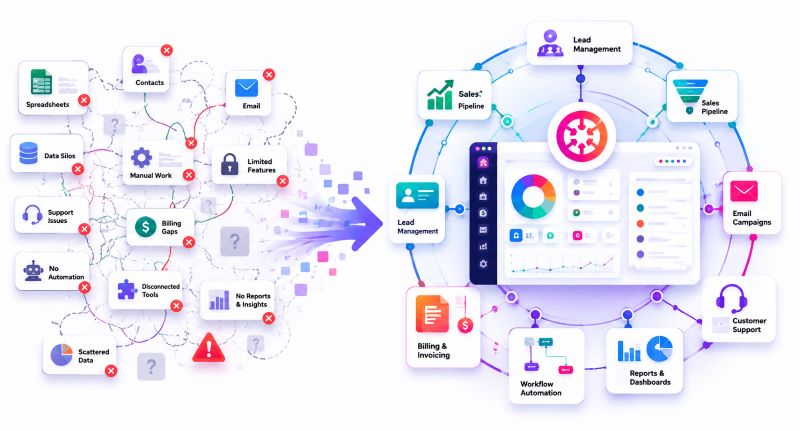
Fragmented free CRM tools with scattered data, limited features, and disconnected workflows transforming into an organized all-in-one CRM platform for small business growth.

What Does “Free CRM” Actually Mean?

Not all free CRMs are built the same. Most fall into one of three buckets:

  • Freemium plans — basic access with hard caps on contacts, users, or features
  • Open-source CRM — free to download, but requires technical setup and ongoing maintenance
  • Free trials — full platform access for a limited period, typically 14 days

Each has trade-offs. Freemium tools sound appealing until you realize you can’t automate emails, run reports, or manage more than 250 contacts without paying. Open-source tools require a developer. Free trials, on the other hand, let you test a complete system with zero commitment — and that’s where serious small business owners spend their time.

Why Small Businesses Can’t Afford to Get This Wrong

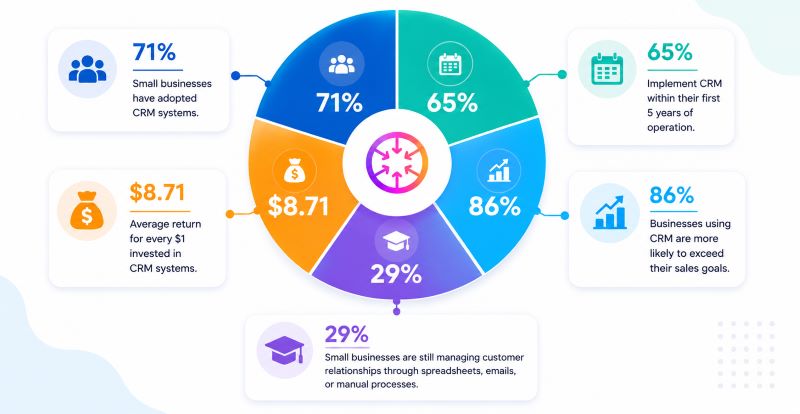
The numbers tell a clear story. 71% of small businesses have now adopted CRM systems, with 65% implementing within their first five years of operation. That’s not a trend — that’s a baseline expectation. Businesses that use a CRM are 86% more likely to exceed their sales goals than those that don’t. NutshellFreshworks

And the ROI is hard to argue with. Businesses earn an average of $8.71 for every dollar invested in CRM systems. Yet many small business owners are still running customer relationships out of spreadsheets and inboxes — and paying for it in lost deals and missed follow-ups. Gtm8020

The real cost of a bad (or no) CRM isn’t the monthly subscription. It’s the leads that go cold, the clients who churn, and the pipeline visibility you never had.

What Free CRMs Usually Get Wrong

Here’s the honest breakdown of where most free CRM tools fail small businesses:

  • Contact and user limits — most cap you at 250–500 contacts and 1–2 users before charging
  • No marketing automation — email campaigns, drip sequences, and lead nurturing are paywalled
  • No billing or invoicing — you’re still switching between tools to close and collect
  • Limited reporting — you can’t see pipeline health, conversion rates, or team performance
  • Weak customer support — free users often get documentation only, no live help
  • Poor scalability — the moment you grow, you’re forced into an expensive migration

Many SMBs rush to purchase cheap solutions and later outgrow them or face the high cost of switching. Starting with a limited free tool often creates more friction than it solves. Possibly

What to Look for in a CRM Free Trial Instead

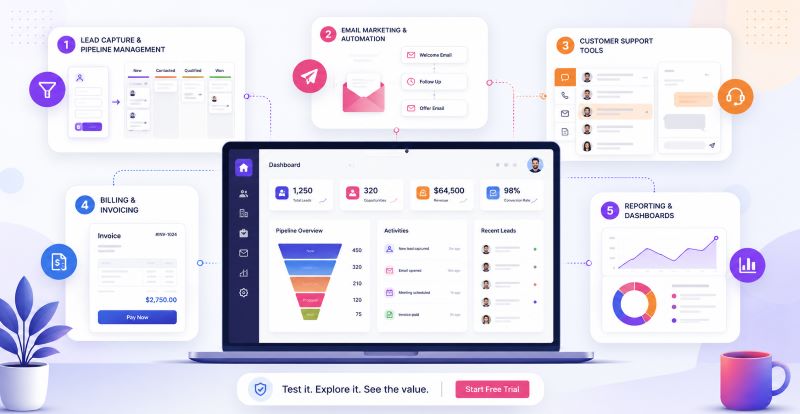
A CRM free trial for a small business that’s worth your time should give you access to the full platform — not a watered-down version. Before you commit to anything, test these five things:

  • Lead capture and pipeline management — can you track deals from first touch to close?
  • Email marketing and automation — can you run campaigns and trigger follow-ups automatically?
  • Customer support tools — does it handle cases, tickets, and service requests in one place?
  • Billing and invoicing — can you quote, invoice, and track payments without leaving the platform?
  • Reporting and dashboards — can you see what’s working across your sales, marketing, and service teams?

If the trial doesn’t let you test all of these, it’s not giving you a real picture of the software.

What Makes an Affordable CRM Actually Worth Paying For

Once your trial ends, the question shifts from “free” to “worth it.” The best affordable CRM for small businesses isn’t the cheapest — it’s the one that replaces the most tools. 56% of annual operational costs of companies increased by using multiple providers. An all-in-one platform that consolidates sales, marketing, support, and billing into one system will almost always be more cost-effective than stitching together four separate subscriptions. Brevo

Key markers of an affordable CRM that delivers real value:

  • Transparent, flat-rate pricing with no hidden per-feature fees
  • Automation included — not locked behind premium tiers
  • Guided onboarding — so your team adopts fast and doesn’t waste the trial period
  • Integrations with tools you already use — email, calendars, payment processors, eSign
  • Scalable user seats — grow with your team without forcing a platform switch
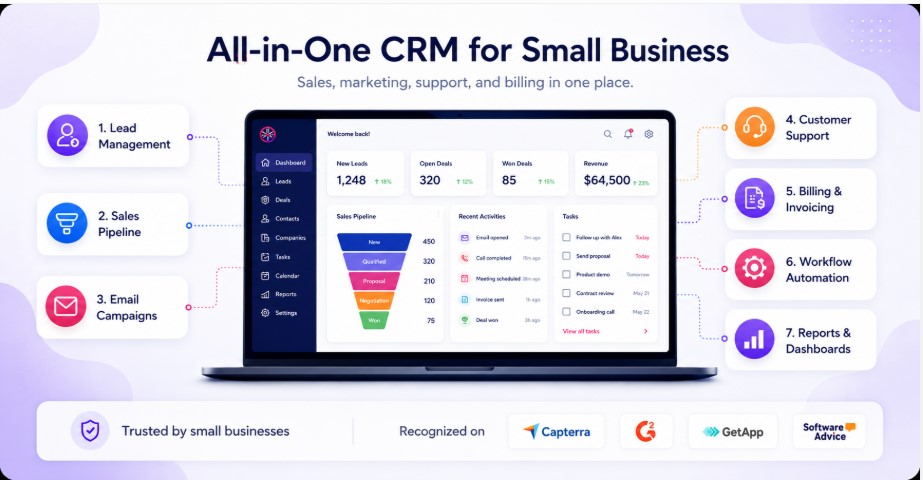
All-in-one CRM dashboard for small businesses showing connected tools for lead management, sales pipeline, email campaigns, customer support, billing, workflow automation, and reports.

Why ConvergeHub Is the Smarter Alternative to a “Free” CRM

ConvergeHub is purpose-built CRM software for small businesses — and it doesn’t make you choose between affordability and capability. It’s an all-in-one platform that unifies sales, marketing, service, and billing under one roof, purpose-built for growing SMBs that need clarity and speed without enterprise-level complexity.

Here’s what you get on the ConvergeHub free trial — no credit card required:

  • Lead management — capture, qualify, score, and nurture leads from every channel
  • Sales pipeline — manage deals with clear stages, collaboration tools, and real-time insights
  • Email campaigns — launch targeted campaigns that move relationships forward
  • Customer support — handle cases, SLAs, and a searchable knowledge base from one dashboard
  • Billing and invoicing — create quotes, send invoices, and track payments without switching apps
  • Workflow automation — trigger follow-ups, reminders, and assignments automatically
  • Reports and dashboards — see performance across every team function in real time

ConvergeHub is recognized across Capterra, G2, GetApp, and Software Advice — and trusted by thousands of small businesses that need enterprise-grade power at an SMB-friendly price point.

The key takeaway

The best free CRM for small businesses isn’t a stripped-down freemium tool; it’s a full-access trial that lets you test what actually matters. ConvergeHub gives you 14 days of complete access to sales, marketing, support, and billing in one platform, with zero credit card required. Growing SMBs don’t need another workaround. They need an affordable CRM for a small business built to scale with them. Start your free CRM trial today.

Frequently Asked Questions

Is there a truly free CRM for small businesses?
 Most “free” CRMs are freemium tools with hard limits on contacts, users, and features. They work for very early-stage businesses but typically lack the automation, reporting, and scalability that growing small businesses need. A CRM free trial for small businesses, like ConvergeHub’s 14-day trial, offers full-platform access with no credit card required — making it a more practical way to evaluate whether a CRM is the right fit.

What’s the difference between a free CRM and a free trial?
 A free CRM gives you a permanently limited version of the software. A free trial gives you complete access to the full platform for a set period — usually 14 days — so you can test every feature before committing. For most small businesses, a free trial gives a far more accurate picture of how the software will perform in real use.

What should I look for in an affordable CRM for a small business?
 Look for a platform that consolidates your core operations — sales pipeline, email marketing, customer support, and billing — into one system. The best affordable CRM for small businesses reduces your total software spend by replacing multiple tools, offers automation on standard plans, and includes onboarding support, so your team gets productive fast.

How much does low-cost CRM software typically cost?
 Low-cost CRM software for small businesses typically ranges from $12 to $65 per user per month, depending on features and plan tier. The key is evaluating the total cost of ownership — a slightly higher-priced all-in-one CRM that replaces three or four separate tools is almost always more affordable than the cheapest standalone option.

Can a small business CRM scale as the company grows?
 Yes — the right small business CRM solution is built to scale with you. Look for cloud-based platforms with flexible user seats, configurable workflows, and integrations that connect your CRM to the tools you’ll add as you grow. ConvergeHub is designed specifically for this: start lean, add users, and expand capabilities without ever switching platforms.

How to Manage MCA Deals, Renewals, and Commissions in One CRM

Managing Merchant Cash Advance (MCA) deals, renewals, and commissions adds operational complexity that can reduce efficiency and visibility. A merchant cash advance CRM dedicated to MCA management centralises transactions and sales workflows to improve accuracy, throughput, and renewal capture. This article summarises core features, commission tracking roles, and renewal-management benefits.

Key Features

MCA management software should track deals, facilitate renewals, and automate commissions. ConvergeHub‘s capabilities support these needs. Key features include:

  • Sales Force Automation: Automates client communication and follow-ups.
  • Deal Tracking: Shows real-time deal status and pipeline position.
  • Commission Tracking: Automates calculations and stores commission records.
  • Renewal Management: Sends reminders and manages renewal workflows.
  • Multi-channel Marketing: Supports outreach across multiple platforms.

These capabilities help MCA businesses maintain control over transactions and sales processes.

Benefits

An MCA platform improves client engagement, reduces manual work, and supports data-driven decisions.

  • Enhanced Customer Relationships: Better tracking enables more personalised outreach.
  • Increased Efficiency: Automation saves time on routine tasks.
  • Improved Sales Pipeline: Visibility supports forecasting and resource allocation.
  • Data-Driven Insights: Analytics inform marketing and operations.
  • Scalability: The system adapts as transaction volume grows.

Using these benefits improves operations and supports revenue growth.

Best Practices for Effective MCA Management

Adopt focused practices to reduce risk and keep pipelines productive.

  • Regular Database Maintenance: Keep client records current.
  • Utilize Automation Features: Automate follow-ups and routine updates.
  • Segment Customer Data: Target clients by behavior or needs.
  • Monitor Performance Metrics: Track KPIs and refine processes.
  • Train Staff on CRM Usage: Ensure effective adoption and usage.

Consistent application of these steps establishes reliable MCA operations.

What Are the Key Features of an Effective MCA Deal Tracking CRM?

An effective CRM provides tools for end-to-end deal management, centralised data storage, and reporting. Core elements include opportunity tracking, data warehousing, and analytics.

  • Opportunity Management: Track and prioritise potential deals.
  • Data Warehousing: Store data for access and analysis.
  • Reporting and Analytics: Generate actionable insights.

ConvergeHub brings these features together to align MCA operations with business goals.

How Does MCA Pipeline Management Improve Sales Visibility?

MCA pipeline management organises transaction data and provides a consolidated view of progress, enabling proactive oversight.

  • Aggregate Data: Pulls information from multiple sources.
  • Opportunity Management: Ensures leads are evaluated and acted on.
  • Customer View: Gives a 360° view of client interactions.

Clear visibility allows better prioritisation and higher conversion rates.

What Role Does Commission Tracking Software Play in MCA Operations?

Commission software automates calculations and maintains transparent records for financial control and audits.

  • Tracks Approval Numbers: Records approvals linked to deals.
  • Automation of Calculations: Reduces manual errors across tiers.
  • Detailed Record Keeping: Preserves transaction history for review.

Automation and record-keeping reduce errors and increase accountability.

How Can Renewal Management CRM Automate and Streamline MCA Deal Renewals?

Renewal CRMs automate reminders, monitor renewal status, and report on renewal performance and engagement patterns.

  • Automated Reminders: Alerts ahead of renewal dates.
  • Tracking Deals: Visualise renewal status at a glance.
  • Reporting: Measure renewal rates and engagement.

These features reduce manual oversight and improve retention capture.

Which Renewal Workflow Automation Techniques Reduce Missed Opportunities?

Use alerts, assigned ownership, and scheduled follow-ups to keep renewals on track.

  • Automated Reminders: Notify teams of upcoming renewals.
  • Task Management: Assign and track renewal tasks.
  • Follow-Up Automation: Use predefined schedules to maintain engagement.

Automation improves workflow reliability and renewal outcomes.

What Are Best Practices for Managing MCA Renewals in One Platform?

Centralise renewal records, configure alerts, and apply opportunity management to maintain consistent oversight.

  • Centralized Data Management: Store renewal data in one place.
  • Automated Alerts: Trigger timely actions.
  • Opportunity Management: Monitor and prioritise renewal opportunities.

These practices support cohesive renewal management and better retention metrics.

How Does Integrating MCA Deal Tracking Solutions Enhance Business Efficiency?

Integration reduces manual entry, improves data accuracy, and produces more useful reporting for strategic decisions.

  • Workflow Improvements: Reduce repetitive tasks.
  • Data Accuracy: Minimise errors across systems.
  • Enhanced Reporting: Combine data for clearer trends.

Integration builds a more efficient, scalable foundation for growth.

What Are the Benefits of Unified MCA Deal, Commission, and Renewal Management?

Consolidating workflows aligns teams, removes duplication, and improves financial oversight.

  • Unified Management: One source of truth for teams.
  • Efficiency Improvements: Streamlined workflows increase productivity.
  • Financial Management: Clearer control of commissions and payouts.

A unified system strengthens operations and client service.

How Do Sales Forecasting Tools Complement MCA Pipeline and Commission Tracking?

Forecasting projects expected volumes and guides resource allocation alongside pipeline and commission data.

  • Improved Efficiency: Plan for expected sales capacity.
  • Better Decision Making: Inform resource and staffing choices.

Forecasting combined with pipeline data supports timely strategy adjustments.

What Steps Should Businesses Take to Implement MCA Management Software Successfully?

Follow a structured rollout: assess processes, verify integrations, and train staff thoroughly.

  • Preparation: Map current processes and gaps.
  • Integration Processes: Confirm system interoperability.
  • Training: Deliver role-based training to users.

Clear planning and training reduce deployment risk and speed benefit realisation.

How to Set Up Commission Tracking and Renewal Alerts in Your CRM?

Define objectives, codify commission rules, and configure alerts to match workflows.

  • Define Objectives: Set tracking and renewal goals.
  • Commission Structures: Specify calculation rules for scenarios.
  • Alert Systems: Configure timely notifications.

Proper setup ensures accurate monitoring and fewer missed actions.

Which Key Performance Indicators Track CRM Effectiveness for MCA Deals?

Track conversion rates, unconverted leads, and renewal rates to measure sales efficiency and retention.

  • Sales Conversions: Lead-to-sale conversion percentage.
  • Monthly Unconverted Leads: Volume of leads not closed.
  • Renewal Rate: Share of contracts renewed.

Monitoring these KPIs informs continuous improvement.

Frequently Asked Questions

1. What factors should businesses consider when choosing MCA management software?

Consider scalability, ease of use, integration, mobile access, vendor support, and security controls tailored to MCA data.

2. How can small businesses benefit from MCA management software?

Smaller teams gain automation, clearer commission calculations, and analytics that improve cash-flow decisions and client follow-up.

3. How does data security play a role in MCA management software?

Security is essential: look for encryption, backups, role-based access, and compliance with standards such as GDPR or PCI-DSS.

4. What are common challenges businesses face when implementing MCA management software?

Expect user resistance, training needs, and integration hurdles; mitigate them with communication, tailored training, and post-launch support.

5. How can businesses maximize the return on investment (ROI) from MCA management software?

Adopt relevant features fully, train staff, and use analytics with regular reviews to refine usage and improve ROI.

6. What role does customer support play in MCA management software effectiveness?

Strong vendor support speeds issue resolution, aids adoption, and sustains uptime and productivity.

7. How can businesses ensure compliance with regulatory requirements when using MCA management software?

Choose software with compliance features, conduct audits, consult specialists, and maintain staff training on obligations.

Conclusion

Implementing MCA management software streamlines deals, renewals, and commission tracking through automation and consolidated oversight. These improvements lower operational risk, enhance client interactions, and support revenue goals. Select solutions that match your processes and compliance needs to realise measurable benefits.

Contact ConvergeHub to learn more about how our MCA management software can help your business grow efficiently.

CRM Onboarding Done Right: How to Get Your Small

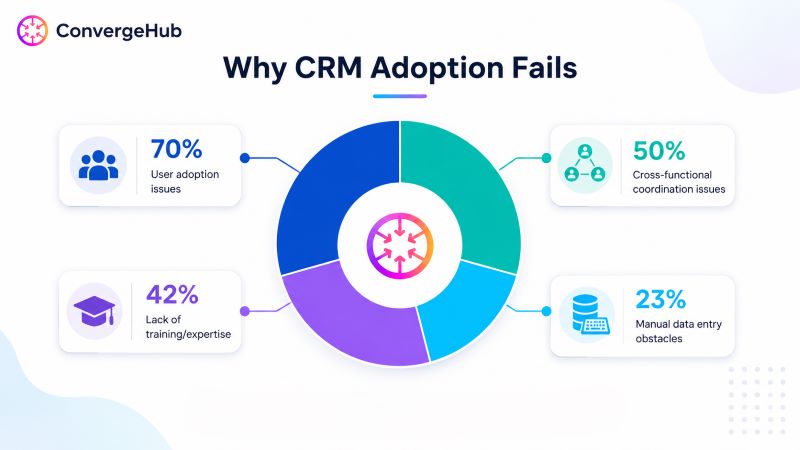
You’ve invested in a CRM. You’ve set it up, imported your contacts, and briefed the team. And then… crickets. Sound familiar? CRM adoption for small business teams is one of the most persistent challenges in modern operations. According to Rethink Revenue, over 70% of CRM projects fail to meet their objectives — not because the technology is flawed, but because people don’t use it. The good news? This is a solvable problem. With the right onboarding strategy, even the most resistant team members can become consistent CRM users.

CRM adoption failure infographic showing a donut chart with user adoption issues at 70%, cross-functional coordination issues at 50%, lack of training/expertise at 42%, and manual data entry obstacles at 23%.

Why CRM Adoption Fails (And It’s Not What You Think)

Before fixing the problem, it’s important to understand it. Most small business owners assume that once a simple CRM software is in place, adoption will follow naturally. It rarely does.

The data tells a clear story:

The pattern is consistent: resistance isn’t about the tool — it’s about the roll out. Teams that receive proper onboarding, clear processes, and ongoing support adopt CRM at significantly higher rates.

Step-by-Step: CRM Onboarding That Actually Sticks

1. Start With Why — Before You Touch the Software

The biggest onboarding mistake is leading with features. Instead, lead with business impact. Show your team what changes for them: fewer follow-up reminders to track manually, no more digging through email threads, clearer pipelines.

Ask each team member: what’s the most frustrating part of managing customer relationships right now? Then demonstrate exactly how the CRM solves that problem.

2. Assign a CRM Champion

Every successful CRM implementation for small business has an internal owner — someone who isn’t just the admin but the internal advocate. This person sets up workflows, answers questions, and keeps usage accountable.

They don’t need to be technical. They need to be trusted by the team and committed to the process.

3. Configure Before You Train

A simple CRM software becomes complicated when it’s not set up for your specific workflow. Before any training session, configure the CRM to reflect:

  • Your actual sales stages — not the default template
  • Fields your team will realistically fill out (fewer is better to start)
  • Automation for tasks they currently do manually (follow-up reminders, lead assignment)
  • Integrations with tools they already use — email, calendar, marketing platforms

Note: Capterra data shows 30% of CRM users find their tools inefficient, and 20% switch systems due to poor usability. Poor configuration is frequently the root cause — not the platform itself.

4. Train in Roles, Not in Groups

A sales rep and a customer service rep don’t use CRM the same way. Avoid one-size-fits-all training sessions. Instead, break training into role-specific workflows:

  • Sales team: lead entry, pipeline management, activity logging, follow-up sequences
  • Customer service: contact history, case notes, communication tracking
  • Management: reporting dashboards, pipeline visibility, team performance

Keep sessions short — 30 to 45 minutes per role. Record them for reference. Follow up with a written quick-start guide for each function.

5. Make Data Entry Painless

Manual data entry is the most cited reason teams stop using CRM. As per reports, 23% of users cite it as a major obstacle. Reduce friction by:

  • Enabling email and calendar sync so activities log automatically
  • Using mobile CRM features for on-the-go entry — 70% of businesses now use mobile CRM to enhance sales strategies.
  • Setting up automations that pre-fill fields from inbound leads or forms
  • Limiting required fields to only what’s truly necessary at each stage

6. Build Accountability Into Daily Operations

CRM onboarding fails when it’s treated as a one-time event. Build CRM usage into existing routines:

  • Reference CRM data in every sales meeting — not spreadsheets or verbal updates
  • Use CRM reports in weekly performance reviews
  • Set clear expectations: pipeline must be updated by end of each business day
  • Recognize and reward consistent usage publicly

When CRM becomes the source of truth for decisions, the team has a clear reason to keep it current.

7. Review, Refine, and Iterate

The first 90 days of CRM onboarding are critical. Schedule monthly check-ins to:

  • Identify which features aren’t being used — and find out why
  • Remove or simplify fields causing friction
  • Add automations as the team becomes more comfortable
  • Gather direct feedback from team members on what’s working

Adoption is not a launch event. It’s an ongoing process of continuous improvement and team alignment.

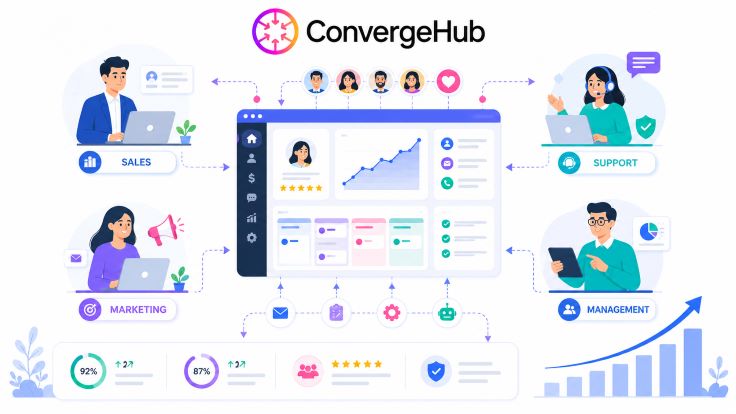
ConvergeHub CRM workflow illustration showing sales, marketing, support, and management teams connected to a central CRM dashboard with customer data, task automation, performance metrics, and growth charts.

How ConvergeHub Makes CRM Onboarding Easier for Small Businesses

One of the biggest blockers to CRM adoption is complexity. When a platform requires weeks of configuration or dedicated IT support, small business teams disengage before they even begin.

ConvergeHub is built specifically as an easy to use CRM for small business — combining sales, marketing, support, and billing in a single platform, so teams aren’t toggling between disconnected tools.

Key features that support faster, smoother CRM onboarding:

  • Intuitive interface: designed for non-technical users, reducing the learning curve from weeks to days
  • Role-based access: team members see only what’s relevant to their function, reducing overwhelm
  • Built-in automation: follow-up sequences, lead assignment, and task reminders run automatically
  • Email and calendar sync: activities log without manual entry, eliminating the #1 adoption friction point
  • Customizable pipelines: configure stages to match your actual sales process, not a generic template

For small businesses serious about CRM adoption, ConvergeHub removes the barriers that typically cause teams to abandon the system within the first few months. Explore ConvergeHub →

Conclusion

CRM onboarding isn’t a checkbox — it’s a change management process. The businesses that get it right don’t just implement software; they shift how their teams think about customer data, follow-ups, and accountability. The ones that get it wrong often blame the tool, when the real gap was in the rollout.

The steps outlined here — starting with why, assigning ownership, configuring before training, and building usage into daily operations — aren’t complicated. If you’re evaluating platforms, the right easy to use CRM for small business makes a significant difference. A system that’s intuitive, well-integrated, and built for your team’s actual workflow removes the friction that kills adoption before it starts. ConvergeHub is purpose-built for exactly that — giving small business teams a simple CRM software that doesn’t require a dedicated IT team to run effectively.

Frequently Asked Questions

What is CRM adoption and why does it matter for small businesses?

CRM adoption refers to how consistently and effectively a team uses a CRM system in their daily work. For small businesses, low adoption means the investment in the software delivers little to no value — customer data stays incomplete, follow-ups get missed, and sales pipelines remain inaccurate. High adoption, on the other hand, directly drives revenue, retention, and team efficiency.

How long does CRM onboarding typically take for a small business team?

For most small businesses, the core onboarding phase takes 30 to 90 days — enough time to configure the system, conduct role-specific training, and establish daily usage habits. Full adoption, where CRM becomes embedded in team operations, typically takes 3 to 6 months depending on team size and complexity.

What’s the best way to get resistant employees to use a CRM?

Focus on personal benefit over business mandate. Show team members how the CRM reduces work they already find frustrating — manual follow-ups, lost contact history, unclear pipeline status. When the CRM solves real day-to-day problems, resistance drops significantly. Pairing this with visible leadership commitment and public recognition for consistent usage also accelerates buy-in.

Is there a simple CRM software that’s easy enough for non-technical teams?

Yes. Platforms like ConvergeHub are designed specifically for small business teams without dedicated IT support. They offer guided setup, intuitive dashboards, and automation that reduces the need for manual input — making them accessible to teams with no prior CRM experience.

How do I know if my CRM onboarding is actually working?

Track a few key signals: Are team members logging activities consistently? Is pipeline data being updated without reminders? Are managers pulling reports from the CRM instead of asking for manual updates? If the answer to these is yes within the first 60 to 90 days, onboarding is on track. If not, revisit training gaps and reduce friction points — often a few workflow tweaks or automations are enough to turn things around.

How to Choose a Merchant Cash Advance CRM: A Buyer’s Guide for Funders & ISOs

Selecting the right Merchant Cash Advance CRM affects efficiency and outcomes for funders and Independent Sales Organizations (ISOs). With many CRM options available, buyers should focus on capabilities that map to MCA workflows. This guide highlights essential features, selection criteria, and common pitfalls to help funders and ISOs improve operations and customer engagement.

Buyer’s Guide for Funders and ISOs on Choosing a Merchant Cash Advance CRM

A well-chosen CRM streamlines sales workflows and client interactions to improve lead generation, follow-up, and conversions. Funders and ISOs should favor systems built for MCA processes; reviewing solutions such as this industry-specific MCA CRM is a useful starting point.

Key Features to Consider

When evaluating MCA CRM options, prioritize these core capabilities:

Feature Benefit
Lead Management Tracks and nurtures prospects through the sales funnel.
Sales Force Automation Reduces administrative overhead so sales teams can sell.
Data Analytics Delivers actionable insights on performance and customer behavior.
Customization Options Lets you adapt workflows and fields to your business needs.

These capabilities together increase efficiency and free resources for strategic growth.

Selection Criteria

Evaluate CRM platforms against practical criteria:

  • User-Friendliness: Intuitive interfaces and quick adoption.
  • Cost-Effectiveness: Compare pricing models and total cost of ownership.
  • Scalability: Support for growth in users and clients without rework.

Prioritizing these factors helps ensure a scalable, cost-effective CRM investment.

Potential Pitfalls to Avoid

Common selection risks include:

  • Over-Customization: Adds complexity and cost beyond what’s needed.
  • Neglecting User Feedback: Leads to low adoption and wasted investment.
  • Underestimating Implementation Effort: Plan for integration, migration, and training.

Addressing these areas improves rollout success and user adoption.

What Key Features Should Funders and ISOs Look for in Merchant Cash Advance CRM?

Focus on advanced lead management, strong analytics, and reliable integrations to maximize CRM value. For pricing comparisons, see the detailed pricing options.

How Does Lead Management Software Enhance ISO Performance?

Lead management automates follow-ups, centralizes interactions, and enables lead scoring so teams prioritize high-value prospects and convert more efficiently.

ConvergeHub offers integrated CRM solutions for small and mid-sized ISOs to support lead tracking and customer management.

What Sales Pipeline Optimization Capabilities Are Essential in MCA CRM?

Essential pipeline features include automated lead tracking, sales forecasting, and performance analytics to spot bottlenecks and improve close rates.

How Do Pricing and ROI Influence the Choice of Alternative Lending CRM Software?

Evaluate price against expected ROI. Choose solutions that improve operational metrics while fitting your budget and profitability targets.

What Are Typical Pricing Models for Merchant Cash Advance CRM Solutions?

Common models include:

  • Subscription-Based: Recurring monthly or annual fees.
  • One-time License: Single payment for perpetual access.
  • Pay-as-You-Go: Usage-based billing that scales with demand.

Match the pricing model to your cash flow and long-term needs.

How to Assess ROI from Using Small Business Lending CRM?

Measure ROI by comparing CRM costs to gains such as higher conversions, better retention, and time saved through automation. Track metrics like conversion rates, retention, and operational cost savings.

What Integration Capabilities Should You Consider When Selecting Funding CRM Solutions?

Ensure the CRM connects with accounting, marketing, and communication tools to avoid manual reconciliation and maintain data continuity.

Which Other Financial and CRM Platforms Commonly Integrate with Merchant Cash Advance CRM?

Common targets include:

  • Accounting: QuickBooks, Xero
  • Email Marketing: MailChimp, Constant Contact
  • Communication: Slack, Zoom

Verified integrations reduce manual work and speed workflows.

How Does Integration Impact Lead Tracking and Sales Pipeline Management?

Integration creates a unified customer view across systems, improving decision-making and helping sales teams prioritize effectively.

Why Are Customer Success Stories and Case Studies Critical in Choosing MCA CRM?

Case studies and success stories set realistic expectations and show how features translate into measurable benefits for similar organizations.

How Do Case Studies Illuminate CRM Benefits in Alternative Lending?

They combine results and user feedback to illustrate gains in efficiency, satisfaction, and sales outcomes specific to alternative lending.

Where Can Funders and ISOs Find Reliable Testimonials on MCA CRM Solutions?

Look for testimonials on vendor sites, review platforms, and via customer referrals. Attend forums or industry events to hear first-hand experiences. For a hands-on view, request a product demonstration.

Also evaluate vendor support, SLAs, and whether the provider offers detailed consultations; you can connect with experts to discuss your requirements.
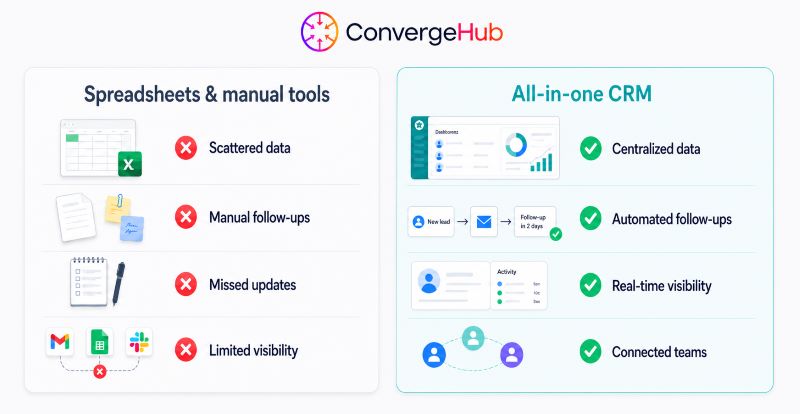
A focused review of features, selection criteria, and risks helps funders and ISOs pick a platform that drives growth and efficiency.

Frequently Asked Questions

1. How can I determine if a Merchant Cash Advance CRM is user-friendly?

Request a demo and test common workflows. Look for intuitive navigation, low learning overhead, and dashboards that match your operations. Supplement demos with user reviews.

2. What should I expect during the implementation process of an MCA CRM?

Implementation commonly includes deployment, integrations, data migration, and training. Plan timelines and vendor support to minimize disruption.

3. How can I measure the success of my chosen MCA CRM?

Set benchmarks—conversion rates, lead-tracking quality, retention—and monitor operational efficiency and user engagement to gauge success.

4. What are the key differences between subscription-based and one-time license CRM pricing?

Subscriptions include updates and support with predictable costs; one-time licenses may avoid recurring fees but often exclude ongoing updates. Choose the model that fits your financial and update needs.

5. How important are customer reviews and case studies when choosing an MCA CRM?

Reviews and case studies reveal real-world performance, common issues, and vendor responsiveness, helping you set realistic expectations.

6. What role do customization options play in selecting an MCA CRM?

Customization aligns the CRM with workflows and improves adoption, but keep configurations focused to avoid unnecessary complexity and cost.

7. What are the typical challenges faced during CRM adoption in the funding industry?

Common challenges include low engagement, inadequate training, and resistance to change. Apply change management and structured training to improve adoption.

Conclusion

Choosing the right Merchant Cash Advance CRM can materially improve efficiency for funders and ISOs. By prioritizing core features, verifying integrations, and avoiding common pitfalls, organizations can boost customer engagement and sales outcomes. Contact ConvergeHub to explore resources to make an informed selection.

Why MCA Brokers Lose Deals Without a Dedicated CRM (and How to Fix It)

Lead management determines outcomes for MCA brokers. Without consistent tracking and a dedicated CRM, brokers miss follow-ups, fail to prioritize leads, and lose deals. This article explains the core problems, the limits of manual methods, and how a targeted Merchant Cash Advance CRM improves closing rates, workflows, and client engagement.

What Lead Management Challenges Cause MCA Brokers to Lose Deals?

Several practical lead-management gaps commonly cost brokers opportunities.

  1. Inaccurate Contact Information: Outdated or incorrect details prevent timely follow-up.
  2. Lead Stagnation: Without staged tracking, prospects stall and conversion chances fall.
  3. Poor Lead Nurturing: Irregular or missing follow-ups weaken relationships and engagement.

These issues point to the need for systems that centralize data and enforce consistent follow-up. For a commercial example, see ConvergeHub CRM.

How Inefficient Lead Tracking Impacts Deal Closure Rates for MCA Brokers

Fragmented tracking reduces close rates by breaking communication, obscuring decision-makers, and missing systematic follow-ups.

  1. Loss of Communication: Missing threads lead to confusion and lost opportunities.
  2. Difficulty Identifying Decision Makers: Poor records extend sales cycles and waste effort.
  3. Inconsistent Follow-Ups: Without reminders, prospects slip out of the pipeline.

A dedicated CRM helps preserve conversations, map contacts, and trigger timely outreach.

Why Manual Processes and Disjointed Systems Reduce Broker Productivity

Manual data entry and siloed tools shift time from selling to administration and introduce errors.

  1. Data Entry Errors: Manual input degrades lead quality and follow-up accuracy.
  2. Inefficient Lead Distribution: Disorganization slows response to high-value leads.
  3. Lack of Workflow Automation: Administrative tasks consume time that could support sales.

Centralized CRM workflows remove repetitive tasks and reduce error rates.

Which CRM Features Drive Higher Deal Closures for MCA Brokers?

A Merchant Cash Advance CRM should include targeted capabilities that directly support conversion.

  1. Sales Force Automation: Automates repetitive tasks so brokers spend more time selling.
  2. Centralized Data Management: One source of truth for contact and deal information.
  3. Lead Scoring: Prioritizes prospects by engagement and conversion likelihood.

These features streamline effort and focus resources on the best opportunities.

How Merchant Cash Advance CRM Enhances Lead Management and Pipeline Automation

MCA CRM applies pipeline automation to keep leads moving and reduce manual oversight.

Opportunity management records stages and triggers follow-ups; data warehousing supplies context for tailored pitches; automated sequences prevent neglect and raise conversion odds.

What Role Does Client Management Software Play in Streamlining Broker Workflows?

Client management software organizes client information and automates routine tasks to improve efficiency.

  1. Client Data Collection: Centralized capture supports personalized outreach.
  2. Automation of Tasks: Reminders and sequences free brokers for selling activities.
  3. Enhanced Sales Pipeline Management: Structured workflows reduce administrative overhead.

To see how these capabilities work in practice, you can request a demo.

How Does ConvergeHub CRM Solve Deal Loss Issues for MCA Brokers?

ConvergeHub offers features aligned to MCA operations that address common loss points.

  1. Comprehensive Lead Management: Tracks contacts and stages so opportunities aren’t missed.
  2. Automated Follow-Ups: Ensures timely, consistent communication.
  3. Reporting and Analytics: Reveals which strategies improve closures.

These tools help brokers mitigate the operational gaps that cause lost deals.

What Metrics Demonstrate Increased Close Rates and Faster Lead Response with ConvergeHub?

Several measurable indicators show CRM impact on broker performance.

  1. Improvement in Deals Closed: Users report higher closure counts after CRM adoption.
  2. Revenue Growth: Brokerages often see revenue improvements year over year.
  3. Lead Conversion Metrics: Better tracking yields higher conversion percentages.

Such metrics help quantify CRM ROI over time.

How Can Brokers Request a Personalized Demo and Access Pricing Plans?

Brokers can request a personalized demo and review pricing to evaluate fit.

  1. Demo Request Process: Submit a demo request on the website and expect a prompt response.
  2. Pricing Plans Availability: Plans vary by size and need; review the Pricing Plans.
  3. Access to Additional Resources: Vendors typically provide support materials to speed adoption.

These steps let brokers assess features, cost, and support for implementation.

Why Is Integrating CRM with Existing Broker Software Critical to Maximize Results?

Integration reduces duplicate entry and ensures consistent customer data across tools.

  1. Improved Customer Experience: Unified records produce smoother client interactions.
  2. Streamlined Operations: Automated data flows cut manual work and errors.
  3. Reduction of Manual Errors: Fewer handoffs mean more accurate records.

Well-integrated systems let brokers deliver reliable service while saving time.

How Does Seamless Integration Avoid Data Silos and Boost Efficiency?

Seamless integration enables real-time sharing and consolidated views of customer data.

  1. Real-Time Data Sharing: Ensures team members use current information.
  2. Enhanced Decision-Making: Combined data supports better strategy and prioritization.
  3. Streamlined Workflows: Synchronization reduces manual coordination.

These advantages let brokers focus on client outcomes rather than reconciling systems.

What Best Practices Should MCA Brokers Follow When Implementing CRM Tools?

Follow a focused implementation plan to realize CRM benefits.

  1. Evaluate Business Needs: Choose features that address your specific challenges.
  2. Comprehensive Training for Employees: Training ensures effective use and faster ROI.
  3. Ensuring User Adoption: Involve staff in selection and rollout to boost buy-in.

These practices improve adoption and deliver better outcomes.

Frequently Asked Questions

How can MCA brokers improve lead accuracy?

Use reputable sources, run validation checks, and clean records regularly; a CRM with validation automates much of this work.

What are the benefits of automating lead nurturing processes?

Automation provides timely, consistent communication, increasing engagement while saving time on routine tasks.

Can CRM systems be tailored to unique brokerage needs?

Yes. Many CRMs offer configurable workflows, custom fields, and reporting so the platform fits your processes.

What is the impact of lead scoring on sales strategies?

Lead scoring helps prioritize prospects, concentrate resources on high-value leads, and streamline pipeline activity.

How is ROI measured when adopting a CRM solution?

Track sales growth, conversion rates, retention, and efficiency gains before and after CRM implementation to quantify ROI.

What training resources are available for CRM users?

Vendors provide webinars, tutorials, documentation, and onboarding; community forums and support services supplement training.

How can brokers ensure long-term CRM success?

Conduct regular reviews, continue staff training, collect user feedback, and integrate the CRM with other tools for consistency.

Conclusion

Dedicated CRM systems are essential for MCA brokers who want consistent lead management and higher close rates. By centralizing data, automating follow-ups, and integrating tools, brokers reduce missed opportunities and improve client outcomes. Contact ConvergeHub to evaluate tailored CRM solutions to start optimizing operations and performance.

How Much Does CRM Software Cost? A Pricing Breakdown for Small Businesses

If you’ve been searching for the right CRM software for small business, chances are the pricing question has already stopped you mid-scroll. Too cheap and you worry about what’s missing. Too expensive and it’s just not viable. The good news? CRM pricing in 2025 has a range broad enough for every budget — and understanding what drives those costs is half the battle. This guide breaks it all down without the jargon, so you can make a smart, confident decision.

Illustration explaining the key factors that drive CRM software pricing, including users, features, customization, integrations, automation, data storage, support, and deployment needs.

What Factors Drive CRM Software Pricing?

CRM pricing is shaped by four main variables: the number of users, the feature tier, whether it’s cloud-based or on-premise, and the billing cycle (monthly vs. annual). Most small business CRMs range from free entry-level plans to mid-tier all-in-one platforms, with pricing scaling as your team and requirements grow.

Before comparing price tags, it helps to know what you’re actually paying for. CRM platforms typically price based on:

  • Per-user seat count: Most CRMs charge per user per month. A 3-person team and a 15-person team will see very different invoices even on the same plan.
  • Feature depth: Basic contact management costs far less than platforms bundling sales automation, email marketing, customer service, and billing in one place.
  • Deployment model: Cloud-based CRMs (the overwhelming majority today — 87% of businesses now prefer cloud CRM) are subscription-based with lower upfront costs. On-premise solutions require infrastructure investment.
  • Billing cycle: Annual billing almost always unlocks meaningful savings over month-to-month pricing.
  • Add-ons and integrations: Marketing automation, service modules, or advanced analytics are sometimes sold separately, adding to base costs.

How Are CRM Plans Typically Structured?

Most CRM vendors offer tiered plans — entry, professional, and enterprise — each with increasing feature access, user limits, and storage capacity. Small businesses typically land in the entry-to-professional range, while growing SMBs benefit most from mid-tier plans that include automation and multi-module capability.

Here’s how the standard tier structure breaks down:

1. Entry-Level / Starter Plans

These cover the basics: contact management, a sales pipeline view, and simple task tracking. They’re a good starting point for solopreneurs or very small teams just moving off spreadsheets. The limitation is scalability — 40% of salespeople still rely on spreadsheets and email to track customer data, and entry plans are one step above that, not much more.

2. Professional / Mid-Tier Plans

This is where most SMBs operate. Professional plans typically include sales automation, email marketing, reporting dashboards, and higher contact and storage limits. The trade-off between features and cost is most favorable here.

3. Enterprise Plans

Built for larger teams with complex workflows — advanced analytics, custom roles, dedicated support, and API access. For most small businesses, this is more than needed and more than budget-friendly.

4. All-in-One Plans

A growing category worth attention. These bundle sales, marketing, customer service, and billing into a single platform — eliminating the need to pay for multiple disconnected tools. For growing businesses managing the full customer lifecycle, all-in-one CRM for small business platforms often deliver stronger value per dollar than assembling a stack of best-of-breed solutions.

Comparison graphic showing the difference between free and paid CRM software, highlighting limits in users, features, automation, integrations, reporting, customization, support, and scalability.

Free CRM vs. Paid CRM: What’s the Real Difference?

Free CRM plans are real — but they come with hard ceilings. Contact limits, storage caps, and restricted automation mean most small businesses outgrow them quickly. Paid plans offer the scalability, automation, and reporting depth that growing businesses actually need to compete.

Free plans can work in very early stages, but the ceiling arrives fast. Most cap out at a few thousand contacts, minimal storage, and no automation. Once you hit those limits, you’re either deleting data or upgrading on short notice — neither of which is ideal when you’re mid-growth.

The bigger picture: businesses using CRM are 86% more likely to exceed their sales goals than those that don’t. Free plans often deliver only a fraction of the capability that drives those numbers.

The investment math also tends to work in paid CRM’s favor. The average ROI on CRM is $8.71 for every $1 spent, and when implemented well, that figure can climb significantly. Most businesses see positive ROI within 12 months of implementation.

Illustration of people climbing steps toward connected CRM tools, showing business growth through customer management, automation, analytics, security, and integrated sales and service workflows.

What Should Small Businesses Actually Pay For?

Small businesses should prioritize paying for CRM features that directly impact revenue: sales pipeline management, contact and lead tracking, email automation, and basic reporting. Paying for advanced enterprise features before you need them inflates cost without delivering proportional value.

Must-haves for most SMBs:

  • Contact and lead management
  • Sales pipeline visibility
  • Email and follow-up automation
  • Basic reporting and dashboards
  • Mobile access

Worth paying for as you scale:

  • Marketing automation and campaign tools
  • Customer service / ticketing integration
  • Billing and invoicing within the same platform
  • AI-powered lead scoring and forecasting
  •  

On the AI front, this isn’t future-talk anymore. 65% of businesses have already adopted CRM systems with generative AI, and those using AI in their CRM are 83% more likely to exceed sales goals. If your shortlisted platform doesn’t have an AI roadmap, that’s worth factoring into your long-term cost calculus.

A common SMB mistake: choosing the cheapest CRM per seat without accounting for what’s missing. If your CRM doesn’t include email marketing, you pay for a separate tool. No service ticketing? Another tool. No billing module? Yet another.

Consider: CRM adoption drives an average 29% increase in sales revenue and a 34% boost in sales productivity. When you frame CRM cost against those gains, the question shifts from “can we afford this?” to “what does it cost us not to have it?”

For CRM for growing businesses, the scalability dimension is equally important. A platform that requires migration every two years because you’ve outgrown it costs far more in disruption, data risk, and re-training than a platform that scales with you from the start.

What Makes ConvergeHub Different on Pricing?

ConvergeHub is built specifically for small and mid-sized businesses — and its pricing reflects that. Rather than the enterprise-first pricing model that trickles down, ConvergeHub starts from the SMB use case and builds up.

What that means practically: you get low-cost CRM software that doesn’t strip out the features that actually matter. Sales automation, marketing tools, customer service, and billing management are all available within a single platform — so you’re not paying five subscriptions to replicate what ConvergeHub delivers in one.

The platform is also designed to be an easy-to-use CRM for small business teams — meaning implementation is faster, training overhead is lower, and user adoption rates are higher. That matters for ROI. A CRM that sits half-used because it’s too complex to navigate is not affordable CRM software — it’s sunk cost.

Visit ConvergeHub’s pricing page for current plan details, or request a free demo to see how the platform maps to your specific workflow and team size before you commit to anything.

Illustration of a business professional analyzing CRM software costs, with an iceberg visual showing hidden pricing factors such as setup, customization, integrations, automation, support, security, and ongoing maintenance beneath the visible sticker price.

The Bottom Line

CRM pricing isn’t one-size-fits-all — but the right framework for evaluating it is. Look past the per-seat monthly rate and assess total cost of ownership, scalability, and feature alignment with your actual workflow. For most growing SMBs, the question isn’t whether to invest in CRM software for small business — it’s which platform gives you the most leverage on that investment. ConvergeHub is built to answer that question specifically for businesses like yours. Explore plans and start your free trial here.

Frequently Asked Questions

What is the average cost of CRM software for small businesses?

CRM software pricing for SMBs varies widely depending on features, user count, and billing cycle. Entry-level paid plans can start low, while mid-tier all-in-one platforms that cover sales, marketing, and service are higher. Annual billing typically offers savings over monthly. The most important metric isn’t the monthly fee — it’s the return on that investment, which averages $8.71 for every dollar spent on CRM.

Is free CRM software good enough for a small business?

Free CRM can work at the very earliest stage, but most small businesses outgrow free plans quickly due to contact caps, storage limits, and no automation. If your business is actively managing a sales pipeline and nurturing leads, a paid plan will typically deliver measurable returns that far exceed the subscription cost.

What’s included in an all-in-one CRM for small business?

An all-in-one CRM for small business combines contact management, sales pipeline tracking, email marketing automation, customer service ticketing, and often billing or invoicing — all within a single platform. This eliminates the cost and complexity of maintaining multiple separate tools and gives teams a unified view of every customer interaction.

How do I know if a CRM is worth the price?

Evaluate a CRM against three criteria: Does it address your actual operational bottlenecks? Is it easy enough that your team will actually use it? And does the pricing scale logically with your growth without forcing expensive plan jumps? Most reputable platforms offer a free trial — use it to test against real workflows, not demo scenarios.

Does ConvergeHub offer a free trial?

Yes. ConvergeHub offers a free trial so you can test the platform against your real business needs before committing. You can also request a demo to see the platform in action with guidance from the team.

What is the best CRM software for small business in 2025?

The best CRM for your business depends on your team size, industry, and which capabilities you need most. For SMBs that want sales, marketing, service, and billing under one roof without enterprise-level pricing complexity, an all-in-one platform like ConvergeHub is worth evaluating. Prioritize platforms built for your scale — not ones designed for large enterprises that offer a scaled-down SMB version.

CRM for IT Companies: Stop Losing Clients to Poor Follow-Up & Communication

For IT service providers, CRM for IT companies is no longer optional — it is the backbone of sustainable client retention. Scattered follow-ups, missed touchpoints, and siloed communication are silently draining revenue from IT firms every day. In a sector where trust and responsiveness define long-term contracts, poor client communication is a deal-breaker. This blog breaks down why IT companies lose clients to follow-up failures and how the right software eliminates that risk.

The Cost of Poor Follow-Up in IT Services

The numbers are stark. According to Project.co’s Business Communication Report, 66% of customers have switched to a competitor due to poor business communication. For IT firms managing complex service contracts, this is not a minor inconvenience — it is a revenue crisis.

What does poor follow-up actually cost IT companies?

  • Lost contracts: 29% of organizations lost a customer or underperformed on a project due to ineffective communication (Axios HQ, 2025).
  • Wasted hours: CRM systems save businesses 5–10 hours of employee workload per week by automating repetitive tasks (SLT Creative, 2026).
  • Missed revenue: Globally, businesses lose an estimated $3.7 trillion annually due to poor customer experiences (Insights ME, 2026).
  • Churn risk: 65% of customers have permanently stopped doing business with a brand after poor service experiences (Insights ME, 2026).

In the IT and Managed Services sector, client retention sits at 83% — one of the higher industry rates — but that number drops sharply when follow-up and communication break down (SellersCommerce, 2026).

ConvergeHub CRM interface illustrating the complete IT client journey from lead and discovery call to technical demo, proposal, project delivery, support, and renewal.

Why IT Companies Struggle with Client Communication

The root causes are structural, not individual. Most IT firms grow fast and patch together disconnected tools — email threads, spreadsheets, ticketing systems — that were never designed to deliver a unified client experience. The result:

  • No centralized client history: Account managers leave and institutional knowledge walks out with them.
  • Inconsistent follow-ups: Leads and renewal conversations fall through the cracks with no automated reminders in place.
  • Siloed teams: Sales, support, and billing operate from different systems with zero shared visibility.
  • Reactive communication: Issues are only addressed after clients raise them — not before.
  • Manual data entry bottlenecks: Sales reps spend up to 32% of their day on manual CRM data entry instead of client-facing work (Wave Connect, 2026).

This is where CRM for IT service providers becomes a structural fix, not just a software upgrade.

What CRM Software for IT Companies Actually Solves

A purpose-built CRM in the IT sector addresses every breakdown point in the client communication chain. Here is what measurable impact looks like:

  • 27% improvement in client retention from centralizing all customer data and enabling proactive, personalized engagement (CRM.org, 2026).
  • 17% increase in lead conversions and 21% rise in agent productivity with CRM adoption (DemandSage, 2026).
  • 8–14% shorter sales cycles through pipeline automation and timely follow-up triggers (Salesmate, 2026).
  • 300% increase in conversion rates through consistent follow-up, accurate lead scoring, and personalized outreach (SalesSOo, 2026).
  • $3–$5 ROI for every $1 spent on CRM when properly implemented (Wave Connect, 2026).

For CRM software for IT companies, these are not hypothetical gains. They are the direct result of replacing fragmented workflows with a single, connected system.

ConvergeHub CRM dashboard showing a connected client communication timeline across email, calls, meetings, support tickets, projects, and renewals, with an IT professional managing the relationship from a laptop

Key CRM Features IT Companies Cannot Ignore

Not all CRMs are built for IT service delivery. These are the non-negotiable features for CRM in the IT sector:

  • Automated follow-up sequences: Trigger reminders, renewal alerts, and check-in emails without manual intervention.
  • Unified client records: Every support ticket, sales conversation, invoice, and email in one place — accessible to every team member.
  • Pipeline management: Track deals, renewals, and upsell opportunities with clear stage visibility.
  • Billing integration: Connect invoices and payment status directly to client accounts — no switching between systems.
  • Task and reminder automation: Ensure no follow-up, deadline, or client commitment is ever missed.
  • Reporting and dashboards: Monitor team productivity, pipeline health, and client satisfaction in real time.

94% of tech companies use CRM systems to manage customer relationships — making it the standard operating infrastructure in the IT sector (Breakcold, 2026).

Split-screen ConvergeHub CRM illustration showing a stressed IT professional managing scattered spreadsheets, emails, calls, and support alerts on the left, and an organized professional using a centralized CRM dashboard with contacts, tasks, pipeline, and follow-ups on the right.

How ConvergeHub Solves This for IT Companies

ConvergeHub is an all-in-one CRM for IT companies built to replace the disconnected tool stack that causes client communication to collapse. It brings sales, marketing, support, and billing into a single platform — so every team member works from the same client record, every follow-up is tracked, and no opportunity slips through.

Here is what IT service providers get with ConvergeHub:

  • Complete client visibility: Every interaction, ticket, deal, and invoice in one unified record.
  • Automated follow-up workflows: Set triggers once — ConvergeHub handles the follow-through automatically.
  • Pipeline and renewal tracking: Stay ahead of contract renewals and upsell windows before clients even think to look elsewhere.
  • Integrated billing: Create quotes, send invoices, and track payments without leaving the CRM.
  • Team alignment: Sales, support, and billing work from one shared platform — no silos, no dropped context.

Start your free 14-day trial at www.convergehub.com — no credit card required.

The Key Takeaway

IT companies do not lose clients because of poor technical delivery — they lose them because of poor follow-up and communication. Implementing the right CRM for IT companies closes that gap permanently. With automated follow-ups, centralized client records, and unified team visibility, ConvergeHub gives IT service providers the operational backbone to retain clients, win more contracts, and scale with confidence. The question is not whether you need CRM software for IT companies — it is how long you can afford to operate without it.

Frequently Asked Questions

1. What is CRM for IT companies?

CRM for IT companies is a customer relationship management platform designed to help IT service providers manage client communication, sales pipelines, support tickets, follow-ups, and billing from a single system — replacing disconnected tools and eliminating gaps in client engagement.

2. Why do IT companies need CRM software specifically?

IT firms manage long sales cycles, complex service contracts, and multi-team client relationships. Generic tools like spreadsheets and email chains cannot track renewal timelines, automate follow-ups, or provide unified client visibility. CRM software for IT companies is built to handle this complexity without adding administrative burden.

3. How does CRM in the IT sector improve client retention?

CRM systems improve client retention by centralizing all client data, automating proactive follow-ups, tracking service commitments, and ensuring no touchpoint is missed. Research shows CRM adoption improves retention by up to 27% (CRM.org, 2026) — a direct result of consistent, personalized engagement replacing reactive, ad hoc communication.

4. What should IT companies look for in a CRM?

IT service providers should prioritize: automated follow-up workflows, unified client records across sales and support, pipeline and renewal tracking, integrated billing, and real-time reporting. The best CRM for IT service providers eliminates the need for multiple disconnected tools by consolidating everything into one platform.

5. Can ConvergeHub work as a CRM for IT service providers?

Yes. ConvergeHub is purpose-built for SMB IT firms and managed service providers. It unifies sales, marketing, support, and billing in a single platform — giving IT companies complete client visibility, automated follow-ups, and the pipeline management tools needed to retain clients and grow revenue.

Is CRM Software Worth the Investment for Small Businesses?

What Is CRM Software and Why Do Small Businesses Need It?

CRM stands for Customer Relationship Management. At its core, small-business customer management software organizes all your customer and prospect data in one place — including contacts, deal history, communication logs, and follow-up reminders. Instead of juggling spreadsheets, sticky notes, or overflowing inboxes, your team works from a single source of truth. For small businesses, that clarity is a game-changer. You stop losing leads to the cracks, respond faster, and close deals more consistently. But the question remains: does the investment justify the cost?

The Data on CRM ROI for Small Businesses

Let the numbers answer the question.

  • Businesses earn an average of $8.71 for every $1 spent on CRM software (Nucleus Research via CRM.org)
  • 83% of small businesses report a positive ROI after implementing a CRM solution (LinkPoint360)
  • 51% of small businesses see an increase in lead conversion rates after adopting a CRM tool (LinkPoint360)
  • CRM systems increase sales productivity by up to 34% and improve reporting accuracy by 42% (LinkPoint360)
  • When properly implemented, CRM can deliver a 245% return on investment according to IBM (Flowlu)
  • Businesses using CRM see a 29% increase in sales and a 27% boost in customer retention (SellersCommerce)
  •  
  • These aren’t enterprise-only numbers. SMBs across industries are seeing real, measurable returns — which is exactly why the global CRM market is set to reach $126.2 billion in 2026 (SellersCommerce).
Comparison infographic by ConvergeHub showing spreadsheets and manual tools versus an all-in-one CRM — manual tools cause scattered data, manual follow-ups, missed updates, and limited visibility, while ConvergeHub CRM offers centralized data, automated follow-ups, real-time visibility, and connected teams.

What Can a CRM Actually Do for Your Small Business?

1. Lead Management CRM: Stop Losing Prospects

A lead management CRM tracks every prospect from first contact to closed deal. You can see exactly where each lead sits in your pipeline, set automated follow-up reminders, and assign tasks across your team. No more forgetting to call someone back or losing a hot lead because your inbox was too noisy.

2. Sales CRM for Small Business: Close Deals Faster

A sales CRM for small business gives your team a structured view of every opportunity. Deal stages, win probabilities, and activity history are all visible at a glance. Studies show CRM can increase a company’s sales conversion rate by up to 300% (LinkPoint360) — that kind of pipeline visibility directly impacts your bottom line.

3. Marketing CRM for SMBs: Personalize at Scale

A marketing CRM for SMBs helps you segment contacts, run targeted email campaigns, and track which marketing channels are actually bringing in revenue. This matters because 80% of consumers are more likely to purchase from companies that offer personalized experiences (LinkPoint360). With the right CRM, even a two-person team can deliver personalized outreach at scale.

4. Customer Support CRM Software: Retain the Customers You Already Have

Acquiring a new customer costs 5–7x more than retaining one. Customer support CRM software gives your team full visibility into every customer’s history — so your support reps can resolve issues faster and more accurately. CRM users see a 27% improvement in customer retention (SellersCommerce), which has a direct impact on lifetime value and referral revenue.

5. Customer Lifecycle Management CRM: Grow Revenue From Existing Customers

A customer lifecycle management CRM helps you track customers from their first interaction all the way through renewals, upsells, and referrals. Instead of treating each sale as a one-time transaction, you build systems that keep customers engaged — and spending — long after the initial purchase.

Is Affordable CRM Software Actually Powerful Enough for SMBs?

Yes. The days of CRM being an enterprise-only tool are over. Today’s affordable CRM software options offer powerful automation, contact management, pipeline tracking, and reporting — without the six-figure price tags. Many platforms offer scalable pricing that grows with your team, so you’re not paying for features you don’t need yet.

When evaluating the best CRM for SMBs, look for:

  • Simple onboarding and a clean interface your team will actually use
  • Built-in automation for follow-ups, task reminders, and lead assignment
  • Email and marketing integration in one platform
  • Transparent, scalable pricing with no hidden fees
  • Mobile access so you can manage deals on the go
  • Strong customer support for when you need help

ConvergeHub is built specifically with SMBs in mind. It combines sales CRM, marketing automation, customer support, and billing into a single platform — so small business owners don’t have to stitch together five different tools to run their operations.

How Long Does It Take to See ROI From a CRM?

According to G2 user data, companies typically recover their CRM investment in around 13 months (Flowlu). However, many small businesses begin seeing operational improvements — like faster response times, fewer missed follow-ups, and better pipeline visibility — within the first few weeks of implementation. The key to faster ROI: clean data, team adoption, and making sure your CRM is properly configured for your specific sales process.

Infographic illustrating why CRM is worth your time — highlighting key benefits of using a CRM system for business growth and productivity.

The Bottom Line

The data is clear: CRM for small businesses is one of the highest-ROI investments a growing company can make. With the right affordable CRM software, small businesses can compete with larger players — personalizing outreach, automating follow-ups, and retaining customers more effectively. If you’re still managing your pipeline in spreadsheets, you’re leaving revenue on the table. Explore how ConvergeHub can help your business grow smarter today.

Frequently Asked Questions

Is CRM software worth it for very small businesses or solo operators?

Yes. Even if you’re a one-person operation, a CRM helps you stay organized, follow up consistently, and present a more professional experience to customers. Many affordable options start free or at low monthly rates, making the barrier to entry minimal.

What’s the difference between a CRM and a spreadsheet?

A spreadsheet is static — it stores data but doesn’t do anything with it. A CRM is active. It reminds you to follow up, logs every interaction automatically, tracks your deals through your pipeline, and generates reports. The difference in productivity and accuracy is significant as your customer base grows.

How do I choose the best CRM for my SMB?

Start by mapping your core needs: Do you need lead management? Email marketing? Customer support? Billing? Then look for a platform that covers those areas without requiring multiple add-ons. ConvergeHub, for example, is a unified CRM built for SMBs that combines all four functions in one place.

Can CRM software replace a salesperson?

No — but it makes your salespeople significantly more effective. CRM automates the administrative work (logging calls, scheduling follow-ups, tracking deal status) so your team can focus on selling, building relationships, and closing.

What kind of ROI can a small business realistically expect from CRM?

Industry data shows that businesses earn an average of $8.71 for every $1 invested in CRM software (Nucleus Research via CRM.org). For small businesses specifically, 83% report positive ROI — with lead conversion rates improving in over half of SMB implementations.

Is ConvergeHub a good CRM for small businesses?

ConvergeHub is designed specifically for SMBs that need an all-in-one platform — combining sales pipeline management, marketing automation, customer support, and billing under one roof. It’s a practical choice for small teams that want to consolidate tools and grow without the overhead of enterprise software.

9 Features Every Merchant Cash Advance CRM Should Have in 2026

Financial technology continues to advance, increasing demand for specialised tools in merchant cash advance (MCA) operations. A purpose-built CRM for MCA providers streamlines workflows and improves lead-to-sale conversion. In 2026, organisations should prioritise capabilities that manage leads and automate sales to remain competitive. This article outlines essential CRM features that drive efficiency and revenue.

When evaluating MCA CRM software, distinguish core lead-management functions from advanced automation. We cover AI analytics, lead scoring, customer engagement, and integrations with financial APIs and communication platforms that support borrower engagement and compliance.

What Are the Core Features of Merchant Cash Advance CRM Software in 2026?

An effective MCA CRM should provide sales force automation (SFA) to streamline daily activities, a robust data warehouse for trend analysis, and a 360-degree customer view that consolidates behavioural and preference data. Together these capabilities enable proactive relationship management, faster decision-making, and higher conversion rates. ConvergeHub’s Merchant Cash Advance CRM packages these tools to support lead management and sales automation.

How Does Lead Management Optimization Enhance MCA Sales Pipelines?

Optimising lead management sharpens the sales pipeline by prioritising prospects via lead scoring and automating routine tasks so teams focus on high-value nurturing. Integrated analytics guide resource allocation, reduce revenue leakage, and accelerate cycles to improve outcomes.

Why Is Sales Pipeline Automation Critical for Alternative Lending Success?

Automation reduces tracking errors and ensures consistent engagement. Automated scoring and opportunity management focus effort on high-return prospects and support demand forecasting so strategies align with market trends, improving the borrower experience and enabling scalable growth.

How Can AI-Powered Analytics Transform Merchant Cash Advance CRM Outcomes?

AI analytics turn customer behaviour and transaction signals into predictive insights that refine forecasting and personalise outreach. Machine-learning models surface high-potential leads and recommend timely actions, increasing conversion efficiency. Businesses needing tailored functionality should review specialized merchant cash advance solutions.

What Role Do AI Forecasting and Lead Scoring Play in Increasing Conversion Rates?

AI forecasting and lead scoring identify high-potential prospects from historical and behavioural data, enabling automated recommendations that deliver the right message at the right time. This targeted approach concentrates resources on likely conversions and supports stronger, longer-term customer relationships.

Which Integration Capabilities Are Essential for Advanced Financial Technology APIs?

Seamless integrations are critical—connectivity to accounting systems, payment processors, CRM widgets, and communication platforms ensures smooth data flow and a unified user experience. These integrations reduce operational friction and improve cross-department collaboration so customer interactions are informed and consistent.

What Customer Communication and Compliance Features Must MCA CRM Software Include?

An MCA CRM must combine multichannel customer communication with built-in compliance tools. Automated follow-ups, personalised messaging, and compliance checks speed response times while ensuring legal adherence and auditability—features that protect both customers and lenders.

How Do Customer Communication Tools Improve Borrower Engagement and Retention?

Personalised, timely interactions strengthen loyalty; automated payment reminders and multichannel outreach meet borrowers on preferred platforms and demonstrate proactive servicing, improving retention and lifetime value.

What Alternative Lending Compliance Features Ensure Regulatory Alignment?

MCA CRMs should include automated compliance checks, risk-assessment rules, and reporting to surface regulatory issues early and reduce non-compliance risk. Clear audit trails and enforcement of policy workflows protect the business and build borrower trust.

Which Security, Pricing, and Scalability Factors Should Influence MCA CRM Selection?

Prioritise security, transparent pricing, and scalability. Encryption, access controls, and timely updates protect sensitive data. Clear pricing aids budgeting, and scalable architectures allow the platform to handle growth without disruption. For pricing details, see transparent pricing plans.

Why Are Security and Data Privacy Imperative for Alternative Lending CRMs?

Security and data privacy prevent unauthorized access and ensure compliance with data-protection obligations. Implementing robust controls and demonstrating privacy practices reinforces borrower confidence and legal compliance.

How Does Transparent Pricing and Scalability Affect Small to Medium Business Adoption?

Transparent pricing and predictable costs reduce adoption barriers for SMBs, while scalable plans let firms grow without unexpected expenses. Flexible onboarding options simplify implementation and accelerate time to value.

Ready to Streamline Your MCA Operations?

To improve lead management, automate sales, and maintain compliance, evaluate advanced CRM solutions that combine AI analytics, integrations, and security. Identifying these essential features is the first step toward an informed selection that supports growth and operational efficiency.

Request a personalised demonstration to see how a tailored MCA CRM can change your operations. A demo lets you review features in context and ask business-specific questions. Request a demo today to assess how the platform can benefit your merchant cash advance business.

For enquiries or further information about our merchant cash advance CRM solutions, contact our team to discuss requirements and recommendations. Contact us for tailored support and detailed information.

Frequently Asked Questions

1. What is a Merchant Cash Advance (MCA)?

A Merchant Cash Advance (MCA) provides businesses with a lump sum in exchange for a percentage of future credit card sales or receivables, repaid through sales percentages. This option suits small and medium-sized businesses needing rapid capital but may not qualify for traditional loans.

2. How can CRM software help in managing customer relationships?

CRM software centralises customer data, tracks interactions, and analyses behaviour. Contact management, relationship tracking, and automated communications enable timely, personalised support that improves loyalty and satisfaction.

3. What are the risks associated with Merchant Cash Advances?

MCA risks include high effective costs, potential overextension, and dependence on variable sales for repayment. Cash flow can be strained during slow periods, so owners should evaluate future sales projections carefully.

4. How do customer communication tools support retention?

Communication tools support retention through personalised, timely interactions—automated follow-ups, reminders, and customised outreach keep customers informed and valued, encouraging repeat business.

5. What is the importance of data analytics in MCA CRM?

Data analytics provide insights on customer behaviour, sales patterns, and operations, revealing trends that enable better targeting, resource allocation, and improved conversion rates.

6. How do automated compliance features strengthen MCA operations?

Automated compliance features enable real-time monitoring and reporting to uphold regulatory standards, reduce legal risk, limit human error, and preserve client trust through transparent practices.

7. What factors should be considered when selecting an MCA CRM?

Key selection factors include scalability, security protocols, and pricing transparency. The CRM should grow with your business, protect data effectively, and offer clear pricing to help budgeting and decision-making.

Conclusion

Selecting the right Merchant Cash Advance CRM is essential to optimise lead management and automate sales. Leveraging AI analytics, integrated compliance, and secure architecture can streamline operations and increase conversion rates. Begin assessing solutions today to improve productivity and business outcomes, and explore tailored CRM offerings to evaluate their impact on your results.

Contact ConvergeHub to learn more about how our Merchant Cash Advance CRM solutions can help you achieve these goals and drive your business forward.