Picking the best CRM for startups isn’t about grabbing whatever platform has the longest feature list — it’s about finding software that fits how early-stage teams actually operate: small headcount, tight budgets, and no patience for a six-month rollout. More than 90 percent of companies with ten or more employees now run on some form of CRM, and startups that wait until their spreadsheets break down are usually already behind on deals they can’t see. This guide walks through what actually matters when evaluating a CRM for startups in 2026, including why AI CRM capabilities have quietly become a baseline requirement rather than a bonus.
Startups rarely fail for one dramatic reason — they fail from a stack of small ones that compound. CB Insights’ latest analysis of failed venture-backed companies found that poor product-market fit was cited in 43 percent of shutdowns, with bad timing and unsustainable unit economics close behind. All three of those causes share something in common: they’re symptoms of not knowing what’s actually happening with customers and revenue in real time.
That’s the quiet argument for adopting a CRM earlier than most founders think they need to. A spreadsheet can’t tell you which leads are going cold, which deals are stuck, or which customer segment is actually converting. A CRM can — and for a small team, the time savings alone matter. Salesforce’s research into small business sales teams found that reps currently spend roughly 60 percent of their time on non-selling tasks like manual data entry and tool-switching — time a three- or five-person startup sales function simply doesn’t have to spare.
There’s no single best CRM for every company — there’s the one that fits your stage. For a startup, that usually comes down to a short list of practical demands:
A few years ago, AI inside customer relationship management software was a premium add-on. Not anymore. Salesforce’s 2026 State of Sales report, based on responses from more than 4,000 sales professionals, found that 87 percent of sales organizations now use some form of AI across their sales process, and 94 percent of sales leaders who’ve deployed AI agents call them critical to meeting business goals. Gartner’s own forecasting projects the CRM sales software market growing at a 12.8 percent compound annual rate through 2029, with generative AI and AI agents cited as the primary driver of that growth.
For a startup, this shift is practical, not just a trend. An AI CRM can draft follow-up emails, summarize a messy deal history before a call, score leads automatically, and flag deals that have gone quiet — work that would otherwise fall on whichever founder or early hire has the least on their plate that week. When you’re comparing platforms, treat AI CRM capability as a checklist item, not a nice-to-have.
| Task | Traditional CRM | AI CRM |
| Lead scoring | Manual review of every lead | Automatic, prioritized by likelihood to close |
| Follow-up emails | Written from scratch each time | Drafted automatically, edited in seconds |
| Reporting | Static exports someone has to build | Plain-language summaries generated on demand |
| Setup | Field-by-field manual configuration | Guided, largely no-code setup |
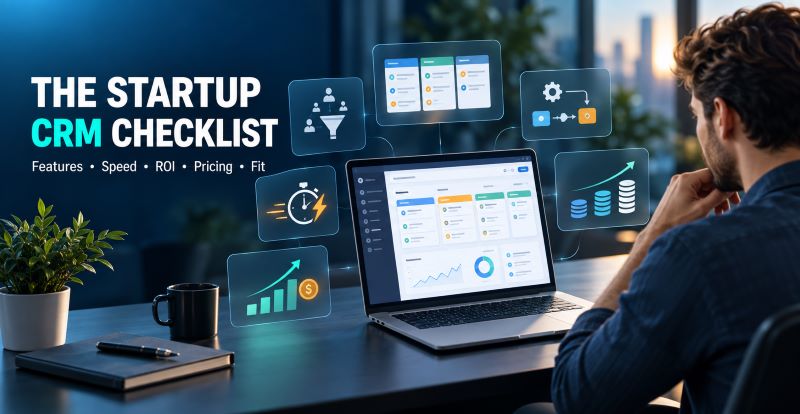
Whatever platform you shortlist, it should cover these basics without add-on pricing for each one:
Startups typically don’t have the lead volume to waste any of them. Harvard Business Review’s audit of 2,241 U.S. companies found that firms contacting a web lead within an hour were nearly seven times more likely to qualify it than those who waited longer — and roughly a quarter of the companies studied never responded to the lead at all. A CRM that automatically routes and flags new leads the moment they arrive closes that gap without requiring a dedicated rep to sit and watch an inbox all day.
Nucleus Research has tracked CRM return on investment for over a decade, and its most-cited figure — $8.71 returned for every dollar spent — is still the number most vendors quote. More recent Nucleus analysis puts the realistic average closer to $3.10 per dollar as adoption gaps eat into returns. The gap between those two numbers tells the real story: a CRM’s ROI depends almost entirely on whether the team actually uses it. For a startup with no budget to waste, that’s a strong argument for choosing the CRM your team will actually open every day over the one with the longest feature list on a sales deck.
Most CRM vendors price per user, per month, which sounds simple until a startup starts adding seats for founders, early sales hires, and support staff who only need occasional access. A few things to watch for when comparing quotes:
None of this shows up clearly on a pricing page, so it’s worth asking directly during a demo rather than assuming the advertised price is what you’ll actually pay once the team grows past a handful of seats.
Before signing anything, ask every vendor on your shortlist the same five questions:
There’s no single best CRM for startups — there’s the one that matches your stage, your budget, and how fast your team needs to move without adding overhead. What’s changed heading into 2026 is that AI CRM capability is no longer optional table stakes; it’s part of what makes a platform usable for a lean team in the first place. ConvergeHub was built around exactly that brief: fast setup, pricing that doesn’t punish growth, and AI built into the everyday work of managing leads, deals, and follow-ups. If you’re evaluating options right now, book a demo and see how it fits your pipeline before you commit to anything.
The best CRM for startups in 2026 is one built for lean teams: fast to set up, priced to scale with headcount, and equipped with AI CRM features that automate lead scoring, follow-ups, and reporting without needing a dedicated admin to run it.
Yes. Most CRM adoption research shows companies bringing in a CRM within their first few years of operation, usually once spreadsheets stop being able to track leads and deals reliably. Waiting until things feel chaotic almost always means losing visibility into deals before the switch happens.
A traditional CRM stores and organizes customer data for a team to work with manually. An AI CRM uses that same data to actively do work — scoring leads, drafting follow-ups, summarizing deal history, and surfacing which accounts need attention — rather than just displaying it.
Budgets vary widely by team size and feature needs, but the more useful question is total cost per rep once automation and AI features are factored in, not just the sticker price. A cheaper plan that requires more manual work often costs more in lost time than a slightly pricier one that doesn’t.
Lead capture and scoring, a customizable pipeline, built-in email and quoting tools, basic automation, and reporting that doesn’t require a data analyst to interpret. Anything beyond that is a bonus at the early stage.
Modern CRMs, including AI CRM platforms, are largely built for self-setup with guided onboarding and no-code configuration. If a platform requires a developer or consultant just to get started, it’s usually a sign it’s built for a much larger company.
For a startup with a handful of users and no legacy system to migrate from, a well-designed CRM can typically be up and running within days rather than weeks. Migration time increases mainly when there’s a lot of existing spreadsheet or legacy CRM data to clean and import.
Buying more platform than the team needs. Enterprise-grade CRMs built for large sales organizations often come with complexity, cost, and setup time that a five-person startup team doesn’t have the bandwidth to absorb.
Research consistently links CRM adoption to measurable gains in conversion and productivity, largely because it removes the manual tracking that eats into selling time. For small teams specifically, the effect is proportionally larger, since every hour saved on admin work is a bigger share of total capacity.
Typically once the team outgrows manual lead tracking, needs automation to keep up with lead volume, or wants AI CRM features like automated scoring and follow-up drafting that free tiers usually don’t include. Revenue growth and headcount growth are both good triggers to revisit the plan.