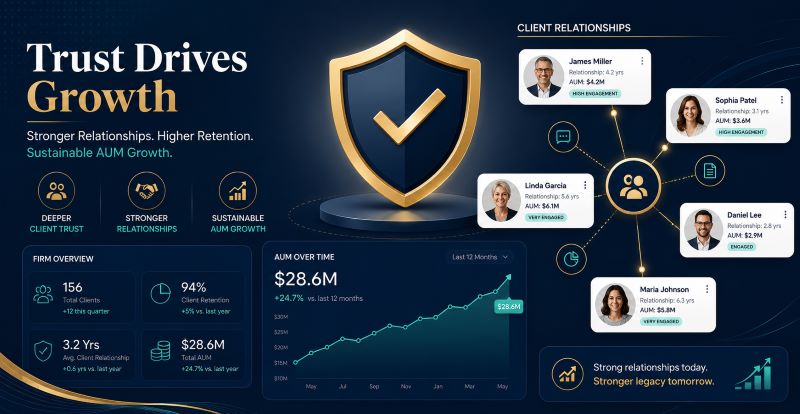
In financial services, trust is the product, and losing it costs AUM. Yet most small advisory firms still manage multimillion-dollar client relationships through spreadsheets and fragmented notes. A purpose-built CRM for small businesses closes that gap. According to a 2025 Investor Engagement Survey by Logica Research and CapIntel, 61% of clients say a lack of trust would cause them to leave their advisor. Let’s explore more in the following blog.
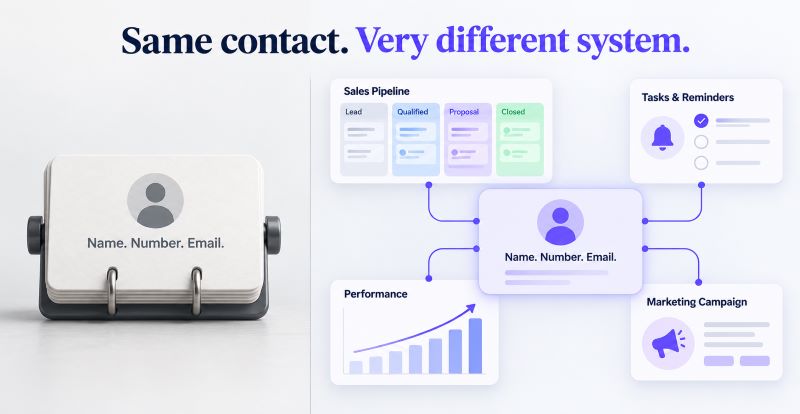
Small financial advisory firms face a specific operational paradox: their business is built entirely on relationships, but they rarely have the systems to manage those relationships at scale.
When a client calls to ask about their last portfolio review, the advisor scrambles. When a compliance audit arrives, the documentation is incomplete. When a key advisor leaves, institutional knowledge walks out the door.
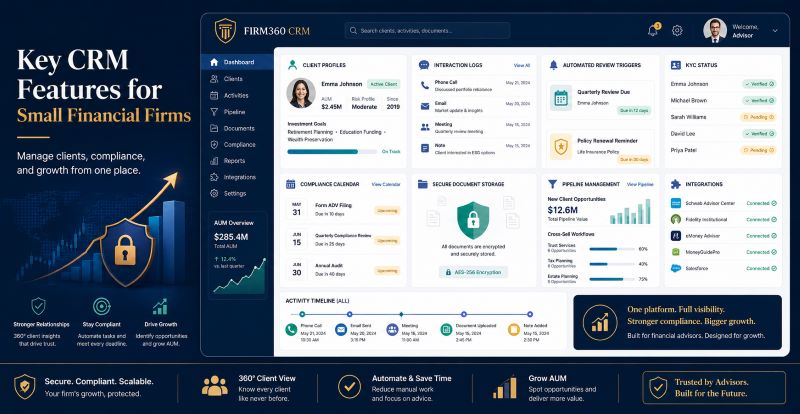
This is exactly the problem CRM for the financial services industry is designed to solve. Unlike generic CRM tools, financial CRM software built for this sector comes equipped with features that address both the relational and regulatory dimensions of the business — client lifecycle management, audit-ready interaction logs, review meeting automation, and KYC status tracking.
The data reinforces the urgency. Firms that implement unified client views report 3–5x faster client onboarding and a 40–60% reduction in advisor time spent searching for client information, according to Vantage Point’s 2026 CRM benchmarking report. That time goes back into client-facing work — which is where AUM growth actually happens.
In a regulated industry, every client conversation carries weight — legally and relationally. Interaction history tracking is not just a convenience feature; it is a compliance imperative.
FINRA requires firms to maintain meticulous records of all client communications under SEC Rule 17a-4, mandating that electronic records be stored in a Write Once, Read Many (WORM) format, preventing alteration during required retention periods. A robust financial CRM software solution automates this documentation, creating timestamped, tamper-evident logs of every call, email, meeting note, and advisory recommendation.
For small firms, the practical impact is significant:
Beyond compliance, interaction history directly shapes client experience. When an advisor can pull up a full relationship timeline before a call — including a client’s financial goals, risk tolerance, last discussed concerns, and personal milestones — the conversation feels informed and intentional. Clients notice. That consistency is what builds the kind of advisor-client trust that drives referrals and long-term AUM retention.
One of the highest-value and most overlooked capabilities of CRM for financial services is automated meeting triggers. Here is what you need to know
Many small firms lose clients not through bad advice, but through simple neglect — a quarterly review that slipped, a policy renewal that wasn’t flagged, a life event that went unacknowledged.
Workflow automation in a financial CRM can trigger review meetings based on predefined criteria: time elapsed since last contact, changes in a client’s AUM threshold, an approaching policy renewal date, or a significant life event logged in the CRM. The result is a proactive engagement model that removes the burden of manual follow-up from advisors’ plates.
The business case is compelling. A wealth management firm that implemented CRM-driven workflow automation saw an 18% improvement in client retention and a 25% increase in advisor productivity. Yes, with key processes like scheduling portfolio review meetings, sending follow-up reminders, and generating compliance reports fully automated.
For small firms managing 50 to 200+ client relationships, this kind of systematic outreach is the difference between reactive service and proactive relationship management. It also supports cross-sell and upsell opportunities — the CRM flags when a client’s asset threshold crosses a new tier, prompting a conversation about expanded services before the client starts looking elsewhere.
When evaluating financial CRM software, small firms should focus on features that directly map to their compliance requirements and relationship management goals. ConvergeHub, for instance, is built to give small businesses exactly this kind of all-in-one capability — without the enterprise-level complexity:
The right client relationship management system doesn’t just organize data — it makes that data actionable, surfacing the right insights at the right moment across the entire client lifecycle.
Small firms that build their practice on a structured CRM foundation are not just managing relationships better — they are building a scalable, compliant, and auditable business that grows AUM methodically, not accidentally. The firms winning on retention, referrals, and regulatory readiness all share one common thread: they stopped relying on memory and started relying on systems. If your firm is ready to make that shift, ConvergeHub gives small financial services businesses the all-in-one CRM for small businesses they need to compete, comply, and grow — without the enterprise complexity.
Ready to turn every client interaction into a competitive advantage? Start with ConvergeHub — the CRM built for small businesses that mean business.
What is CRM for financial services, and how is it different from a generic CRM?
CRM for financial services is purpose-built to address the unique requirements of advisory firms, wealth managers, and financial services providers. Unlike generic CRM tools, financial CRM software includes compliance features such as FINRA-compliant communication archiving, KYC status tracking, AUM management fields, and audit-ready interaction logs — all critical for regulated financial environments.
How does a CRM help with compliance in financial services?
A financial CRM software solution automates the documentation of all client interactions, creates immutable audit trails, and manages compliance calendars for regulatory filing deadlines. This directly supports adherence to SEC Rule 17a-4 and FINRA requirements — reducing the manual burden on advisors and compliance officers while minimizing regulatory risk.
Can a small financial advisory firm afford CRM software?
Yes. Purpose-built CRM platforms for small financial practices are available at $35 to $60 per user per month. The ROI — in client retention, advisor productivity, and reduced compliance risk — typically far exceeds the cost, especially when a single retained client relationship can represent hundreds of thousands of dollars in AUM.
How does CRM software help grow AUM?
By enabling proactive engagement through automated review triggers, client segmentation, and personalized outreach, CRM reduces client attrition and surfaces cross-sell opportunities. Firms using CRM-driven workflow automation have reported up to an 18% improvement in client retention — directly translating to preserved and grown AUM without proportional increases in headcount.
Is CRM adoption mandatory for regulated financial firms?
While no regulation mandates a specific CRM tool, SEC and FINRA requirements for record-keeping, communication archiving, and audit readiness make a structured client relationship management system effectively necessary for compliant operations. Firms relying on email and spreadsheets face significant exposure during regulatory examinations.