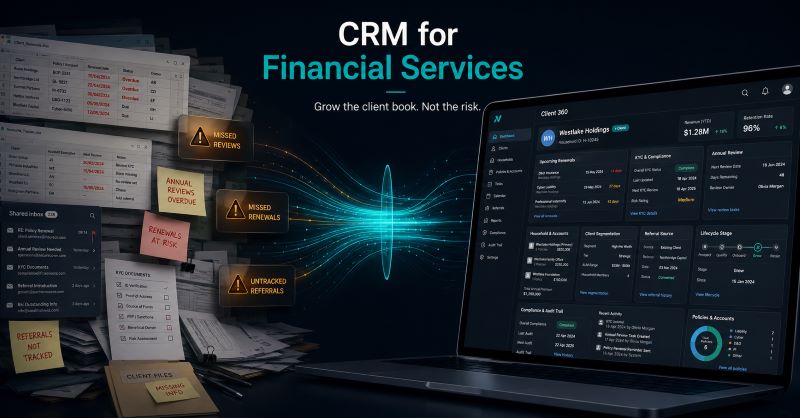
Small financial services firms are under pressure to deliver the kind of personalized, responsive service that large institutions promise, without the headcount to match. A dedicated CRM for financial services firms solves this by centralizing client data, automating compliance-sensitive workflows, and giving advisors a single view of every relationship. For firms still relying on spreadsheets and shared inboxes, the shift to a purpose-built system is often what separates steady growth from missed renewals, compliance gaps, and client churn.
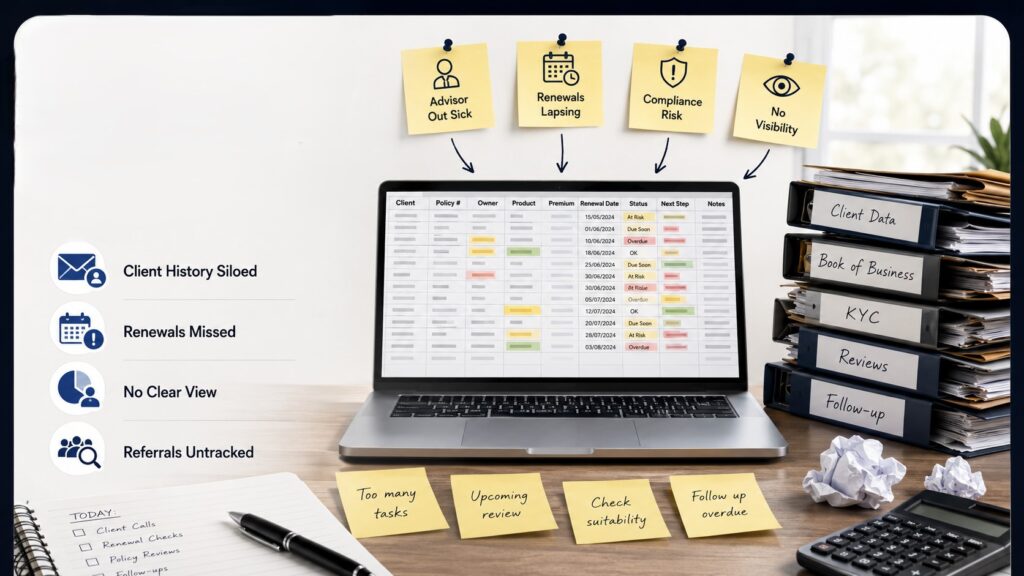
Financial advisory, lending, and insurance firms carry a unique burden: every client interaction has a compliance trail, a renewal date, and a revenue implication. Spreadsheets can’t keep up once a book of business crosses a few hundred households or accounts.
This is exactly where CRM software for small businesses earns its keep — it isn’t just contact storage, it’s the operational backbone that lets a five-person firm behave like a much larger one.
Not every general-purpose CRM fits a regulated environment. Firms evaluating options should look for:
A scalable CRM software for SMBs solution should support this level of structure without requiring an enterprise IT budget or a dedicated administrator to maintain it.
A customer lifecycle management CRM tracks a client from first inquiry through onboarding, servicing, retention, and eventual referral — and financial services firms benefit more from this than almost any other industry, because the lifecycle is long and the stakes of losing a client midway are high.
Firms that map this lifecycle inside a CRM, rather than across disconnected tools, get a much clearer read on where clients drop off and why.
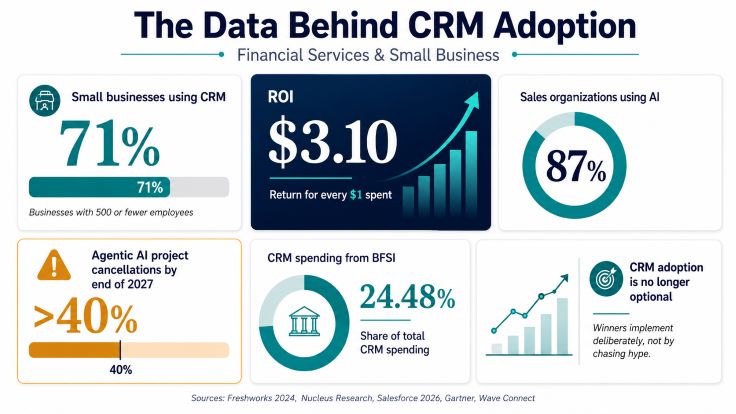
The data on CRM performance backs up why small firms are prioritizing this investment.
Taken together, these data points point to a clear pattern: CRM adoption in financial services is no longer optional, but the winners are the firms that implement it deliberately rather than chasing every new AI feature.
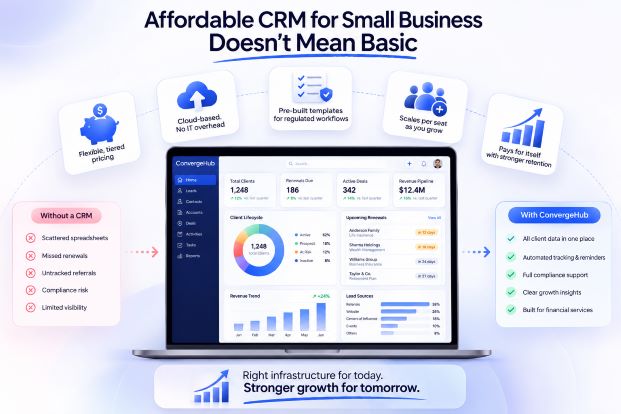
Cost is often the biggest hesitation for small firms, but affordable CRM for small businesses today includes most of what a regulated firm actually needs.
The right system pays for itself through fewer missed renewals, faster onboarding, and better retention — not through the sticker price alone.
Small financial services firms don’t need enterprise budgets to compete on client experience — they need the right infrastructure. A well-implemented CRM for financial services firms replaces scattered spreadsheets and inbox tracking with a single, compliant system that scales alongside the business. From lifecycle management to renewal tracking to referral capture, the right platform turns client relationships into a measurable, defensible asset rather than something that lives in one advisor’s head. Firms that get this foundation right now will be far better positioned to grow their client base without growing their risk.
What should a small financial services firm look for first in a CRM?
Compliance features — audit trails, role-based access, and documentation workflows — should come before flashy automation. A firm can add advanced features later, but a compliance gap is expensive to fix after the fact.
Is a generic CRM good enough, or do financial services need something specialized?
A generic CRM can work for basic contact management, but firms handling sensitive financial data, KYC documentation, or policy renewals benefit from CRM features purpose-built for regulated industries, including permission controls and compliance-ready audit logs.
How long does it typically take a small firm to see ROI from a CRM?
Most firms see early wins within the first two to three months, in the form of faster onboarding and fewer missed follow-ups, with fuller revenue impact building over the following year as data quality and adoption mature.
Can a small firm scale its CRM as its client base grows?
Yes — this is the core advantage of cloud-based, tiered CRM platforms. Firms can start with essential contact and workflow tools and layer in automation, reporting, and integrations as the client book expands, without switching systems.