How to Manage Merchant Cash Advance Syndication?

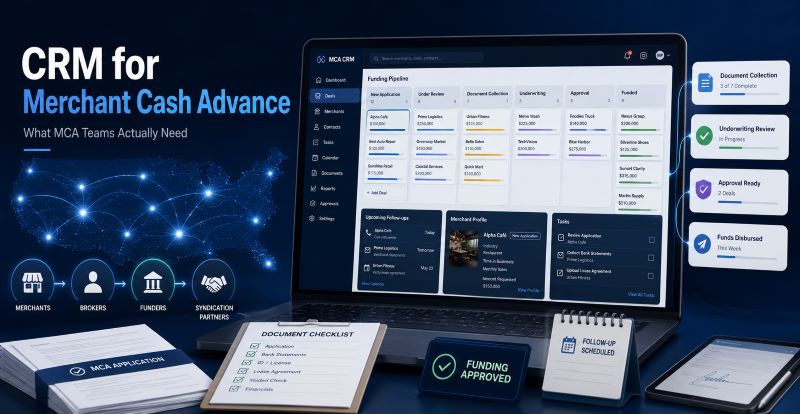
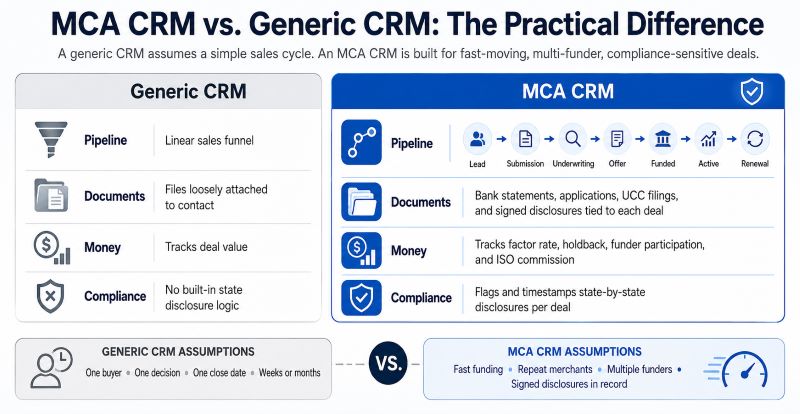
Merchant cash advance (MCA) syndication lets multiple funders jointly provide capital, sharing risk and enabling larger transactions. Using MCA CRM software centralizes workflows, standardizes processes, and improves collaboration to reduce coordination friction and keep funder agreements compliant.

What Is Merchant Cash Advance Syndication and Why Is It Important?

MCA syndication coordinates capital from several funders for a single borrower, diversifying investor exposure and enabling deals that would be too large for one funder. It increases liquidity access for borrowers outside traditional lending and helps funders scale portfolios.

How Does the MCA Syndication Process Work?

The syndication workflow follows clear phases—partner selection, deal management, and approval—to align participants and keep execution orderly.

  • Finding a Syndication Partner: Identify funders through industry networks and existing relationships.
  • Deal Workflow Management: Coordinate underwriting, credit review, and deal terms centrally to keep the process moving.
  • Application and Approval Phases: Complete due diligence, finalize terms, and secure approvals with tracked milestones.

Clear sequencing reduces delays and improves the chance of successful funding.

Additional analysis of syndication mechanics clarifies the tactical steps and relationship management activities required throughout the process.

Syndication Strategies & Process for Funder Management

The source examines alternative syndication strategies and the activities required to execute each step of the syndication process, concluding with a worked example of a syndication.

Syndicated Lending 7th edition: Practice and Documentation, 2019

What Roles Do Funders and Agreements Play in Syndication?

Funders provide capital and set underwriting criteria that shape which deals they join. Agreements record profit shares, risk allocation, and responsibilities so the syndicate can operate predictably and reduce disputes.

How Can CRM Software Streamline Merchant Cash Advance Syndication?

CRMs consolidate deal data, enforce templates and processes, and create audit-ready records. They automate status updates, centralize documents, and enable threaded collaboration so approvals are faster and errors are fewer.

ConvergeHub provides a CRM that combines sales, marketing, and service workflows with features applicable to MCA syndication.

Which CRM Features Support MCA Deal Tracking and Workflow Automation?

Core CRM capabilities for syndication emphasize visibility, automation, and consistency:

  • Deal Tracking: Real-time status and pipeline visibility so funders can act on current information.
  • Sales Force Automation: Automate follow-ups, document routing, and routine tasks to reduce manual work.
  • Template-Based Submissions: Use templates for applications and agreements to ensure consistent, error-minimized submissions.

Together, these features speed approvals, reduce operational risk, and improve decision quality.

How Does CRM Integration Improve Funder Participation Agreement Management?

Integrating CRM into syndication centralizes agreement records and enforces process controls, improving consistency and auditability.

  • Centralized Data Management: Store agreements, terms, and documents in a single repository for easy review.
  • Automated Alerts: Trigger notifications for milestones, renewals, or required actions so nothing is missed.
  • Collaboration Tools: Secure file sharing and discussion threads reduce miscommunication and speed resolution.

Leveraging these capabilities keeps funder participation agreements accessible, monitored, and actioned consistently.

Industry practice shows that robust CRM features support the administration and documentation of syndicated agreements.

Managing Financial Syndication & Agreements with CRM

The referenced case describes how IDLC arranges syndication finance for large client requirements and supports documentation, execution, and administration of syndicated facilities.

Customer Relationship Management (CRM) Through CAD of IDLC Finance Limited, 2018

What Are Best Practices for Managing Funder Participation Agreements in MCA Syndication?

Apply controls that keep agreements current, auditable, and enforceable across the syndicate.

  • Regular Audits: Periodic reviews catch compliance or process gaps early.
  • Clear Communication: Defined protocols and regular updates maintain transparency and trust.
  • Compliance Checks: Stage-gated checks reduce regulatory and operational risk.

These practices strengthen governance and speed dispute resolution.

How to Ensure Compliance and Risk Management in Agreement Handling?

Strong verification, risk assessment, and ongoing monitoring protect funders and borrowers through the syndication lifecycle.

  • Compliance Verification: Ensure agreements meet legal and regulatory standards.
  • Risk Assessment: Evaluate borrower credit risk and deal-level exposures before funding.
  • Monitoring Agreements: Track performance and intervene when outcomes diverge from expectations.

Prioritize verification, assessment, and monitoring to limit legal exposure and maintain portfolio health.

What Tools Help Monitor Deal Status and Syndication Stages Effectively?

Combine CRM, reporting, and analytics to get operational control and strategic insight across syndication stages.

  • CRM Tools: Centralize tracking and workflows for each deal.
  • Reporting Features: Generate routine and ad-hoc reports to measure deal progress.
  • Analytics Capabilities: Identify trends and inform portfolio-level decisions.

Use these tools together to increase visibility and support data-driven syndication decisions.

How to Leverage Merchant Cash Advance Funder Portals for Syndication Efficiency?

Funder portals centralize documents, workflows, and communications so all participants access the same up-to-date information.

  • Centralized Information: Store and share critical documents in one place.
  • Automated Processes: Automate submissions and approvals to reduce admin burden.
  • Performance Metrics: Track portfolio and deal-level metrics to assess effectiveness.

Properly implemented portals speed exchanges and improve coordination.

What Are the Benefits of Using Funder Portals in MCA Syndication?

Funder portals improve communication, deal tracking, and risk management across the syndicate.

  • Streamlined Communication: Reduce misunderstandings with a single communication channel.
  • Efficient Deal Tracking: Centralized access helps stakeholders monitor progress.
  • Risk Management: Built-in monitoring tools help detect and mitigate issues earlier.

These benefits contribute to a more disciplined, transparent syndication process.

How to Integrate Funder Portals with CRM Systems for Seamless Deal Tracking?

Integrate portals and CRM to create a single source of truth for syndication data.

  • API Connections: Use APIs for real-time data sharing.
  • Data Mapping: Map fields so information flows accurately between systems.
  • User Training: Train users on workflows to ensure adoption and reduce errors.

Focus on APIs, accurate mapping, and training. To further enhance your MCA syndication process, consider exploring the comprehensive features offered by ConvergeHub.

Effective management of funder participation agreements is critical to successful MCA syndication. For a streamlined approach to sales, marketing, and customer service workflows, review ConvergeHub’s pricing options tailored for the MCA market.

Ready to evaluate how ConvergeHub can improve your syndication workflows? Contact us to request a demo and assess how the platform can increase collaboration and efficiency.

Frequently Asked Questions

What are the key challenges in managing MCA syndication?

Challenges include coordinating multiple funders, maintaining agreement compliance, and ensuring consistent underwriting. CRM workflows and automated controls reduce manual coordination and speed approvals.

How can businesses ensure effective communication among funders during syndication?

Use formal communication protocols, scheduled updates, and a centralized platform. CRM collaboration tools keep messages and documents in one place for transparency.

What role does technology play in improving MCA syndication processes?

Technology automates routine tasks, centralizes records, and provides analytics to support underwriting and portfolio choices, reducing errors and accelerating execution.

How can organizations measure the success of their MCA syndication efforts?

Track KPIs such as deal close velocity, successful syndications, funder ROI, borrower satisfaction, and compliance rates to identify gaps and optimize processes.

What are the potential risks associated with MCA syndication?

Risks include borrower default, operational errors, and regulatory non-compliance. Robust due diligence and CRM-based agreement controls help mitigate these risks.

How can funder portals enhance the MCA syndication experience?

Portals centralize documents, automate routine submissions, and provide real-time deal status, reducing administrative burden and improving decision speed.

Conclusion

Managing MCA syndication with CRM software like ConvergeHub improves visibility, standardizes agreement administration, and reduces operational risk. Automating workflows and leveraging portals and analytics helps syndicates operate more efficiently and collaborate more effectively.

Your Prospects Aren’t Replying

Tell me if this sounds familiar… a rep has a decent conversation with a prospect. he sends a follow-up email. A few days go by. No reply. This is where the awkwardness begins.
     
fire gif The Catalyst
Date: 04.08.2026
carve-left
Tell me if this sounds familiar…
a rep has a decent conversation with a prospect.
he sends a follow-up email.
A few days go by.
No reply.
This is where the awkwardness begins.
Another email goes out.
Then another.
By that point, everyone can feel the tension. The rep wants to keep the deal moving, the buyer has stopped engaging, and each new message starts sounding more like a reminder than a reason to respond.
hero img
That’s usually the point where teams start confusing activity with progress.
carve-right
What buyers see buyer
Most follow-up emails look familiar from the buyer’s side.
infographic
The language is polite. The timing seems reasonable. The message still lands flat.
A buyer reads it and sees one more request for attention. There’s no new context, no added value, and no clearer path forward. The easiest thing to do is move on to the next email in the inbox.
That pattern plays out every day in active pipelines.
carve-left
What stronger follow-ups do leadicon
A good follow-up gives the buyer something useful.
infographic
The point is movement. Every message should help the deal progress in some visible way.
When follow-up carries weight, response rates improve naturally.
carve-right
Four follow-up moves that work better leadicon
1. Bring back the buyer’s own words
People respond when they feel understood.
“On our last call, you mentioned lead routing slows down every time volume spikes. I pulled together two ways teams usually fix that. I can send them over if useful.”
2. Give them something they can use internally
A lot of deals slow down because the buyer is carrying the conversation back into their team.
“I know this is being reviewed internally. I outlined the first two workflow changes most teams make and what each one affects. Sharing it here in case it helps with the discussion.”
3. Widen the conversation
A deal becomes stronger when more of the buyer’s organization is visible.
“Who else on your side would want to see how this would actually work day to day? It may make sense to include them in the next conversation.”
4. Put timing into real language
A lot of follow-up becomes vague because timing stays vague.
“You mentioned this becomes more urgent once your current sales cycle closes. When does that happen on your side?”
carve-left
A simple test for every follow-up leadicon
Before sending the message, ask one question:
What does the buyer have after reading this that they did not have before?
A stronger follow-up usually gives them one of these:
infographic
That small discipline changes the quality of the entire sequence.
carve-right
A quick change you can make this week leadicon
For the next 7 days, give your team one simple rule:
No follow-up goes out unless it includes one of these three things:
That means every message should do some real work.
A rep can send:
radio a short summary of what they heard
radio one practical idea tied to the buyer’s situation
radio a suggestion for who else should join the next conversation
radio a sharper agenda for the next step
radio a timeline question that helps the buyer clarify priority
By the end of the week, you’ll start seeing which reps know how to create momentum and which ones are just sending reminders.
That one rule usually improves follow-up quality faster than another round of deal inspection.
carve-left
Where ConvergeHub helps leadicon
ConvergeHub gives teams the context they need to send follow-ups that feel relevant and timely.
infographic
This makes consistency easier and keeps follow-up grounded in the actual deal.
carve-right
What gets a response
Follow-up works best when it helps the buyer move one step closer to a decision.
That’s what moves deals forward.
That’s the difference that shows up in results.
inbox  Start your 14-day FREE Trial and test a tighter follow-up approach this week.
inbox  If your team is following up regularly but response rates are thin, schedule a brainstorming session with us to understand where your deals are actually slowing down.

Best MCA Servicing Software for Fintech Lenders

Merchant Cash Advance (MCA) servicing software and MCA CRM help fintech lenders automate loan administration and payments, improve borrower communication, and enforce risk controls. This article summarises key features, automation benefits, and workflow tips, and highlights how ConvergeHub’s integrated CRM supports small and medium fintech businesses.

A robust Loan Management System (LMS) is fundamental to automating and streamlining the full loan lifecycle, from underwriting through servicing.

Loan Management Systems: Automating Servicing & Enhancing Efficiency

A Loan Management System (LMS) is an electronic solution that automates and streamlines the loan lifecycle, including underwriting, servicing, collections, and closing. Core functions include centralized data management, process automation, scalability, compliance controls, credit evaluation, and support for multiple servicing types. LMS solutions reduce human error, increase operational efficiency, and simplify the borrower experience.

Modernizing mortgage loan servicing: A study of Capital One’s divestiture to Rushmore, SR Sangannagari, 2021

What Are the Key Features of Merchant Cash Advance Software for Fintech Lenders?

MCA software centralises applications, document capture and analytics to speed processing and reduce overhead.

  • Client Data Collection: Collect and manage applicant data.
  • Automation Features: Automate reminders and document flows.
  • Analytics Capabilities: Track loan performance and borrower trends.

These capabilities shorten cycle times and lower operational cost. ConvergeHub consolidates these functions in a single CRM.

How Does Automated Loan Tracking Enhance MCA Loan Management?

Automated tracking provides real-time status, notifications and easier account monitoring to reduce missed payments and speed resolution.

  • Document Management: Central storage for loan files.
  • Notifications and Alerts: Timely alerts for payments and actions.
  • Speed and Efficiency: Less manual tracking, more strategic focus.

Implementing tracking strengthens controls and borrower experience.

Which Payment Processing Tools Improve MCA Servicing Efficiency?

Payment tools that integrate with core systems and automate collections improve cash flow and reporting.

  • Integration with Existing Systems: Maintain compatibility with financial software.
  • Automation of Payment Processes: Automate collections to cut errors.
  • User-Friendly Interfaces: Simpler payment flows for borrowers.

Better payment tools mean faster settlements and clearer accounts.

How Does Fintech Lending CRM Improve Borrower Communication and Risk Management?

A fintech CRM centralises borrower profiles and enforces repeatable communication and risk workflows.

  • Centralized Client Information: Full borrower profiles and history.
  • Automated Workflows: Consistent, timely communications.
  • Enhanced Compliance: Automated documentation and reporting.

These features strengthen relationships while reducing operational risk.

Rebuilding and maintaining consumer trust remains critical for fintech lenders, particularly in light of prior illegal lending practices that harmed industry reputation.

CRM Strategies for Fintech Lending & Customer Trust

The fintech sector faces a consumer trust deficit driven by illegal online lending practices that have impacted the Peer-to-Peer (P2P) lending ecosystem. This research develops a CRM model to rebuild trust in legitimate P2P platforms. Using a systematic literature review (SLR) and PRISMA 2020 guidelines, the study analyses ten academic papers published between 2003 and 2022. Searches used Scopus, Web of Science, and Google Scholar, focusing on CRM implementation and its effect on consumer trust. The research identifies five CRM contribution areas: service personalization, transparency and communication, data security, financial education, and responsive customer relationship management. Findings indic

What CRM Integration Capabilities Support MCA Servicing Workflows?

CRM integrations link accounting, e-signatures and communication tools to eliminate manual handoffs.

  • Integration with Accounting Software: Sync financials for accurate reporting.
  • E-Signature Solutions: Fast, secure signing to speed approvals.
  • Communication Tools: In-app messaging and notifications.

These integrations create unified, faster workflows.

How Do Risk and Compliance Tools Mitigate Lending Risks?

Risk and compliance modules reduce regulatory exposure and help manage credit risk across portfolios.

  • Automated KYC and AML Processes: Streamline identity and AML checks.
  • Unified Client View: Single borrower profile for assessment.
  • Real-Time Compliance Monitoring: Continuous checks against rules.

These controls support regulatory adherence and more effective portfolio management.

Advanced technologies, including AI and machine learning, are increasingly important for improving credit risk assessment in fintech lending.

Fintech Lending Efficiency: AI/ML for Risk Assessment

As of 2016, LendingClub’s performance resembled that of large banks, supporting the view that use of alternative data and AI/ML may have enhanced credit risk assessment relative to traditional methods. The study also examines capital market incentives for lenders to assume credit risk. Market value regression using the NPL ratio indicates that market discipline encourages lower-risk consumer lending.

Consumer lending efficiency: Commercial banks versus a fintech lender, JP Hughes, 2022

Why Choose ConvergeHub’s MCA Loan Management System for Small to Medium Fintech Lenders?

ConvergeHub configures an MCA loan system for small and medium lenders, combining CRM, automation and analytics.

  • All-in-One CRM Platform: Reduce tool sprawl with a single platform.
  • Workflow Automation: Automate routine servicing tasks.
  • Detailed Analytics: Monitor performance and make data-driven choices.

These features make ConvergeHub a practical choice for MCA servicing.

What Operational Efficiencies Result from Using ConvergeHub’s All-in-One CRM?

Deploying ConvergeHub reduces manual work and improves visibility across teams.

  • Streamlined Workflow: Fewer manual steps, faster processing.
  • Increased Accountability: Clear task ownership and tracking.
  • Enhanced Lead Management: Better tracking of prospects and customers.

These efficiencies support improved throughput and outcomes.

What Case Studies Demonstrate ROI and Customer Success?

Case studies show measurable ROI from faster processing, higher satisfaction and operational savings.

  • User Satisfaction Ratings: Positive user feedback on the platform.
  • Growth Metrics: Faster processing and improved acquisition.
  • Operational Improvements: Lower costs through automation.

These examples illustrate practical benefits of adoption.

How Can Fintech Lenders Get Started with the Best MCA Servicing Software?

Lenders should follow a structured rollout to reduce disruption and accelerate time to value.

  • Select the Right Software: Compare features, scalability and reviews.
  • Integration with Existing Systems: Verify compatibility to ease transition.
  • Training for Employees: Provide hands-on training and resources.

A clear plan, integration checks and training support a smooth implementation.

What Are the Pricing Options and Demo Request Processes?

Review pricing models and request demos to compare total cost and fit.

  • Pricing Structure: Evaluate subscription and implementation costs.
  • Demo Request Process: Most providers, including ConvergeHub, offer demo requests to review features.
  • Contact Information: Request tailored proposals and pricing details.

Arrange demos and vendor conversations before procurement decisions.

How Does Ongoing Support Enhance Software Adoption?

Reliable support and training are essential to adoption and long-term success.

  • Multi-Channel Support: Access help across channels.
  • Knowledge Base and Tutorials: Self-service resources for users.
  • Continuous Education: Regular updates and refreshers.

Strong support reduces rollout risk and improves outcomes.

To explore the pricing structure and identify a plan that matches your needs, visit our pricing page.

If you have questions or require tailored guidance, please contact us. Our team can assist with implementation and optimisation of your MCA servicing software.

Frequently Asked Questions

What are the benefits of using MCA servicing software for small lenders?

MCA software increases efficiency, improves borrower communication and automates compliance and reporting to free staff for growth activities.

How can fintech lenders ensure compliance with regulations using MCA software?

Use solutions with built-in KYC/AML, audit trails and real-time monitoring to reduce regulatory exposure and support audits.

What role does data analytics play in MCA servicing?

Analytics reveal portfolio trends, support pricing and risk segmentation, and guide targeted borrower engagement.

How does CRM integration improve the efficiency of MCA servicing?

CRM integration centralises records, automates communications and removes manual handoffs for faster, more consistent servicing.

What training is necessary for staff to effectively use MCA servicing software?

Provide hands-on sessions, documentation and periodic refreshers covering core features, configuration and best practices.

What are the common challenges faced when implementing MCA servicing software?

Typical challenges are integration with legacy systems, change resistance and insufficient training; address them with stakeholder engagement and clear onboarding.

How can lenders measure the success of their MCA servicing software?

Track KPIs such as processing speed, error rates, customer satisfaction and cost per loan, and combine with user feedback to assess ROI.

Conclusion

Implementing MCA servicing software with automation, integrations and analytics improves operational efficiency, borrower experience and risk controls. Evaluating platforms like ConvergeHub helps lenders choose solutions that align with their workflow and growth goals.

How Does MCA Servicing Software Manage Merchant Payments

Merchant Cash Advance (MCA) servicing software automates payment tracking, scheduling and servicing workflows to improve efficiency and accuracy. The platform centralises transactions and provides real-time insights that reduce cash-flow friction. This article outlines core features and their direct effects on merchant cash flow.

Efficiency of Payment Processing

MCA servicing software replaces manual steps with automated processes, cutting human error and ensuring on-schedule payments. Real-time tracking gives finance teams visibility into cash flow so they can act sooner and maintain reliable billing.

Key Features Enhancing Transaction Management

MCA software contains core capabilities that improve transaction control and operational oversight.

  • Multiple Payment Types Supported: Supports diverse payment methods so merchants can accept funds from multiple channels.
  • 360-Degree Customer View: Centralises customer data so teams see interactions, balances and payment history in one place.
  • Automated Payment Tracking: Tracks collections automatically to reduce missed payments and keep records current.

To see these features in action, request a demo of a CRM tailored to MCA workflows.

Overall Impact on Merchant Cash Flow

MCA software improves cash flow by enabling repayment structures tied to sales performance and by stabilising timing through automated collections. This reduces the strain of fixed schedules and frees working capital for reinvestment.

Merchant cash management will continue to evolve with technologies such as instant payments and central bank digital currencies.

Instant Payments & CBDCs for Merchant Cash Management

This paper examines how instant payments and central bank digital currencies may transform merchant cash management, including their potential roles and impacts.

The role of instant payments and central bank digital currencies in transforming merchant cash management, 2025

What Is Merchant Cash Advance Servicing Software and Its Role in Payment Management?

Merchant Cash Advance servicing software manages advances from application through repayment. It records transactions, automates schedules and gives merchants controls and visibility to monitor cash flow and ensure timely repayments.

Defining MCA CRM Software and Its Core Functions

MCA CRM software tailors customer-relationship tools to the MCA industry: automated data capture, interaction tracking and payment-schedule management. These reduce manual entry and help teams focus on customer retention and productivity.

How MCA Software Integrates Payment Processing and Customer Relationship Management

Integrating payment processing and CRM centralises data, reduces bookkeeping errors and supplies real-time transaction records so teams can reconcile accounts and manage customer obligations from one system.

How Does MCA Payment Management Software Automate Merchant Payment Processing?

MCA payment management automates merchant workflows, using scheduled deductions and automated posting to improve collection consistency and reduce late payments. A clear interface makes schedules and balances easy to monitor.

Key Features of Payment Automation in MCA Platforms

The key payment automation features include:

  • Automated Payment Processing: Enables seamless collections with minimal manual input, lowering processing errors.
  • Integration with Communication Tools: Connects to messaging tools to send payment reminders and updates to customers.
  • Real-Time Reporting: Produces timely reports so merchants can assess cash flow and plan finance actions.

Combined, these features streamline payment operations and support predictable cash management.

Scheduling and Tracking Merchant Payments with MCA Software

Scheduling and tracking ensure regular collections and early detection of cash-flow issues. Automated deductions stabilise receipts while tracking flags where merchants need to intervene.

What Are the Benefits of Using MCA Loan Servicing Platforms for Merchant Payment Management?

Using MCA loan servicing platforms delivers practical benefits for merchant payments, including:

  • Improved Transaction Tracking: Automated logs give accurate, auditable transaction histories.
  • Streamlined Payment Processing: Automation shortens processing time and reduces manual tasks.
  • Enhanced Customer Communication: Built-in messaging improves transparency about schedules and changes.

Leveraging these benefits helps merchants run operations more efficiently and strengthen financial resilience.

Reducing Manual Errors and Enhancing Operational Efficiency

Automating data entry and payment posting cuts human mistakes and improves record accuracy. Centralised records let teams spend less time on admin and more on strategic work.

Improving Merchant Communication and Compliance Reporting

MCA platforms support personalised messaging and automated compliance reports. Personalised alerts keep customers informed, while automated reporting reduces manual effort needed for regulatory submissions.

How Does MCA CRM Integration Support Analytics and Performance Tracking?

CRM integration centralises data from payments, sales and support so analytics can measure performance, identify risk, and guide process improvements that lift operational outcomes.

Utilizing Real-Time Analytics for Payment Reconciliation

Real-time analytics supply up-to-date transactions for faster reconciliation, reducing discrepancies and enabling quick adjustments to settlement and payout strategies.

Real-time payment reconciliation improves settlement confidence and operational accuracy.

Real-Time Financial Reconciliation for Merchant Payouts

Implementing real-time reconciliation enables instantaneous verification of payment events as they occur, improving accuracy and settlement confidence.

Data Model for Matching Settlement Advices to Merchant-Level Payouts: A Canonical Approach to Financial Reconciliation in High-Throughput Payment …, 2021

Leveraging Data Insights to Optimize MCA Servicing Workflows

Data insights reveal patterns in payments and customer activity that help refine servicing workflows. Using analytics to prioritise cases and tune schedules increases operational effectiveness and supports growth.

For more information on how to improve your business, ConvergeHub offers a range of solutions.

To understand the costs associated with these solutions, you can review ConvergeHub pricing.

Frequently Asked Questions

What types of businesses can benefit from MCA software?

MCA software suits small and medium-sized businesses with variable cash flow—retail, hospitality and e-commerce—by automating collections and delivering real-time cash visibility.

How does MCA software ensure compliance with financial regulations?

Many systems include compliance checks and automated reporting to maintain accurate records and simplify regulatory submissions.

Can MCA software integrate with existing accounting systems?

Yes. Integrations centralise financial data, reduce duplicate entry and simplify reconciliation between MCA and accounting platforms.

What are the costs associated with implementing MCA software?

Costs vary by features and deployment. Providers typically offer tiers; request demos and quotes to match functionality and budget.

How does real-time analytics improve decision-making for merchants?

Real-time analytics give immediate visibility into cash flow and payment status so merchants can spot trends, adjust strategies and make faster decisions.

What support options are available for users of MCA software?

Most vendors provide documentation, customer service channels and training. Choose a support package that matches your operational needs.

Conclusion

Implementing Merchant Cash Advance software strengthens payment management by automating processes, improving accuracy, and delivering timely insights. With solutions like ConvergeHub, businesses can reduce cash-flow stress while creating more capacity for growth through streamlined and efficient operational practices.

Why Your Deals Keep Stalling

You may have noticed that most deals in the pipeline don’t fall apart in a dramatic way. They just start taking longer. A deal sits in the same stage for longer than it should. You’ve followed up a couple of times, had another call, and still don’t have a clearer sense of how the buyer is moving forward.
     
  Date: 04/01/2026
fire gif The Catalyst
carve-left
You may have noticed that most deals in the pipeline don’t fall apart in a dramatic way.
They just start taking longer.
A deal sits in the same stage for longer than it should. You’ve followed up a couple of times, had another call, and still don’t have a clearer sense of how the buyer is moving forward.
Nothing looks wrong on the surface. The deal is still active. The rep is still engaged. It’s still in the forecast.
But the pace has changed.
And that change is usually where things start slipping.
carve-right
The Deals That Just Sit There leadicon
If you look across your pipeline, you’ll probably find a few deals like this right now.
content3
That middle state is where most pipelines lose momentum.
carve-left
Where This Usually Happens leadicon
In my experience, slowdowns tend to show up in a few very familiar places.
Right after a good first call, when the conversation felt promising but the next step wasn’t tightly defined.
After a proposal goes out, when the deal shifts into waiting and the buyer goes quiet internally.
When there’s only one contact involved, and everything depends on that person carrying it forward inside their company.
Or when timing sounds reasonable on the surface – “next quarter,” “after this project,” “once we review internally” – but nothing is anchored to a real event.
None of these feel like problems in the moment.
Over time, they add up.
carve-right
Where to Intervene When a Deal Slows Down leadicon
Instead of going back and reviewing deals, focus on what your team does in the moment a deal starts slowing.
Ask your reps to watch for one signal:
When the conversation stops changing.
That usually shows up like this:
That’s the point where deals drift.
carve-left
What to Do Right Then
When that signal appears, the goal is to change the shape of the conversation.
A few practical ways to do that:
These moves create momentum because they introduce something new into the deal.
carve-right
What This Changes
Instead of waiting for deals to move, your team starts actively shaping progress.
Conversations evolve.
More context shows up.
Decisions become easier to track.
Momentum becomes visible again.
carve-left
What Actually Moves a Deal
There’s a simple shift that improves this quickly.
Start treating “next step” as something that needs to move the deal forward, not just keep it active.
A follow-up email keeps a deal alive.
A scheduled working session with a clear purpose moves it.
A “checking in” message maintains contact.
A conversation that involves another stakeholder changes the shape of the deal.
When you look at deals this way, the difference becomes obvious.
carve-right
How Strong Deals Behave
You’ll also start noticing how strong deals behave.
They don’t stay contained.
There’s movement, even between calls.
Slower deals tend to stay narrow.
Stakeholder Same contact.
Stakeholder Same discussion.
Stakeholder Same uncertainty.
That pattern repeats more often than most teams realize.
carve-left
Where ConvergeHub Helps
Inside ConvergeHub, you can see this kind of movement much more clearly:
That makes it easier to spot slowdowns early, while you still have time to do something about them.
carve-right
The Moment That Matters
Deals don’t usually break all at once.
They slow down first.
And that’s the moment that matters.
inbox  Start your 14-day FREE Trial and review a handful of deals inside ConvergeHub using these signals.
inbox  Or schedule a brainstorming session with us to understand where your deals are actually slowing down.

We Announce ConvergeHub’s Availability on the Zoom Marketplace

We are excited to share that ConvergeHub is now live on the Zoom Marketplace, bringing seamless CRM integration to virtual collaboration…

We are excited to share that ConvergeHub is now live on the Zoom Marketplace, bringing seamless CRM integration to virtual collaboration. With this launch, businesses can unify customer engagement and Zoom meetings in one streamlined experience — simplifying collaboration, strengthening relationships, and accelerating growth.

“Customer conversations are happening on Zoom every day, and now those conversations can directly fuel CRM success,” said Shampa Bagchi, Founder and CEO of ConvergeHub. “By joining the Zoom Marketplace, we’re making it easier for businesses to capture insights, strengthen relationships, and drive measurable outcomes — all within the tools they already use.”

Key Capabilities of the Integration

  • Access CRM records during Zoom calls to personalize conversations and improve responsiveness.
  • Schedule and launch Zoom meetings directly from ConvergeHub without copy-paste friction.
  • Automatic meeting logging and syncing of details like date, duration, and participants back to CRM records.
  • Streamlined follow-ups with integrated tasks, notes, reminders, and unified interaction history.

Why This Matters

Most CRMs force users to toggle between meeting tools and customer records, creating gaps where context is lost. With ConvergeHub’s Zoom integration, teams can act while details are fresh, ensuring every conversation leads to clear next steps. This reduces manual work, improves consistency, and strengthens customer relationships.

Designed for SMBs and Enterprises

For SMBs: Removes friction by allowing teams to schedule, join, and log Zoom meetings directly in ConvergeHub, keeping customer context close to the conversation.

For Enterprises: Improves governance and visibility by connecting customer-facing Zoom conversations to a reliable CRM system of record.

Please read the full details in our official press release here:
https://www.einpresswire.com/article/901605899/convergehub-now-live-on-zoom-marketplace-bringing-seamless-crm-integration-to-virtual-collaboration

We Celebrate ConvergeHub’s Strong CRM Ratings on SoftwareReviews

We are proud to share that ConvergeHub has received outstanding customer ratings on SoftwareReviews, a leading enterprise software research and review platform…

We are proud to share that ConvergeHub has received outstanding customer ratings on SoftwareReviews, a leading enterprise software research and review platform. These results validate our commitment to building a CRM that is easy to adopt, dependable in daily execution, and valuable for growing businesses.

ConvergeHub currently holds:

  • Composite Score: 8.3/10
  • CX Score: 8.5/10
  • Net Emotional Footprint: +96 (96% positive sentiment)
  • Likeliness to Recommend: 94
  • Plan to Renew: 100
  • Satisfaction of Cost Relative to Value: 90

These scores reflect the trust our customers place in us and reinforce our role as a reliable CRM partner for small and mid-sized businesses.

“Great CRM isn’t just about features — it’s about trust, reliability, and measurable outcomes. These ratings reflect our commitment to making ConvergeHub easy to adopt, dependable in daily execution, and valuable for growing teams,” said Shampa Bagchi, Founder and CEO of ConvergeHub.

Why This Matters

In a crowded CRM market, businesses look beyond feature lists — they want proof of usability, reliability, and long-term value. The strong ratings on SoftwareReviews demonstrate that ConvergeHub delivers on these expectations, helping teams streamline operations, improve customer engagement, and achieve measurable outcomes.

Recognition

ConvergeHub has also been named a 2026 Emotional Footprint Champion in the CRM – Small Business category, building on prior recognition as a 2025 Data Quadrant Champion and 2025 Emotional Footprint Champion.

Please read the full details in our official press release here:
https://www.einpresswire.com/article/897616599/convergehub-earns-strong-crm-ratings-on-software-reviews-reinforcing-customer-trust-usability-and-business-value 

Most Deals Aren’t Real

Open your pipeline and scroll through your current deals. Names, companies, deal values, stages – everything looks active. There is enough there to feel like progress is happening and that the quarter is under control. Then you start clicking into a few of those deals.
     
  Date: 03/25/2026
fire gif The Catalyst
carve-left
Open your pipeline and scroll through your current deals.
Names, companies, deal values, stages – everything looks active. There is enough there to feel like progress is happening and that the quarter is under control.
Then you start clicking into a few of those deals.
One hasn’t had a meaningful update in two weeks.
Another still has a single contact with no visibility into the broader decision.
Another shows “followed up” as the last activity, with no defined next step.
Another has a proposal sent, but no clarity on what happens next.
The pipeline still looks full.
It just doesn’t feel reliable anymore.
carve-right
How Pipelines Become Misleading
Most pipelines build up this way over time.
Nothing looks wrong in isolation.
Across the pipeline, a pattern starts to form – deals remain present without moving toward a decision.
That creates a gap between what the pipeline suggests and what actually converts.
carve-left
A Simple Way to Check Deal Quality leadicon
Skip the reports and look at individual deals.
Take 10-15 open opportunities and review them with a simple lens:
When those answers are clear, the deal has structure.
When they are missing, the deal is sitting in place.
carve-right
Make “Next Step” Mean Something leadicon
A small shift improves this quickly.
Treat every next step as a commitment that must be defined clearly.
A real next step includes:
“Check in next week” keeps the deal open.
 
“Review proposal with the finance team on Thursday at 11am” moves the deal forward.
Over time, this changes how deals behave inside the pipeline.
carve-left
Watch How Strong Deals Behave
Stakeholder Stronger deals expand as they progress.
More stakeholders get involved.
Questions become more detailed.
Internal conversations start to surface.
Stakeholder Weaker deals stay narrow.
One contact remains the point of interaction.
The discussion repeats the same themes.
Movement depends on reminders rather than decisions.
You don’t need a complex model to see this. You just need to observe how the deal is evolving.
carve-right
Where ConvergeHub Helps leadicon
ConvergeHub keeps deal context and movement visible:
This helps you focus on opportunities that are developing, not just existing.
carve-left
inbox  Start your 14-day FREE Trial and observe how deal quality changes when structure is applied.
inbox  Or schedule a brainstorming session with us to understand why your pipeline feels busy but outcomes remain inconsistent.

The Full Pipeline Illusion

Open most CRM dashboards and the first thing you see is a reassuring number. Plenty of opportunities. Deals sitting in different stages. Revenue totals that look promising. On paper, the pipeline appears healthy.
Date: 03/18/2026
fire gif The Catalyst
     
carve-left
Open most CRM dashboards and the first thing you see is a reassuring number.
Plenty of opportunities.
Deals sitting in different stages.
Revenue totals that look promising.
On paper, the pipeline appears healthy.
Then the quarter unfolds.
Some deals stall without explanation.
Others linger in the same stage for weeks.
Forecast numbers shift during every review.
Revenue arrives later than expected.
The pipeline still looks full.
The outcomes tell a different story.
carve-right
The Difference Between Activity and Momentum leadicon
Many pipelines accumulate activity faster than they generate forward movement.
New opportunities enter the system.
Existing deals stay open longer.
Stages fill up gradually.
From a distance, this creates the appearance of growth.
Closer inspection often reveals a different pattern:
deals circulate through the pipeline without progressing toward a decision.
Sales teams remain busy.
Forecasts become harder to trust.
Leadership begins to ask harder questions about what is actually happening inside those stages.
hero img
carve-left
Where Momentum Slows leadicon
When deals remain active without clear forward movement, several signals usually appear:
Each signal on its own feels manageable. Together they create a pipeline that looks productive but moves unpredictably.
carve-right
A Practical Pipeline Review leadicon
This week, open your CRM and review ten opportunities that have remained open longer than expected.
Look at three things:
durationicon Stage duration
How long has each deal been sitting in its current stage?
Stakeholder Stakeholder depth
How many decision participants are actively involved?
Next-step Next-step clarity
Does the opportunity have a specific upcoming action tied to it?
Patterns appear quickly when you review real deals instead of relying on totals.
Many founders discover that the pipeline contains more inertia than movement.
carve-left
What Strong Pipelines Share
Healthy pipelines display a few consistent characteristics:
content2
These signals indicate genuine buying activity rather than accumulated entries.
carve-right
Where ConvergeHub Helps leadicon
ConvergeHub allows teams to see momentum inside the pipeline instead of relying on surface totals.
This clarity makes pipeline reviews more useful and forecasting more dependable.
carve-left
inbox  Start your 14-day FREE Trial and analyze that gap with real data.
inbox  Or schedule a brainstorming session with us to understand why your pipeline looks strong but forecasts keep shifting.
A full pipeline attracts attention.
A moving pipeline creates revenue.

What Is the Best Way to Score a B2B Lead in All in One CRM Software?

Scoring leads correctly helps sales focus on opportunities that matter and drives revenue. This article summarizes proven B2B lead scoring approaches in an all in one crm software, the core criteria to track, model choices, and how automation speeds prioritisation. It also notes how ConvergeHub supports these workflows.

What Are the Key B2B Lead Qualification Criteria in CRM Software?

Lead qualification ranks prospects by conversion likelihood. Use clear, consistent criteria so sales teams pursue the best opportunities.

Common criteria: demographic data (industry, company size, job title), behavioral signals (email opens, site visits, downloads), and fit measures that compare the lead to your ideal customer profile.

Which qualification factors determine lead quality?

Measurable factors that typically determine quality:

  1. Demographic Factors: Industry, company size, and location indicate market fit.
  2. Behavioral Factors: Engagement signals (visits, emails, content) show interest level.
  3. Fit Scoring: Matches on budget, needs, and decision authority confirm suitability.

Combine these signals in a scoring framework to reliably surface higher‑value leads.

How to customize lead qualification criteria for SMBs?

SMBs differ in budget, buying cycles, and decision paths. Adjust criteria to reflect those realities and avoid one‑size‑fits‑all scoring.

  1. Understand SMB Needs: Research common challenges and buying triggers for target SMBs.
  2. Customize Criteria: Weight budget sensitivity, shorter cycles, or single decision-makers appropriately.
  3. Implement Feedback Loops: Collect sales feedback and iterate rules regularly.

Practical, tested criteria improve conversion rates for SMB campaigns.

Which CRM Lead Scoring Models Optimize B2B Sales Prioritization?

Pick models that match your data and sales process. The main approaches are demographic, behavioral, and fit scoring; combining them gives a balanced view.

  1. Demographic Scoring: Points for matches to ideal industries, company sizes, or roles.
  2. Behavioral Scoring: Points for engagement — visits, opens, downloads, demo requests.
  3. Fit Scoring: Points for budget, use case alignment, and authority to purchase.

Weighted together, these models prioritise leads that both fit and engage.

What are Demographic, Behavioral, and Fit scoring models?

Each model answers a specific question: market fit (demographic), engagement (behavioral), and suitability (fit). Use concise signals from each to generate a composite score.

  • Demographic Scoring: Identifies leads in the right verticals or company sizes.
  • Behavioral Scoring: Measures recent and repeated engagement as a proxy for intent.
  • Fit Scoring: Validates budget, pain points, and decision authority.

Together they deliver a clearer, actionable priority list for sales.

How do AI-driven lead scoring techniques improve accuracy?

AI and machine learning surface patterns across large datasets that manual rules miss. They refine feature weights, update scores in real time, and surface strong conversion predictors.

Machine learning models can refine lead scoring by delivering real-time predictive insights that improve prioritisation.

AI-Driven Lead Scoring in Salesforce with Machine Learning

Lead scoring is evolving under AI. Adding machine learning to Salesforce enables predictive analytics for real‑time lead quality assessment, moving beyond simple rule‑based methods.

AI-driven lead scoring in salesforce: using machine learning models to prioritize high-value leads and optimize conversion rates, VK Tarra, 2024

  1. Enhanced Accuracy: AI processes complex, multi-source signals to improve precision.
  2. Real-Time Insights: Models update as behavior changes so reps act on current intent.
  3. Predictive Analytics: Historical patterns reveal which leads convert, improving targeting.

Integrating AI into scoring models is a proven way to boost B2B sales efficiency and targeting accuracy.

AI-Driven Lead Scoring Models for B2B Sales Efficiency

This study examines how AI enhances lead scoring models to improve the accuracy and efficiency of B2B sales funnels.

Enhancing B2B Sales Funnels with AI-Driven Lead Scoring Models

A pragmatic AI layer can speed prioritisation and reduce time spent on low‑value leads.

How Does Sales Automation Enhance Lead Prioritization in CRM Software?

Automation removes manual routing and repetitive follow‑ups so reps focus on closing. When linked to scores, automation enforces consistent, timely engagement.

  1. Increased Efficiency: Assign and route leads automatically based on score thresholds.
  2. Improved Lead Tracking: Real‑time tracking keeps records current for better decisions.
  3. Enhanced Collaboration: Automated tasks and notes improve handoffs between teams.

Tied to scoring, automation scales prioritisation and reduces missed opportunities.

What sales automation features support lead scoring?

Key features that support scoring include assignment rules, email and engagement tracking, and task automation for follow-up.

  1. Lead Assignment Automation: Route leads to the right rep or queue based on score and territory.
  2. Email Tracking: Use opens and replies to increment behavioral scores.
  3. Task Automation: Create follow-up tasks or sequences when leads cross thresholds.

These features speed response times and keep the sales pipeline active.

How to integrate marketing automation with CRM for lead management?

Syncing marketing automation with CRM creates a single source of truth and enables coordinated nurturing from first touch to close.

  1. Define Objectives: Agree on goals like better scoring or improved nurture handoffs.
  2. Choose Compatible Tools: Ensure platforms can sync key fields and events reliably.
  3. Implement Data Syncing: Map fields, set sync cadence, and validate data quality.

A tight CRM–marketing automation sync is central to effective B2B lead management and consistent scoring.

CRM, Marketing Automation, and B2B Lead Management Integration

Customer relationship management systems are widely used in Germany to manage field sales and customer loyalty. Marketing automation systems boost efficiency and effectiveness in marketing. In B2B, lead management is decisive, and modern CRM software increasingly integrates lead management functions.

CRM, CXM, and marketing automation, 2023

With synced data, scores better reflect engagement and readiness, improving handoffs and conversion rates.

Why Choose ConvergeHub as the Best CRM for B2B Lead Scoring?

ConvergeHub is an integrated CRM that combines lead scoring, automation, and a user-friendly interface—suitable for SMBs needing an all‑in‑one sales platform.

  1. Comprehensive Lead Scoring: Supports demographic, behavioral, and fit models with custom rules.
  2. Sales Automation Features: Built‑in automation for assignment, tracking, and tasks.
  3. User-Friendly Interface: Easy for sales teams to adopt and use daily.

These capabilities help teams prioritise leads faster and follow up consistently.

How do ConvergeHub’s lead scoring features improve sales efficiency?

ConvergeHub automates scoring rules, surfaces real‑time engagement data, and lets you customize criteria to match strategy, so reps act on the right leads at the right time.

  1. Automated Scoring Models: Ensures consistent scoring across inbound leads.
  2. Real-Time Insights: Immediate updates on engagement for timely outreach.
  3. Customizable Criteria: Tailor weights and thresholds to your sales motion.

These features reduce manual triage and increase time spent selling.

What case studies demonstrate ROI with ConvergeHub CRM?

Implementations report measurable ROI: higher conversion rates, shorter sales cycles, and improved engagement.

  1. Increased Conversion Rates: Higher conversions after rule-based scoring and automation.
  2. Improved Sales Efficiency: Less time on admin, more on closing deals.
  3. Enhanced Customer Engagement: Better nurture and follow-up raise satisfaction and retention.

To evaluate ConvergeHub for your team, consider requesting a demo.

Frequently Asked Questions

What is the importance of lead scoring in B2B sales?

Lead scoring ranks prospects so sales teams focus on those most likely to close, reducing wasted effort and shortening sales cycles.

How can businesses measure the effectiveness of their lead scoring system?

Track KPIs such as conversion rates, lead response time, and sales cycle length, and compare scored vs unscored outcomes. Use sales feedback to tune rules.

What role does data quality play in lead scoring accuracy?

High-quality, validated data is essential — wrong or missing data produces misleading scores and poor prioritisation.

Can lead scoring be automated, and if so, how?

Yes. CRMs apply rules or ML models to incoming data, update scores in real time, and trigger actions when thresholds are met.

What are some common mistakes to avoid in lead scoring?

Avoid relying on a single model, ignoring data quality, and failing to iterate. Keep rules simple, validate with outcomes, and refine regularly.

How can businesses ensure their lead scoring aligns with their sales strategy?

Start with a clear ideal customer profile and sales goals, align marketing and sales on criteria, and regularly test scores against outcomes.

Conclusion

Effective scoring combines demographic, behavioral, and fit signals, supported by automation and, where helpful, AI. This approach helps B2B teams prioritise high‑value leads and convert them faster. Integrated CRMs like ConvergeHub streamline scoring, deliver timely insights, and automate follow-up—so teams spend more time selling and less time sorting leads.

How Accurate Is Sales Forecasting When Using All in One CRM Software?

Sales forecasting helps organisations predict demand and make better operational decisions. Forecast accuracy affects resource allocation, inventory, and overall performance. This overview explains how all in one crm software raises forecast precision, which features matter, and the efficiencies accurate forecasts deliver.

How Does All in One CRM Software Improve Sales Forecasting Accuracy?

All‑in‑one CRM systems centralise sales and marketing data, enabling real‑time analytics and consistent reports. That single source of truth reduces conflicting inputs, speeds decision making and lets teams tailor forecasts to current conditions so predictions are more actionable and reliable.

What Features in CRM Software Enhance Sales Forecasting?

Key CRM features that improve forecasting include:

  1. Unified Sales Pipeline Management: Keeps deal stages and activity in one place so projections use consistent inputs.
  2. Predictive Analytics Tools: Use historical and behavioural data to surface trends and likely outcomes.
  3. Sales Analytics Dashboards: Visual metrics make performance gaps visible and simplify adjustments.
Feature Description Benefit
Unified Sales Pipeline Management Integrates data from various departments. Reduces discrepancies in forecasts.
Predictive Analytics Tools Analyzes historical data for trends. Informs future sales predictions.
Sales Analytics Dashboards Visualizes key performance metrics. Enhances strategic decision-making.

Together, these features make forecasting more consistent and easier to act on.

How Does Unified Sales Pipeline Management Support Reliable Forecasts?

Unified pipeline management collects activity, opportunity value and stage data consistently. With a single view, teams share the same evidence, collaborate on follow-up and base forecasts on up‑to‑date inputs, improving accountability and reducing errors from fragmented data.

What Role Does Predictive Analytics Play in CRM Sales Forecasting?

Predictive analytics applies statistical models and machine learning to historical and behavioural data to highlight likely outcomes. These models uncover non‑obvious patterns so businesses can anticipate shifts, adjust plans and allocate resources more effectively.

Research shows AI models use broad datasets to spot complex patterns and optimize resource allocation.

AI-Driven Sales Forecasting in CRM for Accuracy

The success of AI-driven sales forecasting models hinges critically on the quality and quantity of historical sales data, customer interactions, and market trends. These models leverage advanced algorithms to identify patterns and correlations that human analysts might miss, leading to more accurate predictions. For instance, AI can analyze customer behavior data within a CRM system to predict future purchasing patterns, or it can prioritize leads based on their predicted revenue potential and likelihood of conversion. This allows businesses to allocate resources more effectively, optimize marketing campaigns, and improve overall sales performance by focusing on the most promising opportunities. The integration of AI into CRM systems transforms them from mere data repositories into powerful predictive tools, enabling proactive decision-making and strategic planning. This shift is crucial for maintaining a competitive edge in dynamic markets where rapid and accurate forecasting is paramount.

… artificial intelligence for enhanced sales forecasting accuracy: a review of AI-driven techniques and practical applications in customer relationship management …, S Venkataramanan, 2024

How Does Predictive Analytics Reduce Forecast Errors?

Predictive analytics lowers errors by combining statistical methods, machine learning and ongoing model updates to keep forecasts aligned with new information.

  1. Statistical Modeling Techniques: Build models from past sales to estimate likely outcomes.
  2. Machine Learning Applications: Learn from fresh data to refine predictions and adapt to change.
  3. Continuous Learning from Data: Regular retraining keeps forecasts current and reduces drift.

These mechanisms together reduce bias and improve the reliability of projections.

Which CRM Revenue Prediction Methods Use AI and Analytics?

CRM revenue prediction approaches that leverage AI and analytics include:

  1. AI-Driven Forecasting Models: Machine learning models that score deals and predict revenue.
  2. Analytics-Based Revenue Projections: Rule‑based and statistical projections enhanced with behavioural signals.
  3. Integration of Historical Data: Blending past performance with current inputs for balanced forecasts.

These methods help organisations turn data into more precise revenue estimates.

Recent studies confirm AI integration in CRMs significantly boosts forecasting accuracy.

Leveraging AI for Accurate CRM Sales Forecasts

By leveraging AI within CRM platforms, organizations can unlock the potential for significantly enhanced sales forecasting accuracy. AI-driven systems automate data collection and analysis, reducing the need for manual intervention and potential human bias. This leads to more objective and reliable predictions, improving resource allocation and strategic planning. The ability to process vast amounts of historical and real-time data allows AI to identify complex patterns and trends that are often missed by traditional forecasting methods, thereby providing a competitive advantage.

From Data to Decisions: Leveraging AI for Accurate Sales Forecasting in CRM., M Shaik, 2024

What Are the Benefits of Using CRM Sales Forecasting Software for SMBs?

For SMBs, CRM forecasting software delivers three practical advantages:

  1. Increased Accuracy in Forecasts: Better data and analytics produce more dependable projections.
  2. Operational Efficiencies: Streamlined workflows and automation reduce manual effort and costs.
  3. Better Resource Allocation: More reliable forecasts help match supply and staffing to demand.

These gains let smaller organisations compete with clearer planning and leaner operations.

How Does CRM Software Increase Forecast Accuracy?

CRM software improves accuracy through data integration, timely updates and stronger analytics.

  1. Data Integration Benefits: Consolidated inputs reduce errors from siloed systems.
  2. Real-Time Updates: Live data keeps forecasts aligned with current conditions.
  3. Enhanced Analytical Capabilities: Deeper analysis reveals actionable trends and drivers.

Together, these features make forecasts more dependable and useful for planning.

Integrated tools, analytics and AI give sales teams deeper insight into consumer behaviour and help optimise operations.

CRM Analytics & AI for Enhanced Sales Forecasting

Through the use of analytics, artificial intelligence, and CRM automation, the sales teams are able to gain valuable information about consumers’ behaviour, preferences, and buying cycles. This helps various organizations develop strategic business decisions that improve how they operate and interact with clients and enhance the chances of accuracy when it comes to prognostications. Sophisticated CRM systems use AI and BI tools to find the best sales leads and opportunities, manage routine sales processes and optimize customer interactions. This way, businesses can work more efficiently and decrease manual work while customers are engaged and satisfied at their best level.

Analytics and Improvement of Sales Management through CRM, 2025

What Operational Efficiencies Result from Accurate Sales Forecasting?

Accurate forecasts translate into practical operational benefits:

  1. Improved Inventory Management: Align stock levels to expected demand and reduce waste.
  2. Better Customer Relationship Management: Time outreach to customer needs indicated by forecasts.
  3. Increased Sales Team Productivity: Focus effort on high‑value opportunities shown by predictive scores.

These efficiencies support growth while lowering avoidable cost.

How Can Businesses Overcome Common Sales Forecasting Challenges with CRM?

CRM features and practices address frequent forecasting problems.

  1. Identifying Common Pitfalls: Use CRM reports to spot outdated inputs and inconsistent entries.
  2. Strategies for Effective Forecasting: Regular reviews and cross‑team calibration keep forecasts grounded.
  3. Leveraging CRM Features for Solutions: Apply predictive tools and standardised templates to reduce judgement errors.

Implementing these steps improves forecast quality and usability.

What Are Typical Factors Affecting CRM Sales Forecast Accuracy?

Main factors that influence forecast quality include data, market conditions and team execution.

  1. Data Quality Issues: Incomplete or inconsistent data undermines prediction accuracy.
  2. Market Volatility: Sudden market shifts require frequent model updates.
  3. Sales Team Performance: Execution and pipeline hygiene affect the reliability of stage-based estimates.

Recognising these drivers helps teams prioritise corrective actions.

How Do CRM Pipeline Management Tools Help Mitigate Forecast Bias?

Pipeline tools reduce bias by enforcing standards, providing objective metrics and encouraging team review.

  1. Standardizing Data Inputs: Consistent fields and validation reduce subjective entries.
  2. Providing Objective Metrics: Quantitative signals guide more neutral decisions.
  3. Facilitating Team Collaboration: Joint reviews balance individual optimism or pessimism.

These practices create fairer, more reliable forecasts that better inform decisions.
See how a CRM can help your organisation — request a demo today.

Frequently Asked Questions

What types of businesses benefit most from CRM sales forecasting software?

SMBs and organisations in sectors with variable demand (retail, e‑commerce) benefit most, gaining better inventory control and planning.

How can businesses ensure data quality for accurate sales forecasting?

Run regular data audits, train staff on entry standards and use CRM automation to capture consistent signals.

What are the common pitfalls in sales forecasting that businesses should avoid?

Avoid relying only on history, neglecting market signals or operating without cross‑team alignment; use current data and collaboration instead.

How does real-time data impact sales forecasting accuracy?

Real‑time data lets you update forecasts quickly, shrinking error from outdated inputs and improving responsiveness to market changes.

What role does team collaboration play in improving sales forecasts?

Collaboration brings multiple perspectives so forecasts reflect sales activity, marketing signals and financial constraints for a balanced view.

How can businesses leverage AI to enhance their sales forecasting?

Apply machine learning to combine historical, behavioural and real‑time data so models surface trends and reduce manual bias.

What are the long-term benefits of accurate sales forecasting for businesses?

Long term benefits include tighter inventory control, higher customer satisfaction and more efficient operations that support growth.

The Metric Most Founders Miss

Most of the Dashboards you watch regularly show a long list of numbers. Leads generated. Meetings booked. Opportunities created. Deals closed. All of those numbers matter. They describe activity and results.
Date: 03/11/2026
     
fire gif The Catalyst
carve-left
Most of the Dashboards you watch regularly show a long list of numbers.
All of those numbers matter.
They describe activity and results.
But very few teams pay attention to the space between them.
One gap is especially revealing: the time between a new lead arriving and the first real conversation with that prospect.
This small window shapes a surprising amount of revenue.
carve-right
Lead-to-Conversation Time leadicon
When a lead enters your system, a countdown begins.
The prospect has already invested a moment of attention.
They searched, clicked, filled a form, or replied to a message.
Their curiosity is active.
The next interaction determines whether that curiosity grows into engagement.
If the conversation begins quickly and with relevance, the relationship starts to develop.
If the process drifts – delayed responses, unclear ownership, scattered follow-ups – the interest fades before the relationship forms.
What remains is a name in the database rather than a prospect in dialogue.
carve-left
Why This Metric Matters leadicon
Lead-to-conversation time reflects several operational realities at once:
A long delay usually signals friction somewhere in the process.
When that friction disappears, conversations start sooner and deal flow improves naturally.
carve-right
A Simple Exercise
Take your last 25 inbound leads.
Look at two timestamps:

when the lead entered
your system

when the first meaningful conversation happened
Calculate the time difference.
You will see patterns quickly.
Some leads moved forward within hours.
Some waited days.
Some never reached a conversation at all.
The variation tells a story about your process.
carve-left
What Strong Teams Do
Teams that maintain short lead-to-conversation times tend to share a few operational habits:
These habits keep momentum intact.
Prospects experience the company as attentive and organized.
Conversations start sooner and progress more smoothly.
carve-right
Where ConvergeHub Helps
ConvergeHub makes this metric visible and manageable.
This allows leadership to see where attention converts into dialogue – and where it does not.
carve-left
inbox  Start a 14-day FREE Trial and track the lead to conversation metric inside ConvergeHub for the next two weeks..
inbox  Or schedule a brainstorming session with us to know how quickly your team moves from lead to conversation.
Small timing differences compound into meaningful revenue differences.